China's sci-tech spending to exceed 400b yuan for first time in 2026; move expected to strengthen innovation, supply chain stability amid global uncertainty: expert
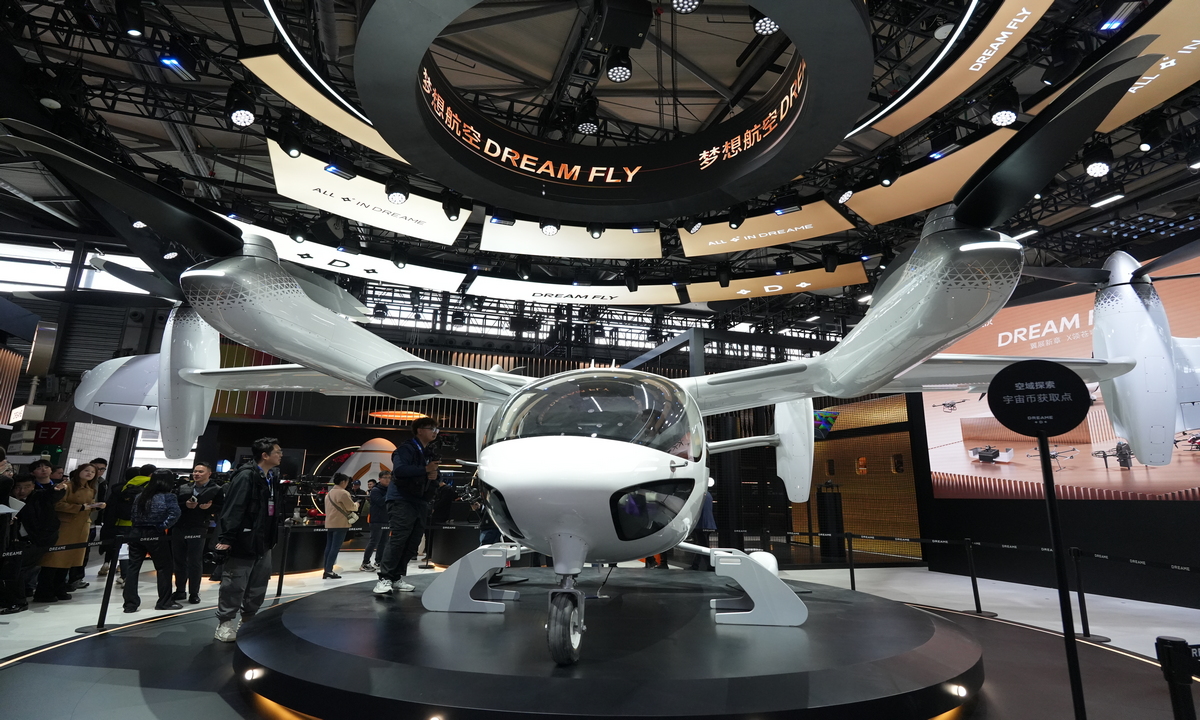
A futuristic electric vertical takeoff and landing aircraft developed by Dreamfly Technology Co makes its debut at the Appliance & Electronics World Expo 2026 in Shanghai, on March 12, 2026. Photo: VCG
China's science and technology spending is expected to exceed 400 billion yuan ($57.87 billion) for the first time in 2026, focusing on both basic and applied research, according to the Ministry of Finance (MOF), a trend that Chinese experts said reflects the government's ongoing efforts to strengthen the country's tech self-reliance and innovation.
Amid rising global unilateralism and protectionism, increasing investment in science and technology is also crucial to secure industry and supply chains, experts said.
According to the 2026 central government budget released by the MOF, this year's science and technology expenditure by the central government is budgeted at 426.42 billion yuan, up 10 percent from 2025, significantly higher than the average growth rate of 5.5 percent for central-level spending, the Securities Times reported on Tuesday.
In 2009, China publicly released the central government budget for the first time. Official data showed that in 2008, science and technology spending stood at about 107.7 billion yuan, accounting for roughly 8 percent of total government expenditure.
Certain figures particularly stand out in the government budget for science and technology. For example, this year's science and technology spending allocates about 116.94 billion yuan to basic research, up 16.3 percent from last year's actual expenditure.
The latest figures from the MOF demonstrate that science and technology rank even higher as a strategic priority as China pursues high-quality development in 2026, the first year of its 15th Five-Year Plan period (2026-30), emphasizing the cultivation of new quality productive forces, Hu Qimu, a deputy secretary-general of the Forum 50 for Digital-Real Economies Integration, told the Global Times on Tuesday.
"Notably, spending is focusing more on basic research, mainly funding national laboratories and major scientific infrastructure, reflecting a shift from short-term applications to building original innovation capacity," Hu said.
Hu added that "basic research may take a long time, but its breakthroughs are often fundamental, playing a key role in strengthening technological competitiveness."
Another notable aspect is the continued focus on applied research or the practical use of technology. According to the budget, the applied research allocation for this year is about 156.91 billion yuan. Although lower than last year, it still accounts for roughly 40 percent of the total science and technology budget, the largest share, highlighting the strong focus on technological applications.
This situation shows that the true value of scientific progress lies in its practical application. Whether in basic or theoretical science, the ultimate goal is to benefit people and be applied in real-world scenarios, Ma Jihua, a veteran industry analyst, told the Global Times on Tuesday.
"China has a natural advantage in this regard, with its vast market size, and its policies strongly emphasize the integration of science and technology with the economy... Therefore, increased government funding for applied research helps translate scientific achievements into practical applications," Ma said.
China's spending on science and technology has been steadily rising. In 2025, the country's research and development (R&D) expenditure intensity reached 2.8 percent of GDP, up 0.11 percentage points from the previous year. Spending on R&D surpassed for the first time the average of the Organization for Economic Cooperation and Development countries, which include the US, Germany and Japan, an official of China's National Bureau of Statistics said at a press conference in January, the Xinhua News Agency reported.
Major tasks for economic and social development in 2026, the first year of China's 15th Five-Year Plan, have already been outlined. According to the national economic and social development plan, the government vows to step up efforts to achieve greater self-reliance and strength in science and technology and secure a leading position in scientific and technological development. That includes continuing "to direct a greater share of total R&D spending to basic research and increase long-term, stable support."
"Science and technology development is not just about technology advancement itself, it also drives industrial upgrades, increases productivity, and makes people's lives more convenient, ultimately making a broader contribution to the high-quality development of the economy," Hu said.
Most importantly, in the context of rising global unilateralism and protectionism, increasing investment in innovation helps reduce external risks and secure industry and supply chain stability, benefiting not only China but the world, Hu said.
RELATED ARTICLES