Japan moves to deepen rare earth co-op with France to diversify supply resource; Tokyo's own disruptive actions real source of ‘supply risks’: Chinese experts
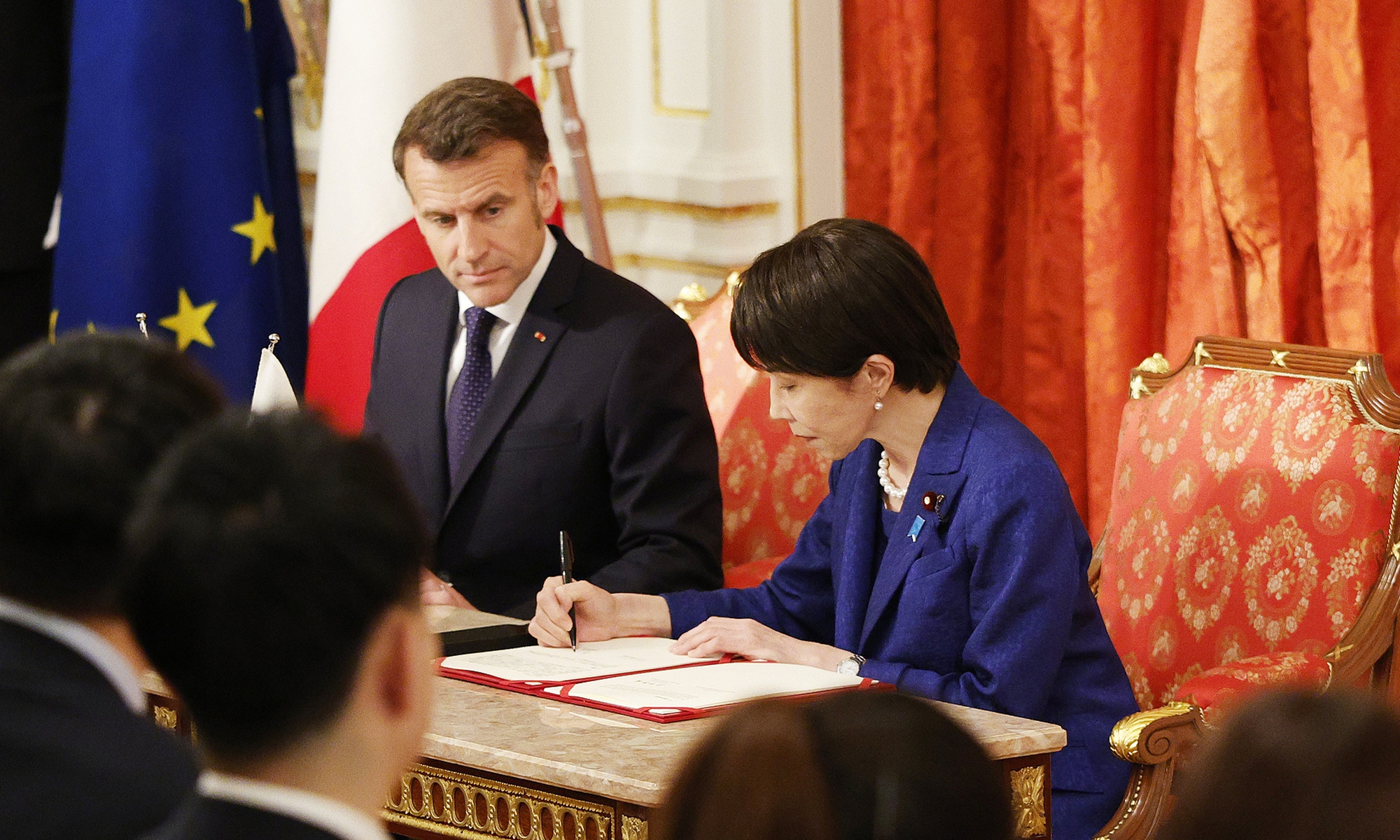
Japanese Prime Minister Sanae Takaichi, right, signs a document as French President Emmanuel Macron looks on during a signing ceremony at the Akasaka Palace state guest house in Tokyo Wednesday, April 1, 2026. Photo: VCG
Japan has moved to deepen cooperation with France on rare earths and critical minerals, a push that Chinese analysts say reflects an attempt by some countries to reshape supply chains based on geopolitical considerations rather than industrial logic, while ignoring that Tokyo's own disruptive actions are the root cause of the so-called "supply risks" and "sense of insecurity."Japan's Minister of Economy, Trade and Industry, Ryosei Akazawa, held talks on Wednesday with France's Minister for the Economy and Finance, Roland Lescure, according to Kyodo News on Wednesday. The two sides signed a document confirming mutual support in rare earth supply and startup development, in a bid to strengthen bilateral economic cooperation, the report said.
Akazawa claimed at the meeting that diversifying supply sources for critical minerals through coordination with "like-minded countries" is important, while Lescure expressed willingness to address it jointly.
Japanese Prime Minister Sanae Takaichi and French President Emmanuel Macron held a summit on Wednesday afternoon in Tokyo. According to Reuters, the two leaders said they would pursue closer security ties in the Indo-Pacific and signed agreements on cooperation in critical mineral supply chains, among others.
A Reuters report earlier on Wednesday framed the planned cooperation as an effort to reduce reliance on China.
Chen Zilei, director of the Research Center for Japanese Economics at Shanghai University of International Business and Economics, said Japan's push to strengthen rare earth cooperation with France is not driven purely by economic considerations, but represents a further step within Tokyo's so-called "de-risking" strategy. It is also a part of a broader geopolitical push by certain G7 countries to reduce reliance on China in the rare earth supply chain, he said.
"The strategy frames resource issues through a security lens while effectively promoting bloc-based and exclusionary restructuring of supply chains," Chen told the Global Times on Wednesday.
Jian Junbo, director of the Center for China-Europe Relations at Fudan University's Institute of International Studies, told the Global Times that while supply chain diversification is understandable, doing so based on a misjudgment of China and the politicization of industrial issues runs counter to basic economic logic and is unlikely to enhance resource security, but instead risks undermining the stability of global industrial chains.
According to Kyodo News, Japan and France said that a joint rare earth refining project is underway in France and is expected to supply Japan once completed, as part of efforts to diversify procurement channels.
However, Japan-France cooperation in the critical mineral sector faces clear practical constraints, similar to previous Western alliances on rare earths. Chen noted that neither Japan nor France are major resource producers, meaning their supply chain restructuring still relies heavily on resource-rich third countries, as well as capital and technological inputs, making their cooperation largely limited to investment and technical coordination.
He added that such efforts are more about strategic signaling than substantive change, with limited impact on the global critical minerals supply landscape, which in the near term remains dominated by China.
Japan has stepped up efforts to secure rare earth supplies through multiple channels. Earlier in March, Japan Australia Rare Earths, co-owned by the state-backed Japan Organization for Metals and Energy Security and Sojitz Corp, struck a deal with Australia's Lynas Rare Earths, under which Lynas will allocate 75 percent of its heavy rare earth oxide output to Japan.
Separately, on March 20, the US and Japan released an action plan to develop alternative supply chains for critical minerals, initially focusing on price support mechanisms for selected minerals.
The Japan Times previously quoted people familiar with the matter saying, "It's not an easy task to reduce dependence on Chinese rare earths while limiting damage to domestic industries." Some rare earths exist only in China, and alternatives to them have yet to be discovered, the report said.
Despite years of diversification efforts, Japan remains structurally dependent on China for most of its rare earth supply. According to Tokyo Shimbun, its reliance fell from 85 percent in 2009 to below 60 percent, but rebounded to 72 percent in 2024 amid rising demand.
Jian stressed that so-called "rare earth shortages" or "supply risks" in Japan and some Western countries stem primarily from their own politicization of economic and trade issues, which they themselves have introduced, disrupting industrial chains, and heightening supply chain uncertainty.
China has decided to strengthen export control on dual-use items to Japan, effective on January 6. China's Ministry of Commerce (MOFCOM) said in an official notice that the measures are taken "to safeguard national security and interests and fulfill non-proliferation obligations." The ministry added that exports of dual-use items to "military users, military purposes, or any end use that contributes to enhancing Japan's military capabilities" are prohibited, and said such measures are implemented in accordance with laws and regulations.
Foreign Ministry spokesperson Lin Jian said in January in response to media questions about the export controls, that China's measures, which were taken in accordance with the laws and regulations, are fully legitimate, justified and lawful.
RELATED ARTICLES