ARTS / CULTURE & LEISURE
Chinese Super League to resume with fans and youth, pointing to sustainable future
Chinese Super League to resume with fans and youth, pointing to future
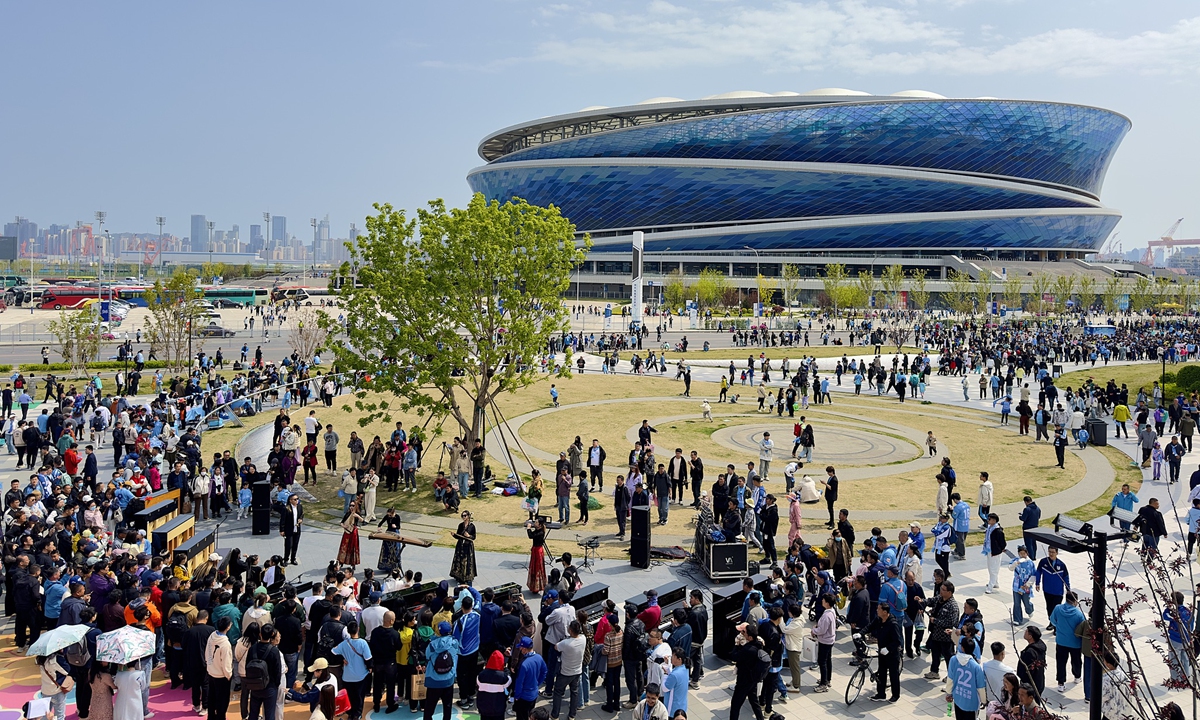
The exterior view of the Suoyuwan Football Stadium in Dalian Photo: VCG
The Chinese Super League returns to action this week after the international break with upgraded governance, a warming fan market and youth development that signal a healthier future and could support the national team.After years of ups and downs, the league and its governing body show strongest evidence that Chinese football is shifting toward sustainable football, a model focused on fiscal discipline and long-term talent rather than flashy spending.
The governance upgrade forms the quiet foundation. During the international break, the Chinese Professional Football League (CFL) held a seminar for domestic clubs on healthy development.
The guiding idea shows a move away from past top-down fixes and uncontrolled spending. Clubs are now being pushed to focus on sustainable operations, youth academies and better fan experiences instead of chasing instant results with expensive foreign players. This structural approach feels different from previous reforms as it treats clubs as self-supporting businesses.
That stability is already showing in results on the field and in the stands. In the third round, 285,546 fans filled the stadiums, averaging 35,693 per match and breaking a single-round record that had stood for 10 years.
Three games alone topped 50,000. The derby between Beijing Guoan and Shanghai Shenhua at the Workers' Stadium in Beijing drew 64,118 - the second highest in CSL history, Dalian Yingbo against Shanghai Port attracted 58,337 at Suoyuwan Football Stadium in Dalian, and the derby between Chengdu Rongcheng and Chongqing Tonglianglong pulled in 55,868 at the Longxing Football Stadium in Chongqing.
According to the figures released by the CFL, the rise in attendance from a first-round average of 28,856 to 35,693 in just three rounds is remarkable. Since the start of the 2026 season, the ongoing surge in momentum is a continuation of the league's steadily thriving market vitality and growing spectator enthusiasm.
The league is now selling real competition, not only imported celebrities. If the trend holds, the season attendance record could be broken by summer. This would prove the revival is built on sporting substance, not financial shortcuts.
The third advantage, youth development feeding both clubs and country, gives the resurgence lasting promise. National-team players from the international camps have returned to their clubs, bringing fresh ideas and higher standards after experiencing high-level international football.
At the same time, CSL fresh faces such as Yunnan Yukun and Chongqing are rising with bold use of young players. These new forces add excitement and create a virtuous circle: The league provides the national team with a wider pool of tested talent, while national-team success inspires more young players at club level.
Skeptics might call the attendance spike a temporary bounce, but the numbers tell a different story. The surge happened before an international break, not a seasonal opening-week excitement. And the young CSL clubs' impact is structural, they are raising overall quality by showing that trusting local talent works.
Chinese football has learned the hard way from the 2010s that money alone cannot buy success. The current path rewards clubs that nurture players, engage fans and operate responsibly. It is slower and less glamorous, but far more sustainable. Problems like training facilities and grassroots development remain, yet the three converging strengths - better governance, fan passion and youth integration - form the most coherent strategy in years.
The league is no longer asking fans to believe in promises but it is delivering proof through record crowds, disciplined operations and a new generation stepping up. If clubs, the governing body and players keep this discipline, the 2026 season could mark the start of real, self-sustaining growth. For the first time in a long while, the evidence suggests CSL football is finally beginning to match its huge potential with on-field and off-field reality. The real reward will be whether this momentum becomes the new normal.
The author is a reporter with the Global Times. life@globaltimes.com.cn
RELATED ARTICLES