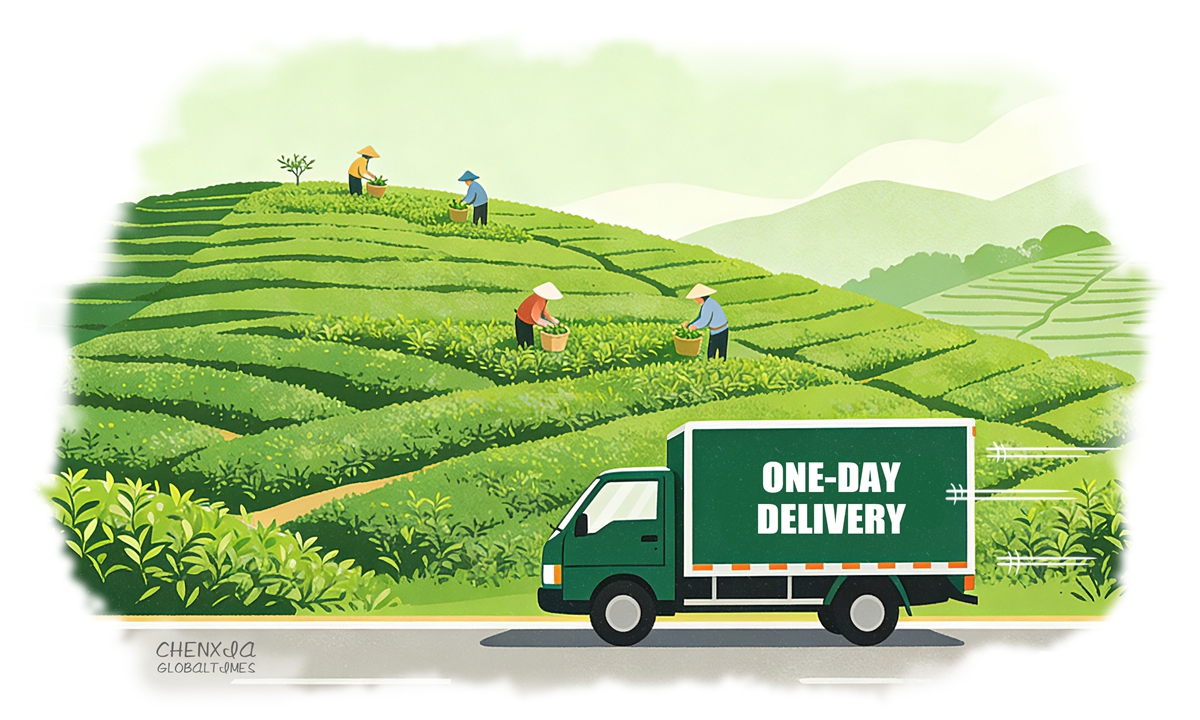
Illustration: Chen Xia/GT
As the Qingming Festival approaches, the spring tea harvest is in full swing. In Anji, East China's Zhejiang Province, the hills of tea plantations are blanketed in vibrant green. By early morning, tea factories are already abuzz with activity. According to tidenews.com.cn, freshly processed tea leaves are swiftly packaged, with postal vehicles stationed outside the factories. Within a single day, the spring tea is dispatched to 62 cities, underscoring the efficiency of the supply chain.Every stage of the supply chain - from harvesting and processing to transportation and sale - is seamlessly integrated. To ensure that spring tea reaches consumers as quickly as possible, local postal services have streamlined their operations.
According to tidenews.com.cn, 32 new collection points have been established in Huzhou, directly connecting services with tea plantations and factories. In addition, 20 mobile collection vehicles are synchronized with harvest and production schedules, while five autonomous delivery vehicles handle door-to-door collection and real-time payment processing.
The ultimate destination of this efficient supply chain is the consumer market. It is consumer demand that drives the swift journey of tea from remote mountain plantations to the hands of everyday consumers, propelling the entire supply chain forward.
Behind a single tea leaf lies a complex, multi-layered industry supported by a dynamic consumer market. According to the Xinhua News Agency, China's above-scale specialized tea-processing enterprises generated more than 120 billion yuan ($17.5 billion) in revenue in 2025, with the entire supply chain surpassing 1 trillion yuan and providing jobs for more than 60 million people annually.
Emerging business models, such as "satellite +" tea planting, smart factories, the rise of new-style Chinese tea beverages, and the integration of tea tourism, have been developing rapidly, driving the sector's continued expansion.
One trillion yuan is already a substantial figure, but the potential for growth is even more impressive. According to Xinhua, a guideline issued by the Ministry of Industry and Information Technology and other departments outlines a target for the entire supply chain to reach 1.5 trillion yuan by 2030. This goal reflects not only a massive consumer market but also a steady increase in consumer demand, driving continued expansion in the sector.
China's tea industry is expanding not only through traditional growth but also via new business models and evolving consumer trends that cater to younger, convenience-seeking, and health-conscious consumers.
One example is the rise of new-style tea beverages, which have gained traction, particularly among younger consumers in recent years.
In Meitan, Southwest China's Guizhou Province, a local company's advanced processing facility uses robotic arms to precisely blend jasmine and osmanthus flowers, the Xinhua Daily Telegraph reported. The company purchases more than 4,000 tons of tea leaves annually, which are then used to create tea bases for the burgeoning new-style tea beverage market.
This is just one aspect of the rapidly evolving tea consumption market. Beyond new-style tea beverages, a range of emerging trends are gaining traction, including tea tourism, tea culture-themed accommodations, wellness resorts in tea-growing regions, and tea-inspired cultural products and gifts. These innovations highlight tea's expanding presence in modern lifestyles, further broadening its appeal to a diverse and discerning consumer base.
The story of a single tea leaf is ultimately a reflection of the resilience and vitality of China's consumer market. Tea provides a unique lens through which we can observe this rapidly evolving market, where new trends and business models are constantly emerging. For businesses, the key is to navigate the rapid pace of market growth and stay attuned to ongoing changes.
The swift delivery of Anji tea is just one example of this dynamic market, reflecting consumers' growing demand for fresh spring tea and their increasing expectations for speed and convenience. As demand continues to rise and the market evolves, these changes are driving the broader trend of consumption upgrading and infusing new energy into the consumer sector.
The author is a reporter with the Global Times. bizopinion@globaltimes.com.cn
RELATED ARTICLES