ARTS / BOOKS
Author Liu Chuxin on his decade of trials and triumphs
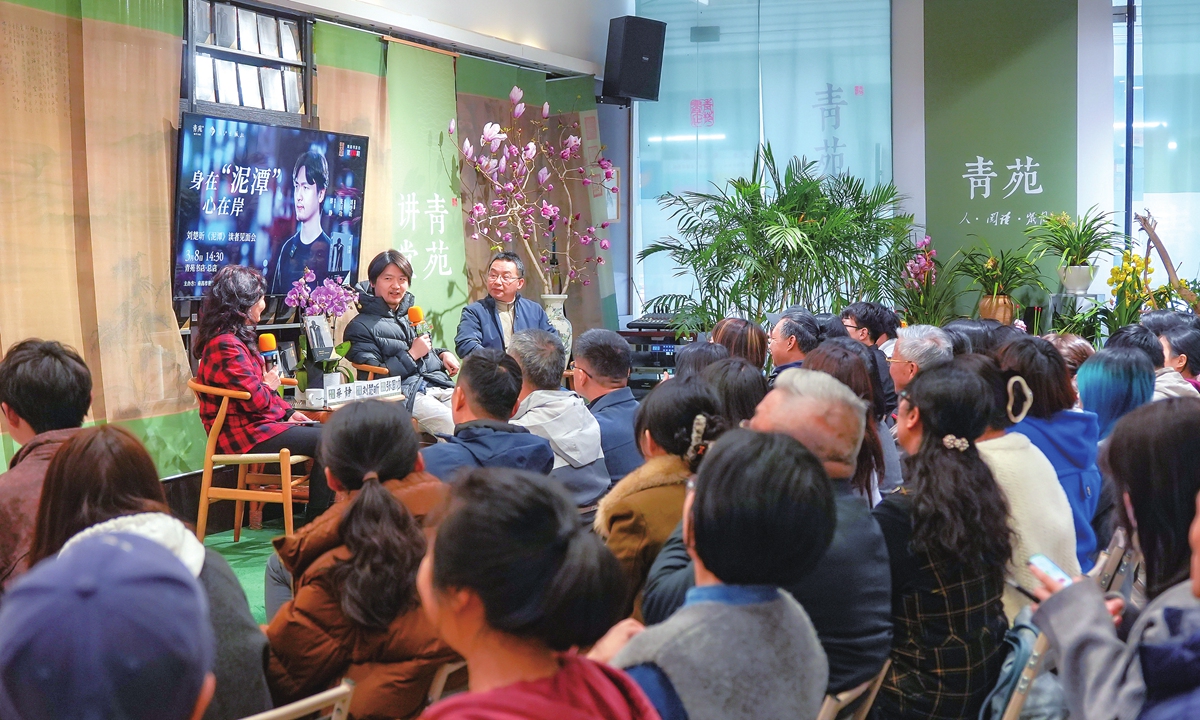
Liu Chuxin (center on the stage) talks to readers at a book sharing session in Nanchang, East China's Jiangxi Province on March 8. Photo: Courtesy of Qingyuan Bookstore
Commenting on his debut novel Quagmire at a recent meet-the-author event in Nanchang, East China's Jiangxi Province, Chinese writer Liu Chuxin told the Global Times that the novel reflects the survival of the individual amid the tides of history and also his personal experience during the writing process, which he equated to being trapped in a quagmire.Liu won the 2025 Lijiang Literary Award with his first book Quagmire. In his acceptance speech, Liu, choking up several times, fondly recalled the last words of his late girlfriend: "One goes through much suffering in life, but looking back, it all becomes part of a legend."
These words have since become a source of spiritual support for his literary creation. His speech sparked widespread discussion on social media, moving many to tears.
As a research assistant at the Hubei Academy of Social Sciences, Liu said he initially set out to write a novel marked by intense conflicts and a wide spectrum of characters from different social strata. After consulting local gazetteers from his hometown of Jingzhou, Central China's Hubei Province, he discovered that the late Qing Dynasty (1644-1911) was a turning point in Chinese history, which ultimately inspired him to begin writing.
From its initial conception in 2013 to the final manuscript, the novel took a full decade to complete. The original draft was 500,000 words, but after repeated revisions and cuts, it was ultimately pared down to around 130,000. Liu said the writing felt like a struggle through a "quagmire": written in fits and starts, revised and rewritten, overturned again and again, and even rejected multiple times.
"I want to subtly convey an idea with my novel: when confronted with conflicts between right and wrong, between differing values, or between ideals and reality, as well as between emotion and reason, one should return to one's moral conscience, or what might be called an innate moral instinct and follow one's true nature, one's inner self. Ultimately, all choices come down to a single question: what kind of person are you, and what is your true nature?" said the 35-year-old.
Set against the backdrop of the Revolution of 1911, the novel offers a unique perspective on how ordinary people struggle to survive amid the tides of history. The story is divided into three parts, each focusing on one of the three protagonists, though none is positioned as the absolute lead. By employing an ensemble narrative technique, characters appear independent yet intricately interconnected. The text experiments with various art of writing such as flashbacks, dissociation and polyphony, creating an atmosphere rich in psychological depth and formal exploration.
Liu said he likes the first part of the book best.
"The novel is set more than a century ago, and I found it difficult to fully grasp the customs, mindsets, and ways of thinking of people from that time. Yet the existential dilemmas they faced are, in fact, identical to those we confront today, such as how to cope with the pain of losing loved ones, how to make choices, and how to deal with the self-doubt that follows the collapse of one's ideals."
This realization led him to shift his approach and integrate existentialist philosophy into the novel. During the revision process, he also drew on techniques from modernist writers, abandoning traditional narrative methods in favor of a nonlinear, stream-of-consciousness style.
Because the protagonist is trapped in intense trauma, he cannot describe his inner wounds in linear, objective language. His trauma has a core that can only be approached through non-linear, fragmented, and even contradictory narrative techniques, Liu noted.
"It's similar to how we speak under extreme psychological shock: our words become jumbled, incoherent, or self-contradictory, broken and interrupted. If we were to narrate the experience calmly and objectively from beginning to end, we would fail to convey the true sense of trauma," he said.
Zhang Guogong, a professor at the School of Humanities of Nanchang University, said at the event that readers might resonate with the book because of the emotional experiences it conveys.
For example, there's the "quagmire feeling" in the workplace, or the anxiety generated by the constant talk about Artificial Intelligence (AI). These, too, evoke a similar sense of being stuck. In every era, people may experience being trapped in a thick, sticky quagmire, searching for meaning while striving forward, said Zhang.
Liu's second work will explore certain aspects of contemporary society. Stylistically, it will be more accessible to readers.
Liu aims to explore issues in modern society, such as the contrasts between rural and urban life, tradition and modernity, reason and instinct.
RELATED ARTICLES