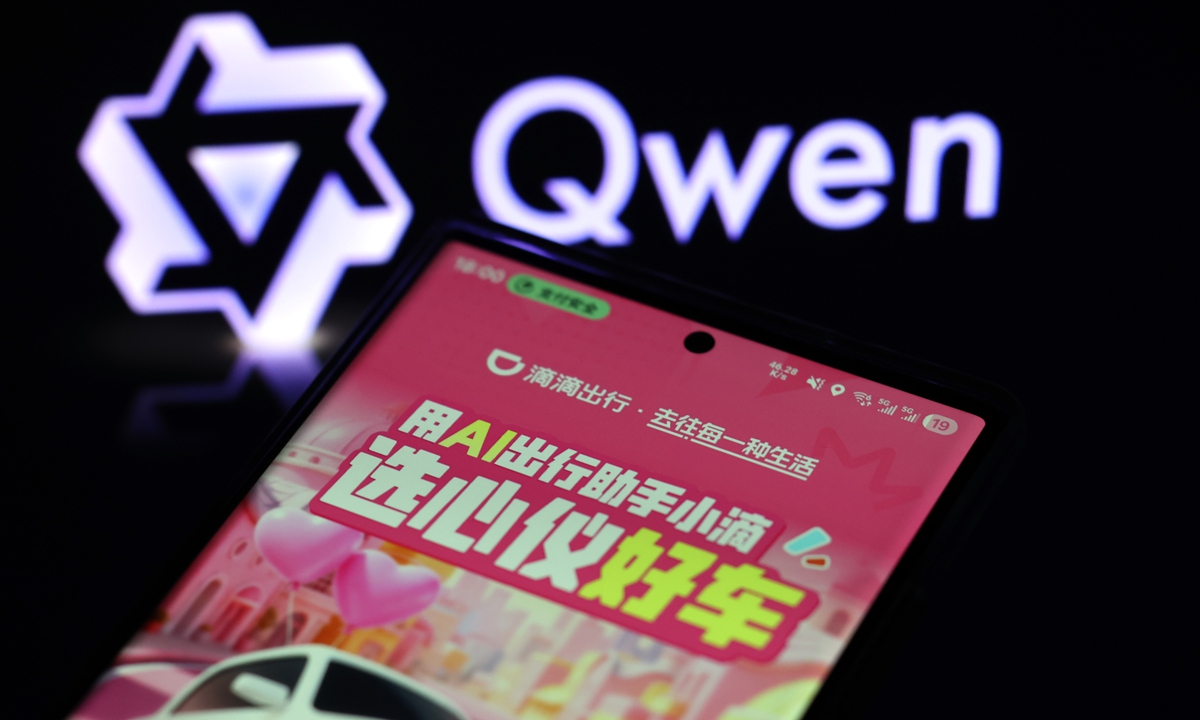
Qwen and Didi launch AI cab-booking functions in late March, respectively. Photo: VCG
A wave of creative ride-hailing requests has recently swept social media after AI assistant platforms including Didi and Qwen rolled out AI-powered cab-booking features in late March, allowing users to interact with services through natural voice conversations.
Instead of simply choosing a destination, passengers are now experimenting with more imaginative requests. While many still input practical needs, others have begun requesting rides to unexpected or even abstract locations, such as "a place where I can become a child again" or "somewhere with no regrets."
The trend builds on recent developments in AI-assisted mobility. On March 17, Didi Global, a ride-hailing platform, officially launched its AI travel assistant, which quickly gained traction among users by upgrading the experience from merely "getting a ride" to "getting the right ride." On March 23, the Qwen app introduced its own AI ride-hailing function, enabling users to complete tasks such as selecting vehicle types, adding stops and scheduling trips through a single sentence, streamlining what was previously a multi-step process.
With these tools, users can express their needs more intuitively. For example, a request like "We are a family of six heading to Shichahai to watch the sunset" can prompt the system to automatically assign a suitable vehicle, such as a minivan. For scenarios involving passengers needing special care, such as "going to the hospital with a patient, need a smooth driver," the AI can prioritize experienced drivers known for steady driving and even relay messages like requesting fresh air in advance.
The conversational nature of AI has also opened the door to more emotional or playful interactions. When one passenger asked for a ride to "a place to get rich overnight," the AI responded by suggesting nearby lottery outlets. Another request to go "somewhere without work" prompted a more empathetic reply, encouraging the user to "take a day off and ride a carousel, briefly returning to a carefree childhood."
Industry observers say the integration of AI into ride-hailing marks an important step in extending "AI task handling" into complex, real-life scenarios. Beyond improving efficiency, the conversational ability of AI assistants is adding a new layer of emotional engagement to everyday services.
Data also points to growing demand for personalized mobility. According to figures released by Didi, among customized ride requests, preferences such as "fast and affordable," "fresh air," and "nearest car" ranked highest, accounting for 57 percent, 12.5 percent, and 9.9 percent, respectively. Meanwhile, the adoption of Qwen's AI services has expanded rapidly. During this year's Spring Festival holidays, 130 million users tried its AI-powered shopping features for the first time, including more than 4 million users aged over 60.
Experts say the data highlights AI's potential in reshaping consumer scenarios. Rather than isolated functions, users increasingly expect integrated assistants capable of understanding intent, processing information and supporting decision-making. For platforms like Didi, their extensive service networks, combined with AI, could better meet diverse and personalized user demands while bringing digital innovation closer to everyday life.
Global Times