ARTS / CULTURE & LEISURE
Fans should treat star athletes as people, rather than symbols
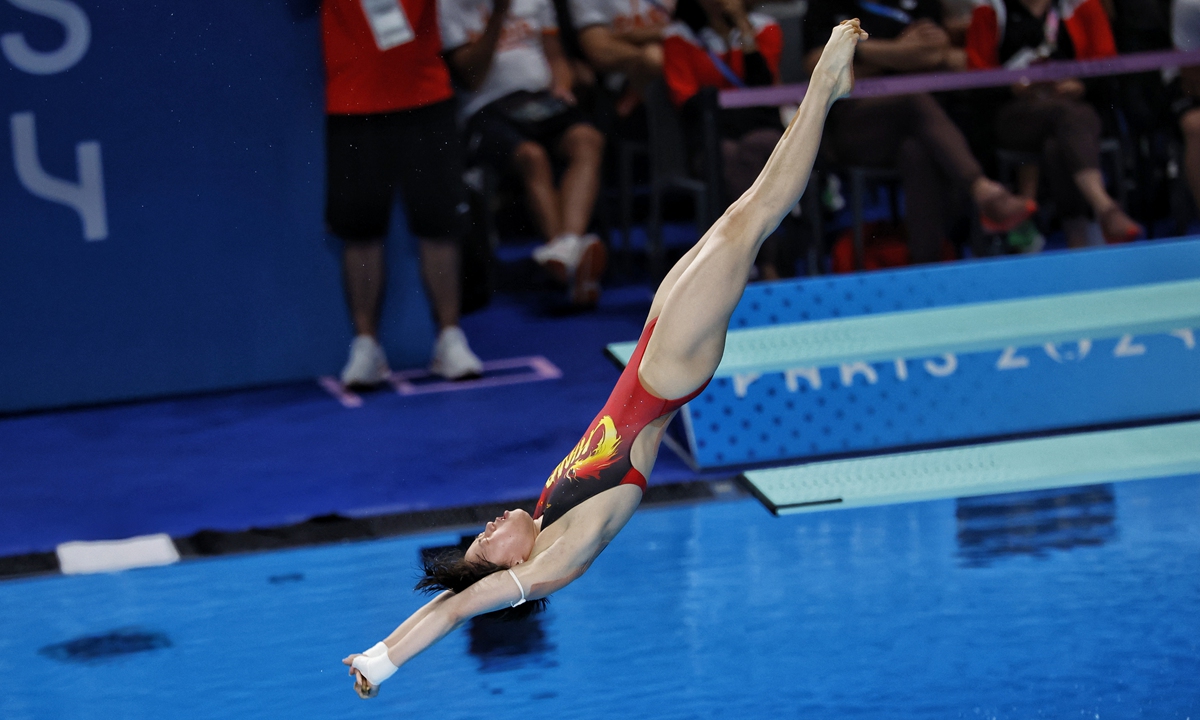
Chinese diving prodigy Quan Hongchan competes during the women's 10-meter platform final in Paris on August 6, 2024. Photo: Li Hao/GT
China's three-time Olympic champion diver Quan Hongchan recently opened up about her struggles with weight management and the pressure of public scrutiny. Her emotional revelation ignited discussions on Chinese social media regarding the detrimental effects of fan culture and the need to respect athletes' natural development, as many voiced support for the 19-year-old athlete.Quan told the Chinese magazine Portrait that she "seriously considered retiring" due to struggles with weight management and the pressure of mounting public scrutiny after the Paris 2024 Olympics.
Despite eating only one meal a day and enduring intense hunger in an effort to lose weight after attending the Paris Olympics, Quan's weight still "refused to go down." Looking in the mirror, Quan felt resistance toward, and dissatisfaction with, her own body. She also pleaded, "Please stop criticizing me. Don't attack my family or my friends," the magazine reported.
It is tempting to frame Quan's distress as a matter of "weight management," but that would miss the underlying issue. What has truly burdened her is not the number on a scale, but the relentless, all-encompassing pressure generated by unhealthy fan culture, said Liu Yu, a Beijing-based sports commentator.
Quan started diving at the age of 7. She joined the Guangdong provincial diving team in 2018 and was selected for China's national team at the end of 2020. The teenager rose to fame at the Tokyo Olympics after winning gold in the women's 10m platform with record points. She then defended her title at the Paris Olympics in 2024 and also won gold in the synchronized 10m platform.
Since her breakthrough at the Olympics, Quan's life has been placed under a microscope. Maihe village in Zhanjiang, Guangdong, where she comes from, has turned into a tourist destination, disrupting her family's daily life.
At the heart of this phenomenon lies a troubling, possessive, almost obsessive form of devotion stemming from unhealthy fan culture. It constructs an imagined "perfect idol," then demands that a real human being live up to that illusion. When reality inevitably falls short, admiration turns into criticism, even hostility.
Within sports communities, this has already led to harmful dynamics with fans pitting athletes against each other, elevating one while tearing down another. Such behaviors fundamentally betray the spirit of sports. The field of sports, at its core, is not about flawless performance. It is about fairness, resilience and mutual respect. It allows for fluctuations, setbacks, and growth. The beauty of competition lies not in perfection, but in the courage to strive.
After the Paris Olympics, Quan began her menstrual cycle and entered a stage of full physical development. Her hormone levels fluctuated significantly, fat distribution changed, and her weight and body shape underwent natural transformations, according to a report published by China Women's News on Monday.
Countless people once cheered Quan's "splash-free" technique during the competitions, but now she deserves even more support in the form of empathy and understanding, said the report.
Quan's experience allows us to confront an uncomfortable question: What do we want our athletes to be? Are they mere gold-medal machines, engineered for victory and frozen in their peak form? Or are they individuals who are young, evolving, sometimes uncertain, deserving of space to grow, to falter, and to find their own path?
True sportsmanship is not measured solely in podium finishes. It is reflected in how we honor the dignity of those who compete, and how we recognize their humanity beyond their achievements. The essence of sports does not reside in the noise of fandoms, but in the quiet, relentless pursuit of excellence, in the countless hours of training, in the willingness to push the limits of the human body and spirit.
To respect sports is to return it to its rightful place. Let athletes belong to their craft, not to the demands of public consumption. Let them focus on training, shine in competition, and live ordinary lives beyond the arena.
The author is a reporter with the Global Times. life@globaltimes.com.cn
RELATED ARTICLES