IN-DEPTH / IN-DEPTH
How is ‘predatory hegemony’ bringing US itself internal and external crises?
‘Seeds of its own destruction’
By , Leng Shumei and Published: Apr 01, 2026 11:09 PM


Editor's Note:
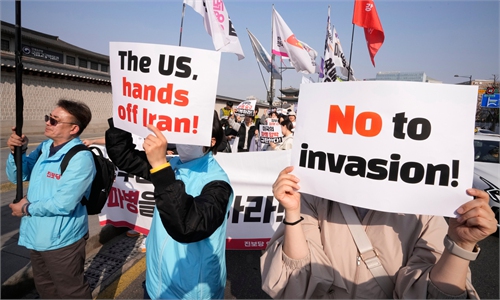
Weeks have passed since the US and Israel launched wide-ranging strikes on Iran on February 28. The US government, although it had told US media on March 11 that the military operation would end "soon," later announced air raids on multiple Iranian targets, including its oil hub Kharg Island, reported media outlets including Axios and Al Jazeera.
Be it military strikes on Iran, raids in Venezuela, a covetous gaze cast upon Greenland or the threat of punitive tariffs against "allies," the conduct associated with the current US government has pushed the notion of "predatory hegemony" to the forefront of international discourse and academic discussions. What exactly does "predatory hegemony" mean? How has this path come to be, as US university scholar Stephen Walt contended in a February article in Foreign Affairs, a "grand strategy" of Trump's second presidential term? Under this approach, what forms of predation has the US carried out across the globe? And what damage has "predatory hegemony" already inflicted - and continues to inflict - on world peace, the international order and even the US itself?
To answer these questions, the Global Times is launching a series of articles to probe and unpack the US' "predatory hegemony." This is the third installment of the series.
Since taking office, the current US government has pursued what critics call a strategy of "predatory hegemony," from launching wars to military intimidation, from wielding economic blackmail to financial bullying. Yet many scholars in US politics and international relations have warned that behind this apparent show of strength lies deep internal fissures and mounting external blowback.
"Predatory hegemony contains the seeds of its own destruction," noted Stephen Walt, a professor of international affairs at the Harvard Kennedy School, in a February article of Foreign Affairs. "In turning to predatory hegemony, the US is in decline," Zhang Jiadong, professor at the Center for American Studies, Fudan University, told the Global Times.
"Those who do many unjust deeds will bring about their own downfall." This ancient Chinese proverb appears to be finding fresh confirmation across the Pacific. So how have these "seeds of its own destruction" taken root and begun to sprout? Why would a strategy of predatory hegemony push the US down a path of decline?
Disarray, unease within US
Some observers including Walt believe that the US' predatory hegemony aims to extract vast benefits, but the actual gains have fallen far short of what it had expected.
"...the benefits touted by the administration have been exaggerated," Walt wrote in his Foreign Affairs article. He further explained that most of the wars Trump claims to have ended are still ongoing, and new foreign investment in the US falls well short of trillions of dollars and is unlikely to fully materialize.
A January 24 Reuters piece listed several international disputes into which the US has intervened. "US President Donald Trump says he should get the Nobel Peace Prize after wading into eight conflicts since taking office last January. But the issues that caused many remain unresolved and conflict has flared again in some of the regions," it concluded.
The ongoing military operations targeting Iran also show no sign of ending anytime soon, said Cao Wei, an associate professor at the School of Politics and International Relations, Lanzhou University. Cao pointed out that US strategic objectives in Iran remain unclear, and since the conflict began, Washington has oscillated between escalating the war and seeking a face-saving exit. "Clearly defined strategic goals are the fundamental basis for the sensible allocation of national resources. Once objectives change, all planning, budgets and logistics fall into disarray," Cao told the Global Times.
And the disarray is already beginning to show. According to US-based news platform The Fulcrum, as of March 13 - two weeks after the military actions against Iran began - the cost rose fast to an estimated $16.5 billion, about $8 billion per week. "If this spending pace continues for six months, we will spend about $200 billion. In fact, the Pentagon just requested that much in a budget supplemental," said an opinion piece by The Fulcrum on March 21. "That's a lot of hard-earned taxpayer wages."
Also, it seems that the new foreign investment in the US is not as robust as some US policymakers would like to believe, "because rearranging supply chains and trade arrangements is costly and time-consuming, and habits of cooperation and dependence do not vanish overnight, some countries have chosen to appease Trump in the short term," Walt explained.
The returns from overseas plunder may have fallen short of expectations, while the heavy costs of wars are now reverberating through US society, said Zhang. As The Fulcrum opinion piece listed, the money being spent on military operations in Iran could instead be used to address a host of domestic needs, such as nutrition and food access for five years in the Women, Infants, and Children (WIC) nutrition program, restore the billions in housing assistance that the Trump Administration stripped away from some formerly homeless people, and adding back for K-12 (from kindergarten to 12th grade) education.
Polling data has already captured the US public's discontent and unease. A recent Fox News survey found that "a huge 59 percent of Americans now disapprove of Trump's performance as commander in chief, a low for his second term," the Independent reported on March 27, adding that "the latest polling from Fox and Reuters also revealed a deep animosity to the war in Iran."
Collapsing alliances
"The administration appears to believe it can prey on other states forever, and that doing so will make the United States even stronger and further increase its leverage. They are mistaken, predatory hegemony contains the seeds of its own destruction," Walt said in the February article.
The seeds have already germinated among the US' close allies, leading to a bankrupt of their trust on the aggressive partner.
According to a report of Politico on March 16, Germany's government rejected the US' demand that NATO allies help secure the Strait of Hormuz, declaring that the alliance has no place in the war.
"This war has nothing to do with NATO. It's not NATO's war," Stefan Kornelius, a spokesperson for German Chancellor Friedrich Merz, was quoted as saying in the report.
The Politico report noted the German government was initially far more supportive of the US and Israeli attacks on Iran. But their attitude changed after the war's impact on Germany's economy continues to grow. Reuters reported on Tuesday that Germany's leading economic institutes cut their economic growth forecasts for this year and next and sharply raised their inflation forecasts in response to the Iran conflict.
Within the current US government's strategy, allies are only taken as cash machines to be extorted at will, and multilateral institutions are regarded as obstacles holding back US power, Zhang said.
The strategy lacks the patience to build an inclusive international order, and crudely reduces international relations to a Hobbesian law of the jungle, according to Zhang.
Some US allies have taken actions to reduce their dependence on the US.
On March 24, Spanish Prime Minister Pedro Sanchez's office said that he would pay an official visit to China from April 13 to 15. AFP noted that this visit comes in the wake of the Spanish leader's fervent criticism of the US government over the war against Iran. It also came after Spain refused Washington's requests to use Madrid's military bases against Iran, despite Trump's threat to sever trade with Spain as a result, according to AFP.
In January, against the backdrop of the US' tariffs and its military intervention in Venezuela, the EU reached a free trade agreement with South American countries in January, the BBC reported.
Also in January, Canadian Prime Minister Mark Carney made a four-day visit to Beijing. During the visit, China and Canada reached a series of agreements including that Canada will grant a quota of 49,000 units for Chinese electric vehicles (EVs) annually, according to China's Ministry of Commerce.
In October 2025, Carney set a goal for Canada to double its non-US exports in the next decade, saying American tariffs are causing a chill in investment. Carney reiterated in an evening address to Canadians that the decades-long process of an ever-closer economic relationship between the Canadian and US economies is now over, the Associated Press reported.
Predestined decline and failure
In the short term, the US is already grappling with mounting social tensions and crumbling allied trust. In the long run, observers note, predatory hegemony will undermine the very international order it seeks to dominate, ultimately eroding US influence.
"The US government's chaotic and predatory foreign policy will serve to deconstruct the old global structure and undermine the existing international order, while spawning new international crises. The current administration adheres to the "America First" doctrine, whose rhetoric and actions further violate norms of national sovereignty and deliver a massive shock to prevailing international norms," Zuo Xiying, a professor at the School of International Relations at Renmin University of China, told the Global Times.
America's evolution into a predatory hegemon will also escalate global geopolitical confrontation, deteriorate global and regional security, and ultimately likely boomerang against itself, said Zuo.
Zhang believes that when the backlash from predatory policies outweighs short-term gains - and when the cost of maintaining dominance exceeds its limits - such a strategy inevitably reaches a dead end. At some future historical juncture, external pressure and internal costs will force the US to undertake a new strategic transformation.
As Walt observed, "Maybe not today, maybe not tomorrow, but a backlash could come with surprising swiftness. To quote Ernest Hemingway's famous line about the onset of bankruptcy, a consistent policy of predatory hegemony could cause US global influence to decline "gradually and then suddenly."
Weeks have passed since the US and Israel launched wide-ranging strikes on Iran on February 28. The US government, although it had told US media on March 11 that the military operation would end "soon," later announced air raids on multiple Iranian targets, including its oil hub Kharg Island, reported media outlets including Axios and Al Jazeera.
Be it military strikes on Iran, raids in Venezuela, a covetous gaze cast upon Greenland or the threat of punitive tariffs against "allies," the conduct associated with the current US government has pushed the notion of "predatory hegemony" to the forefront of international discourse and academic discussions. What exactly does "predatory hegemony" mean? How has this path come to be, as US university scholar Stephen Walt contended in a February article in Foreign Affairs, a "grand strategy" of Trump's second presidential term? Under this approach, what forms of predation has the US carried out across the globe? And what damage has "predatory hegemony" already inflicted - and continues to inflict - on world peace, the international order and even the US itself?
To answer these questions, the Global Times is launching a series of articles to probe and unpack the US' "predatory hegemony." This is the third installment of the series.
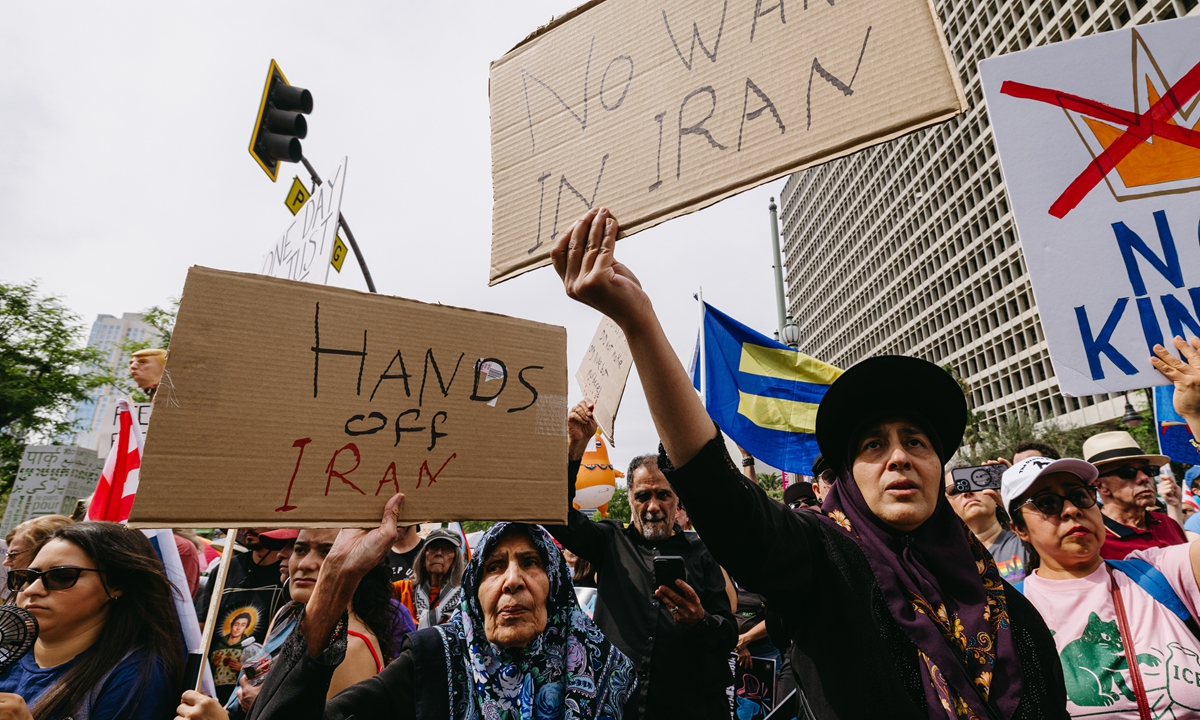
Protesters take to the streets on March 28, 2026 for the "No Kings" rallies across the US.
Since taking office, the current US government has pursued what critics call a strategy of "predatory hegemony," from launching wars to military intimidation, from wielding economic blackmail to financial bullying. Yet many scholars in US politics and international relations have warned that behind this apparent show of strength lies deep internal fissures and mounting external blowback.
"Predatory hegemony contains the seeds of its own destruction," noted Stephen Walt, a professor of international affairs at the Harvard Kennedy School, in a February article of Foreign Affairs. "In turning to predatory hegemony, the US is in decline," Zhang Jiadong, professor at the Center for American Studies, Fudan University, told the Global Times.
"Those who do many unjust deeds will bring about their own downfall." This ancient Chinese proverb appears to be finding fresh confirmation across the Pacific. So how have these "seeds of its own destruction" taken root and begun to sprout? Why would a strategy of predatory hegemony push the US down a path of decline?
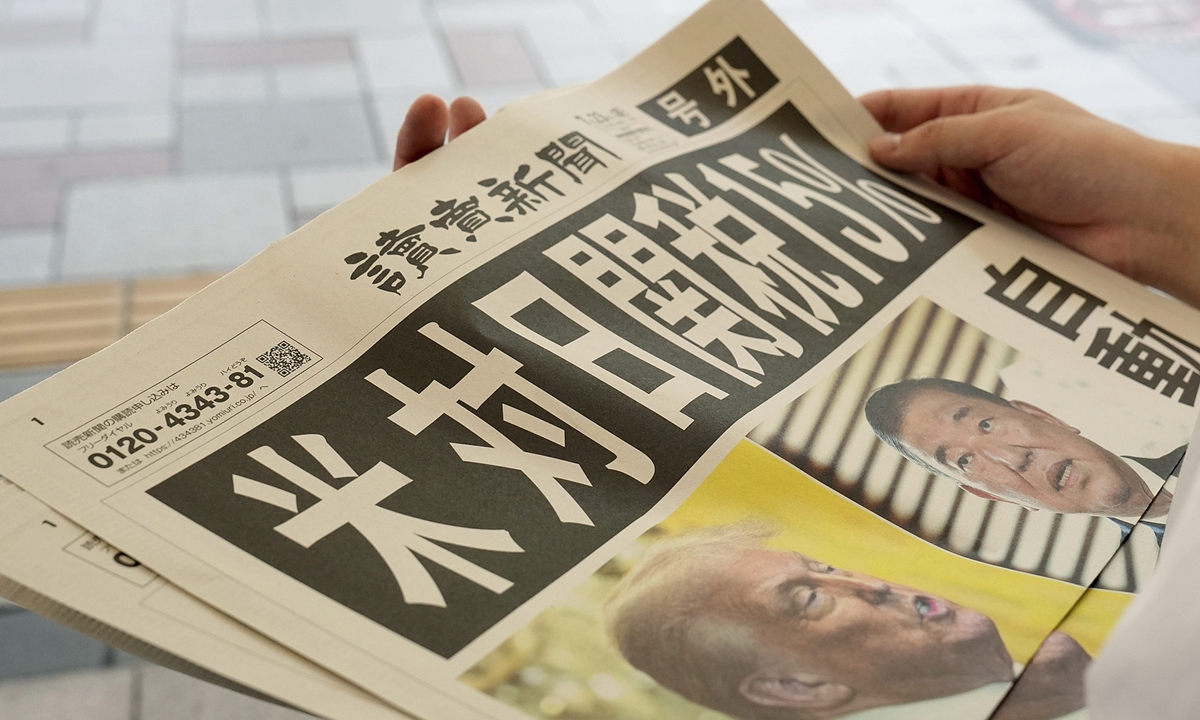
A Japanese daily newspaper reports that the US and Japan made a trade deal to include a 15 percent tariff on US imports from Japan on July 23, 2025. Photos on this page: VCG
Disarray, unease within US
Some observers including Walt believe that the US' predatory hegemony aims to extract vast benefits, but the actual gains have fallen far short of what it had expected.
"...the benefits touted by the administration have been exaggerated," Walt wrote in his Foreign Affairs article. He further explained that most of the wars Trump claims to have ended are still ongoing, and new foreign investment in the US falls well short of trillions of dollars and is unlikely to fully materialize.
A January 24 Reuters piece listed several international disputes into which the US has intervened. "US President Donald Trump says he should get the Nobel Peace Prize after wading into eight conflicts since taking office last January. But the issues that caused many remain unresolved and conflict has flared again in some of the regions," it concluded.
The ongoing military operations targeting Iran also show no sign of ending anytime soon, said Cao Wei, an associate professor at the School of Politics and International Relations, Lanzhou University. Cao pointed out that US strategic objectives in Iran remain unclear, and since the conflict began, Washington has oscillated between escalating the war and seeking a face-saving exit. "Clearly defined strategic goals are the fundamental basis for the sensible allocation of national resources. Once objectives change, all planning, budgets and logistics fall into disarray," Cao told the Global Times.
And the disarray is already beginning to show. According to US-based news platform The Fulcrum, as of March 13 - two weeks after the military actions against Iran began - the cost rose fast to an estimated $16.5 billion, about $8 billion per week. "If this spending pace continues for six months, we will spend about $200 billion. In fact, the Pentagon just requested that much in a budget supplemental," said an opinion piece by The Fulcrum on March 21. "That's a lot of hard-earned taxpayer wages."
Also, it seems that the new foreign investment in the US is not as robust as some US policymakers would like to believe, "because rearranging supply chains and trade arrangements is costly and time-consuming, and habits of cooperation and dependence do not vanish overnight, some countries have chosen to appease Trump in the short term," Walt explained.
The returns from overseas plunder may have fallen short of expectations, while the heavy costs of wars are now reverberating through US society, said Zhang. As The Fulcrum opinion piece listed, the money being spent on military operations in Iran could instead be used to address a host of domestic needs, such as nutrition and food access for five years in the Women, Infants, and Children (WIC) nutrition program, restore the billions in housing assistance that the Trump Administration stripped away from some formerly homeless people, and adding back for K-12 (from kindergarten to 12th grade) education.
Polling data has already captured the US public's discontent and unease. A recent Fox News survey found that "a huge 59 percent of Americans now disapprove of Trump's performance as commander in chief, a low for his second term," the Independent reported on March 27, adding that "the latest polling from Fox and Reuters also revealed a deep animosity to the war in Iran."
Collapsing alliances
"The administration appears to believe it can prey on other states forever, and that doing so will make the United States even stronger and further increase its leverage. They are mistaken, predatory hegemony contains the seeds of its own destruction," Walt said in the February article.
The seeds have already germinated among the US' close allies, leading to a bankrupt of their trust on the aggressive partner.
According to a report of Politico on March 16, Germany's government rejected the US' demand that NATO allies help secure the Strait of Hormuz, declaring that the alliance has no place in the war.
"This war has nothing to do with NATO. It's not NATO's war," Stefan Kornelius, a spokesperson for German Chancellor Friedrich Merz, was quoted as saying in the report.
The Politico report noted the German government was initially far more supportive of the US and Israeli attacks on Iran. But their attitude changed after the war's impact on Germany's economy continues to grow. Reuters reported on Tuesday that Germany's leading economic institutes cut their economic growth forecasts for this year and next and sharply raised their inflation forecasts in response to the Iran conflict.
Within the current US government's strategy, allies are only taken as cash machines to be extorted at will, and multilateral institutions are regarded as obstacles holding back US power, Zhang said.
The strategy lacks the patience to build an inclusive international order, and crudely reduces international relations to a Hobbesian law of the jungle, according to Zhang.
Some US allies have taken actions to reduce their dependence on the US.
On March 24, Spanish Prime Minister Pedro Sanchez's office said that he would pay an official visit to China from April 13 to 15. AFP noted that this visit comes in the wake of the Spanish leader's fervent criticism of the US government over the war against Iran. It also came after Spain refused Washington's requests to use Madrid's military bases against Iran, despite Trump's threat to sever trade with Spain as a result, according to AFP.
In January, against the backdrop of the US' tariffs and its military intervention in Venezuela, the EU reached a free trade agreement with South American countries in January, the BBC reported.
Also in January, Canadian Prime Minister Mark Carney made a four-day visit to Beijing. During the visit, China and Canada reached a series of agreements including that Canada will grant a quota of 49,000 units for Chinese electric vehicles (EVs) annually, according to China's Ministry of Commerce.
In October 2025, Carney set a goal for Canada to double its non-US exports in the next decade, saying American tariffs are causing a chill in investment. Carney reiterated in an evening address to Canadians that the decades-long process of an ever-closer economic relationship between the Canadian and US economies is now over, the Associated Press reported.
Predestined decline and failure
In the short term, the US is already grappling with mounting social tensions and crumbling allied trust. In the long run, observers note, predatory hegemony will undermine the very international order it seeks to dominate, ultimately eroding US influence.
"The US government's chaotic and predatory foreign policy will serve to deconstruct the old global structure and undermine the existing international order, while spawning new international crises. The current administration adheres to the "America First" doctrine, whose rhetoric and actions further violate norms of national sovereignty and deliver a massive shock to prevailing international norms," Zuo Xiying, a professor at the School of International Relations at Renmin University of China, told the Global Times.
America's evolution into a predatory hegemon will also escalate global geopolitical confrontation, deteriorate global and regional security, and ultimately likely boomerang against itself, said Zuo.
Zhang believes that when the backlash from predatory policies outweighs short-term gains - and when the cost of maintaining dominance exceeds its limits - such a strategy inevitably reaches a dead end. At some future historical juncture, external pressure and internal costs will force the US to undertake a new strategic transformation.
As Walt observed, "Maybe not today, maybe not tomorrow, but a backlash could come with surprising swiftness. To quote Ernest Hemingway's famous line about the onset of bankruptcy, a consistent policy of predatory hegemony could cause US global influence to decline "gradually and then suddenly."
RELATED ARTICLES