Foreign media outlets amazed at China’s resilience amid global oil disruptions, analyze underlying reasons; Chinese analyst cites long-term planning, institutional advantage
By Published: Apr 02, 2026 12:07 AM


Latest news
Multiple global research institutions have highlighted the Chinese government's efforts to diversify its energy import sources and its energy structure as an effective buffer amid the ongoing US-Israel-Iran conflict in the Middle East. The conflict has caused global crude prices to surge and produced supply scares in a number of countries, while prompting Japan and South Korea to release their oil reserves.But global researchers pointed out that China is better-positioned to weather the situation, due to its long-term planning and ongoing energy transition that have reduced the weight of crude in its economy, despite being one of the world's major crude importers.
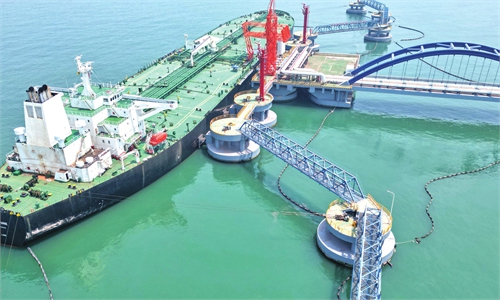
Reuters, in an article titled "How China can survive without the Strait of Hormuz," reported on Wednesday that "the world's largest importer of oil through the Strait of Hormuz is, paradoxically, also one of the best placed to weather the waterway's closure."
In the first quarter of 2025, China imported about 5.4 million barrels per day of crude oil via the Strait of Hormuz, which is "roughly as much from the region as India, Japan and South Korea combined," Reuters said.
However, China has diversified its oil imports, with any one source accounting for no more than 20 percent of the total, in contrast to some countries that rely predominantly on Middle East oil, the report said.
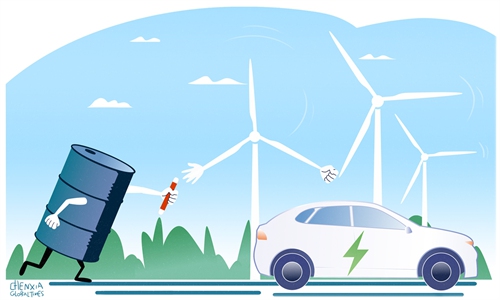
China also boasts an electric vehicle (EV) fleet about as large as the rest of the world combined, vast and growing oil stockpiles, diversified supplies of oil and gas, and an electricity grid that is almost insulated from imports thanks to domestic coal and renewables, the article noted.
"The current situation is really close to what Chinese planners have had in mind for decades," the report said, citing Lauri Myllyvirta, co-founder of the Centre for Research on Energy and Clean Air in Finland, as saying. "It validates the drive to reduce reliance on seaborne fossil fuels."
China's EV boom has also helped the country to reduce its reliance on crude, the Reuters report noted.
According to estimates from the Centre for Research on Energy and Clean Air, oil displaced by EVs in 2025 was roughly equal to what China imported from Saudi Arabia.
Many other global research institutions and media outlets have published similar studies. A Chinese expert said that these findings have highlighted the Chinese government's long-term approach toward energy security and the ability to effectively implement plans across years - which can be summarized as China's institutional advantage.
A March 23 article headlined "On energy, China can sit this crisis out, Here's why," posted on the website of the Quincy Institute for Responsible Statecraft, pointed out that after recognizing the importance of energy security and the dangers of relying on a single source of energy imports, China has over the years diversified its energy import channels and sought to transition away from fossil fuels.
"The potential loss caused by the disruption of the Strait of Hormuz would therefore be bearable, or at least not crippling, for China," said the American foreign policy think tank.
China's leading role in green energy, reflected in its large market shares of EVs, lithium-ion batteries, and solar cells, has helped spark growth across its economy. The green transition will help China reduce its dependence on fossil fuel imports and enable it to use inexpensive and reliable green energy infrastructure to support its high-tech development, the analysis pointed out.
Moreover, new-energy sources are also becoming increasingly tenable, with energy thinktank Ember estimating that wind, solar and hydropower generated about 31 percent of China's electricity in 2024. These locally produced energy sources have helped China to cushion the impacts of the ongoing conflict.
Lin Boqiang, director of the China Center for Energy Economics Research at Xiamen University, told the Global Times on Wednesday that the Chinese government's years-long efforts in building diversified channels from seaborne to pipeline energy, as well as the construction of the world's leading gas reservoir, and a ready pricing mechanism over domestic fuel supply have effectively helped to minimize the impacts of the current conflict and allowed the country to hold its own energy "rice bowl" tightly.
A diversification strategy has triumphed on the current chokehold caused by the conflict. A full-blown new-energy industry, with 43.97 million new-energy vehicles as of June 30 last year, has clearly offered a path toward green transportation that further reduces reliance on overseas crude, Lin said.
RELATED ARTICLES