ARTS / CULTURE & LEISURE
Why are young Chinese so into finding ‘companions?’
By and Bai Xue Published: Apr 02, 2026 05:09 PM

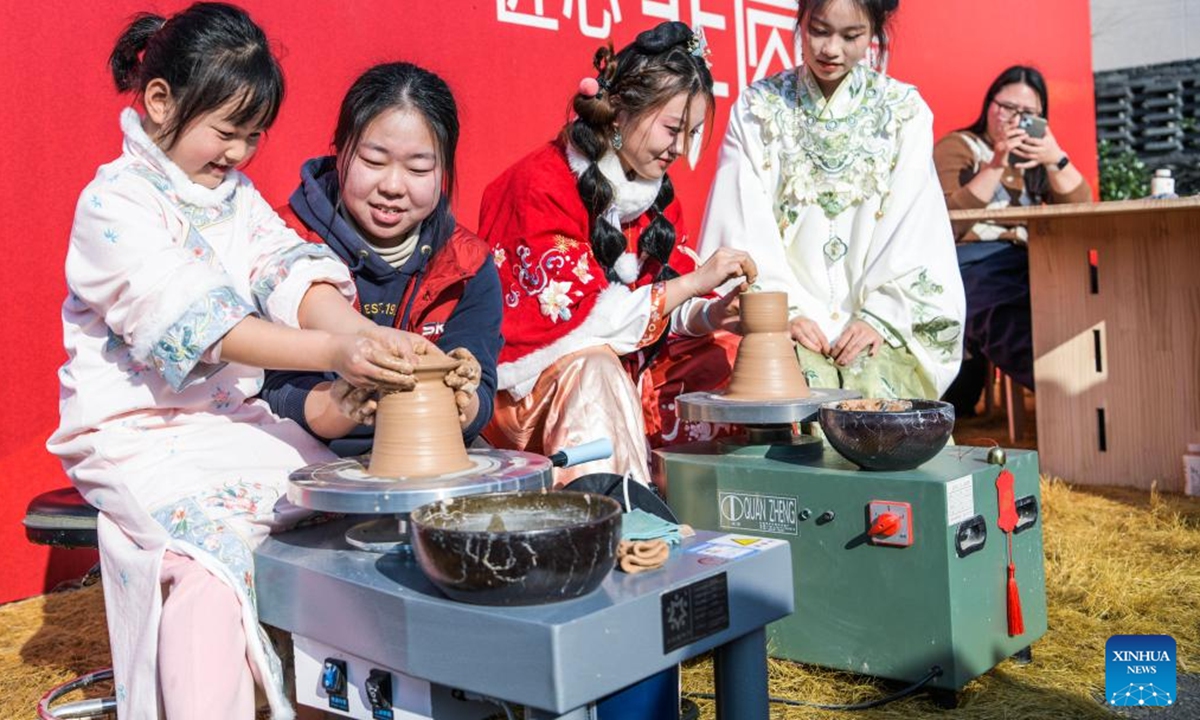
People experience celadon making during a folk culture fair in Cixi, East China's Zhejiang Province, December 28, 2025. (Xinhua/Xu Yu)
Editor's Note: Finding a "dazi," or "companion," is becoming a new way for young people in China to build social connections. Whether for learning skills or travelling together, having a companion allows them to enjoy their independence without becoming isolated. In this report, we speak to several young people to document their unique social styles.
Skill companions: learning together, connecting naturally
From latte art in coffee shops to paper-cutting in community classrooms, a new wave of activities combining skill-building with social interaction is quietly reshaping how young people in Huanggang, Central China's Hubei Province, connect with one another.
On the evening of March 23, the rich aroma of coffee filled a café nestled by Yiai Lake in Huangzhou district, Huanggang. A youth night school coffee workshop was under way, with nearly a dozen young adults learning the finer points of grinding, tamping, steaming milk and creating latte art under the guidance of an experienced barista.
Among them was Tang Bozhou, a 26-year-old from Northwest China's Shaanxi Province who moved to Huangzhou after university.
"I came across the night school registration on a friend's WeChat Moments. I've always been interested in latte art, so I signed up right away," he said. "The caramel macchiato I made tasted far better than anything I could buy. It was such a satisfying experience."
By the end of the session, Tang had gained more than a new skill; he had also made several new friends who shared his interests. As they chatted over coffee, the initial awkwardness faded, replaced by laughter and easy conversation. Over a single cup, Tang found his "skill companion."
This kind of socially driven learning is gaining traction across Huangzhou. Li Jiahao, an official with the Communist Youth League's Huangzhou district committee, said the organization designed the program to combine skill development with natural social interaction.
"We want to help young people move from passive socializing to active engagement, opening up in a relaxed environment and connecting with like-minded peers," Li said. "This 'skill-building plus socializing' model helps them develop abilities while providing a comfortable space to interact. Learning and making friends happen organically."
Fang Xia, owner of the café hosting the coffee workshop, has become an active partner in the youth night school initiative. She has noticed how participants often arrive feeling reserved, but as the sessions progress, the initial distance melts away. "After class, they sit together and talk. Seeing that warmth is truly special," she said.
The night school's offerings now extend far beyond coffee-making. From reading gatherings to intangible cultural heritage workshops such as paper-cutting and e-commerce training, classes are no longer confined to government buildings but have spilled into cafés, bookshops and neighborhoods, woven into the fabric of daily life.
For many young people in Huangzhou, the benefits go beyond social connections. Zhou Chunshui, a local who returned to his hometown, gained practical skills in e-commerce and short-video editing through the night school. He has since become a part-time instructor himself. Others have used training in areas such as moxibustion, coffee-making and short-video operations to find flexible work locally.
In Huangzhou, young people are discovering that "skill-based socializing" offers a way to grow and connect. And the city, in turn, is becoming a more welcoming place for those seeking meaningful encounters.
Travel companions: more than just a photo
In Dunhuang, Northwest China's Gansu Province, home to the legendary Mogao Caves and vast desert landscapes, a simple greeting or a shared hometown accent can turn strangers into travel companions. Here, young travelers are discovering a new way to explore: finding a "companion."
Lü Yinjie, a visitor from Northeast China's Liaoning Province, met three tourists from Lanzhou, Gansu Province, at a night market. "They told me Gansu is not just about the Gobi Desert, there are also snow-capped mountains and grasslands, with all kinds of landscapes to explore," he said. Their conversation gave him a deeper appreciation of the region.
For Tang Kaijie, a young traveler from South China's Guangxi Zhuang Autono¬mous Region, the connection started with a chance remark at the entrance to the Mogao Caves: "Hey, I'm from Guangxi too." A shared dialect quickly broke the ice, and the two decided to explore together.
Yang Meifang, visiting from Shenzhen, South China's Guangdong Province, found unexpected value in the company of fellow travelers. Watching the sunset over Mingsha Mountain, tourists helped each other take photos, turning what could have been a solitary moment into a shared experience. "I love meeting different people on my journeys and hearing their stories," she said.
Of course, companions can also be found online. On social media platforms, many travelers post requests for "meal buddies," and the responses often lead to genuine connections.
Yang Hao, a traveler from Southwest China's Chongqing Municipality, used this method to find a travel planner who had travelled from Central China's Hunan Province to meet her. The two teamed up in Xining city, Northwest China's Qinghai Province, and travelled westward together, visiting the Mogao Caves and Mingsha Mountain. They enjoyed their own space while benefiting from the safety of travelling together - planning routes and handling unexpected situations as a pair.
Xu Haiyan and Liu Hairong, visiting from Shanghai, noted that travelling with a companion felt less complicated than travelling with close friends. "You can share your true thoughts along the way," they said. For many, this kind of social dynamic offers a sense of ease that feels hard to find elsewhere.
For some, a travel companion can even double the joy. Wang Yuting, from Northeast China's Heilongjiang Province, and Li Qian, from East China's Shandong Province, were university friends who set off from their respective cities to meet in Dunhuang. Together, they explored sites, shared meals and made memories.
"Finding someone who shares your taste in food is rare enough; having them with you makes it even more special," they said. "When you click with someone, the trip becomes so much more meaningful."
Along the way, they also experienced the warmth of Dunhuang's locals, from a driver who recommended a cultural show to a photographer who pointed them toward an authentic local eatery. Those unexpected moments, combined with the companionship they found along the road, became treasured parts of their journey.
The article was originally published on the People's Daily on April 2, 2026.
RELATED ARTICLES