Japan’s proposed easing of arms export ban signals push toward further remilitarization, undermines regional stability, peace: Chinese expert
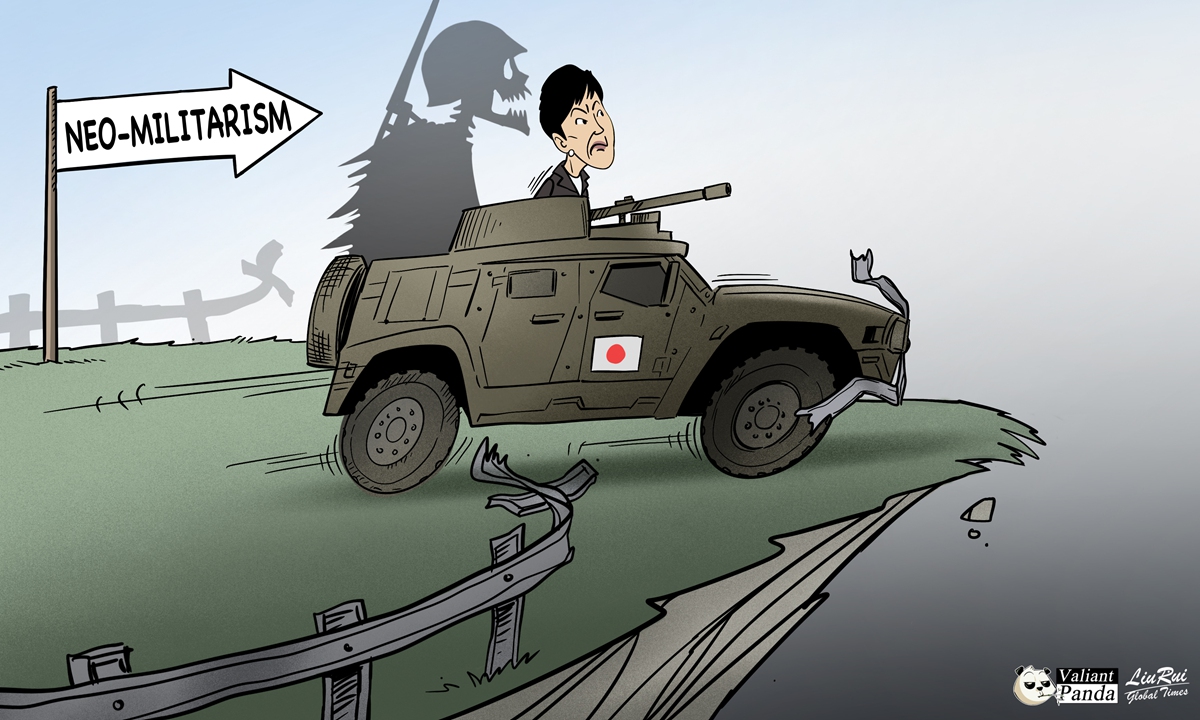
Illustration: Liu Rui/GT
The outline of a plan by the government of Sanae Takaichi to relax restrictions on Japan’s defense equipment exports has been revealed, seeking to allow, in principle, the transfer of lethal weapons, which has sparked concerns and criticism within Japan that it could exacerbate conflicts or fuel an arms race, Kyodo News reported on Friday.
A Chinese analyst warned that Japan is using legislation to drive military expansion and sidestep its postwar pacifist constitution, posing a direct threat to regional stability and peace. By allowing the country to export weapons, Japan attempts to build a military‑industrial chain, leverage arms sales to advance its foreign policy and facilitate its dangerous push toward further remilitarization, which will only exacerbate regional tensions, raise concerns among the international community and put a burden on its own citizens.
The proposal, as outlined in the report, would abolish the existing “five categories” limiting exports to non-combat purposes and, in principle, allow the export of finished products, including weapons capable of causing casualties. It would also introduce exceptions for exports to countries involved in conflicts, leaving room for flexibility.
Parliamentary involvement, previously a key element in reviewing arms exports, would be reduced to post-transaction notification. The plan is expected to be submitted to the executive committee of the Liberal Democratic Party’s Security Research Council next week, with revisions to the operational guidelines of the “Three Principles on Transfer of Defense Equipment” targeted by the end of April. The information was disclosed by multiple sources on April 3, Kyodo News reported.
According to the report, the current operational guidelines restrict equipment exports to non-combat purposes such as “rescue, transport, vigilance, surveillance, and mine clearance.” The Liberal Democratic Party and the Japan Innovation Party agreed in their coalition deal last October to abolish these five categories, and in March proposed easing the rules to Prime Minister Takaichi. The government’s proposal would instead classify defense equipment into two categories—“weapons” and “non-weapons”—based on whether they possess lethal or destructive capabilities.
Concerns have been raised that arms exports could exacerbate conflicts or fuel an arms race. Opposition parties have called for prior parliamentary approval for each export, while the current plan to limit oversight to post-transaction reporting is likely to draw criticism, Kyodo News reported.
On March 31, several peace groups in Japan held a rally in the House of Representatives of the Japanese Diet, opposing the Japanese government's push to lift the ban on the export of lethal weapons. They believe that this move by the Takaichi government violates the spirit of the pacifist constitution and will intensify regional tensions. Moreover, Japan's continuous increase in defense spending will add to the burden on the public and squeeze social security, cnr.cn reported.
In opinion polls conducted by various news agencies, about half of the respondents expressed opposition. In an NHK poll, 53 percent opposed (32 percent supported); in a Jiji Press poll, 48.2 percent opposed (27.0 percent supported, 24.8 percent said "cannot say").
In response to this latest move, a Japanese netizen commented on the X platform that it is unacceptable for a country to become a "death trafficked." Some even claim that "the Takaichi cabinet is as dangerous as the Tojo cabinet. The Tojo cabinet seized power, unilaterally controlled politics, and rashly dragged the country into the Pacific War."
"This public sentiment is deeply rooted in Japan's postwar pacifist tradition," Da Zhigang, a researcher in the Institute of Northeast Asian Studies at the Heilongjiang Provincial Academy of Social Sciences told the Global Times. "Although Japanese society is shifting rightward overall, many still oppose war and arms buildup. If we can use effective channels to remind people of history's lessons and the risks ahead, those anti‑war voices may gradually grow louder."
Japan has long upheld a self-imposed ban on arms exports under its pacifist constitution, but the framework has been steadily loosened since the administration of former prime minister Shinzo Abe. A major turning point came in 2014, when Japan’s Foreign Ministry announced the “Three Principles on Transfer of Defense Equipment and Technology,” which replaced “the Three Principles on Arms Exports”, allowing limited exports under strict conditions.
In the years that followed, Japan approved the supply of missile interceptor parts to the US and the transfer of sensor technology to the UK in 2014, according to the Japan Times, while also unsuccessfully bidding to export submarines to Australia in 2016, the Star reported. In 2020, Japan’s Defense White Paper highlighted the need to “promote cooperation in defense equipment and technology with other countries.”
Since 2023, Japan has moved further by making a major policy shift, with its first export of lethal military equipment occurring as early as 2024, which the Japan Times reported as “the government loosened the country's strict defense export rules as Tokyo continues to shed some of its postwar constraints on defense.”
The move at that time had already sparked concern at home, with media outlets such as Asahi Shimbun said in a commentary that such a large-scale budget has exceeded actual needs and appears inflated, raising the question of whether it is sustainable for the government to focus on building a defense force beyond its capabilities, rather than on whether it has stable financial support, people.cn reported.
Da warned that Japan’s military expansion poses a direct threat to regional stability. "Such actions could trigger an arms race and create new destabilizing factors," he said. By exporting weapons, Japan is not only building a military‑industrial chain and leveraging arms sales to advance its foreign policy and bilateral as well as multilateral relations — a qualitative shift in its security posture.
The move, which evoked memories of colonial wars of aggression that caused enormous loss of life and property in Asia, has exacerbated regional unease over its push toward further remilitarization, he said.
"Although Takaichi's maneuvers may create a 'defense bubble' in the short term, they are essentially tying Japan's economy more tightly to the chariot of ‘neo-militarism'," Da said. The ultimate cost will be borne by the Japanese people. The Takaichi administration's obsession with militaristic adventurism is by no means an antidote for Japan's economy, but rather a poison that accelerates its decline, Da added.
RELATED ARTICLES