ARTS / CULTURE & LEISURE
China’s mass-attendence marathon enters fast lane
Running now in vogue
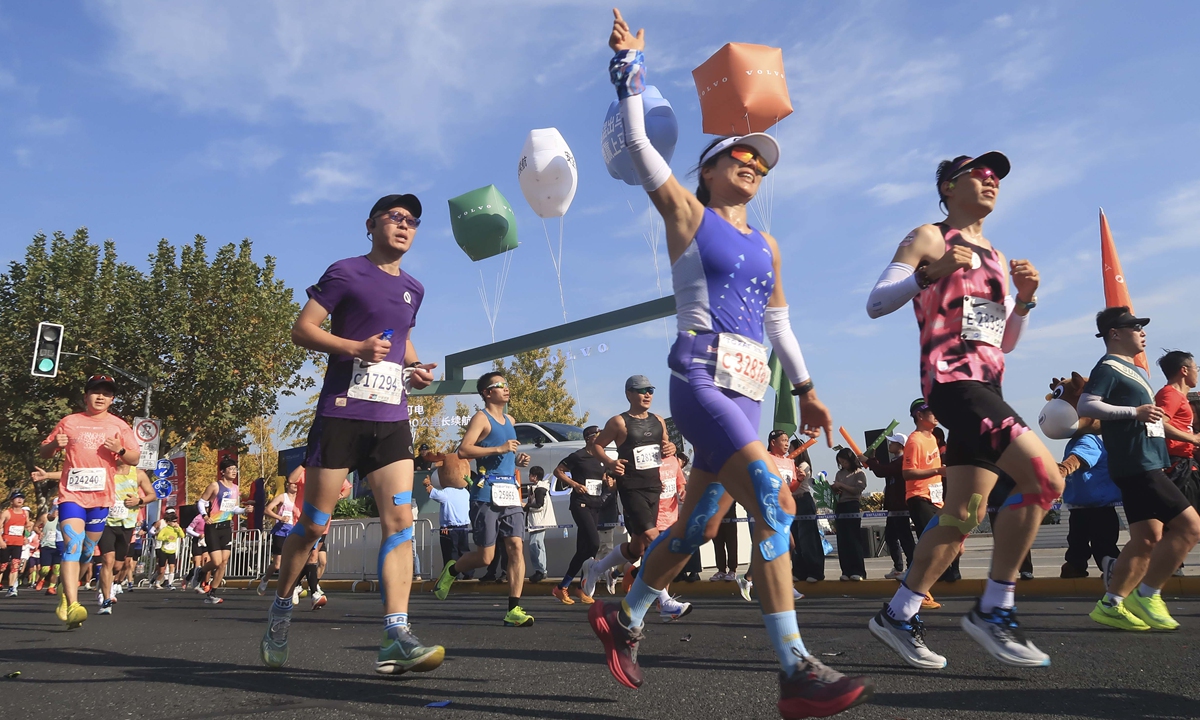
Runners take part in the 2025 Shanghai Marathon on November 30, 2025, in Shanghai. Photo: VCG
More than 22,000 runners will gather at Tiananmen Square and surge north toward the capital's Olympic Park on April 12 as the Beijing Half Marathon opens a new season. The 21.0975-kilometer route, one of China's most iconic, will wind past some of the capital's grandest landmarks as the new season of road racing kicks off.
Yet even before the starting gun fires, the Chinese Athletics Association (CAA) has framed this year's races in a larger story of transformation.
On Saturday, the CAA released the 2025 China Marathon Races Blue Book, revealing a trend that many people say feels counter-intuitive: The total number of marathon-related events nationwide dropped to 594, a decline from 696 in 2024, marking the sport's first large-scale "slimming down."
Yet the data also points to strong growth in economic impact and event quality. The Blue Book also points to the improving quality of participants. The average finishing time for the full 42.195-kilometer marathon stood at 4:06:04.
Meanwhile, certified events generated a direct economic impact of 18.51 billion yuan ($2.68 billion) and drove a total economic pull of 45.4 billion yuan, supporting roughly 183,000 jobs.
Decade-old craze
The figures present an apparent paradox: fewer races but larger economic and social impact. For observers, the shift reflects how China's marathon ecosystem is entering a new phase of development.
"Marathons were once a symbol of unchecked expansion as they sprouted across the country, but after years of development, they are now prioritizing sustainability and deeper integration with culture and tourism," Zhang Bin, a Beijing-based sports commentator, told the Global Times.
The Blue Book's analysis of 284 A-class certified events underscores how "reduction in quantity" is fueling a surge in quality, reshaping not just running but urban economies and public health nationwide.
The changing structure of marathon events reflects a broader evolution in China's road-running boom.
Over the past decade, the sport has transformed from a niche endurance challenge into one of the country's most popular forms of mass participation sports.
China's modern marathon renaissance began in earnest in the 2010s, fueled by rising middle-class interest in fitness, post-Beijing Olympics inspiration, and local governments eager to brand their cities through sports tourism.
By the early 2020s, the sector had exploded: road-running events proliferated across provinces, with total participation numbers climbing steadily.
Late 2025 saw stricter CAA guidelines on race organization, safety standards, and resource allocation, including a pilot framework for mass road-running events. Participation, meanwhile, remained robust.
Economic engine
Despite the reduced number of events, the economic impact of marathon races has continued to expand. Analysis of the 284 A-class events alone showed a direct economic impact of 18.51 billion yuan, up 16.8 percent year-over-year.
Spending on the classic "eat, stay, travel, tour, shop, entertainment" pillars hit 20.11 billion yuan, accounting for 44.3 percent of the total pull effect, the Blue Book said.
Marathons have become powerful urban catalysts, as runners and spectators inject money into hotels, restaurants, transport, and local attractions.
Scenic routes through historic districts or natural landmarks turn races into immersive experiences, boosting repeat tourism and cultural exposure.
Much of this economic momentum comes from the way marathons have been integrated with tourism and local culture.
Wu Wenlong, an official with the organizing committee of the marathon race held in Changxing county, Zhejiang Province, on March 29, told the Global Times that the local marathon is now being celebrated for combining tourism and exercise.
"With picturesque spring views of Taihu Lake unfolding like a traditional Chinese landscape painting on one side, and rich cultural and local lifestyle charms on the other, the marathon race in Changxing truly delivers a visual feast that allows participants to run amid stunning scenery," Wu told the Global Times.
Wu said that the marathon participants will also get discounts to tourist areas in the county, where they can have some local cultural experiences.
"The intangible cultural heritage of Zisun Tea allows runners to immerse themselves in the region's profound local culture. Food vouchers were also added to race bags, enabling runners to redeem authentic dishes such as Huzhou lemon milk and fish soup rice."
Cultural elements were also integrated into the designs of race medals, such as those for the Beijing Half Marathon. The race, also referred to as the Beijing International Long-Distance Festival, is celebrating its 70th anniversary this year.
Featuring the design theme of "Glory during the 70th Anniversary," the finisher medal embodies the perseverance of marathon sports and the 70-year journey of the Beijing International Long-distance Running Festival in one unified piece.
New technology
"The emblem draws inspiration from Beijing's urban layout, adopting the framework of 'three horizontal and three vertical' routes to form a core road network,'" an official with the Beijing Half Marathon told the Global Times.
"The front side adopts a sleek, modern visual style with an artistic '70' icon, creating a striking resonance between the profound heritage of seven decades and the dynamic vitality of running."
Technology is increasingly becoming part of the marathon experience. The Blue Book notes that smart services have evolved from "bonus features" to core competitive edges.
Augmented reality (AR) medal showcases exemplify this: Runners scan their finisher medals via apps to unlock personalized videos, GPS-tracked routes, split times, and even virtual replays overlaid on city landmarks.
Events like the Beijing and Haidian Marathons pioneered such integration, using 5G-A networks and AI to capture moments in real time.
Other tech elements include AI robots at aid stations, instant post-finish highlight videos, and data-driven course management for safety and flow.
"Blending technology into marathon events has offered participants a fresh experience in distance running, which may invigorate their everyday running experience and ultimately help them establish healthier lifestyles," Zhang said.
RELATED ARTICLES