ARTS / CULTURE & LEISURE
Museum events, spring outing trend fuel Qingming tourism
Flower-viewing popular activity during holidays
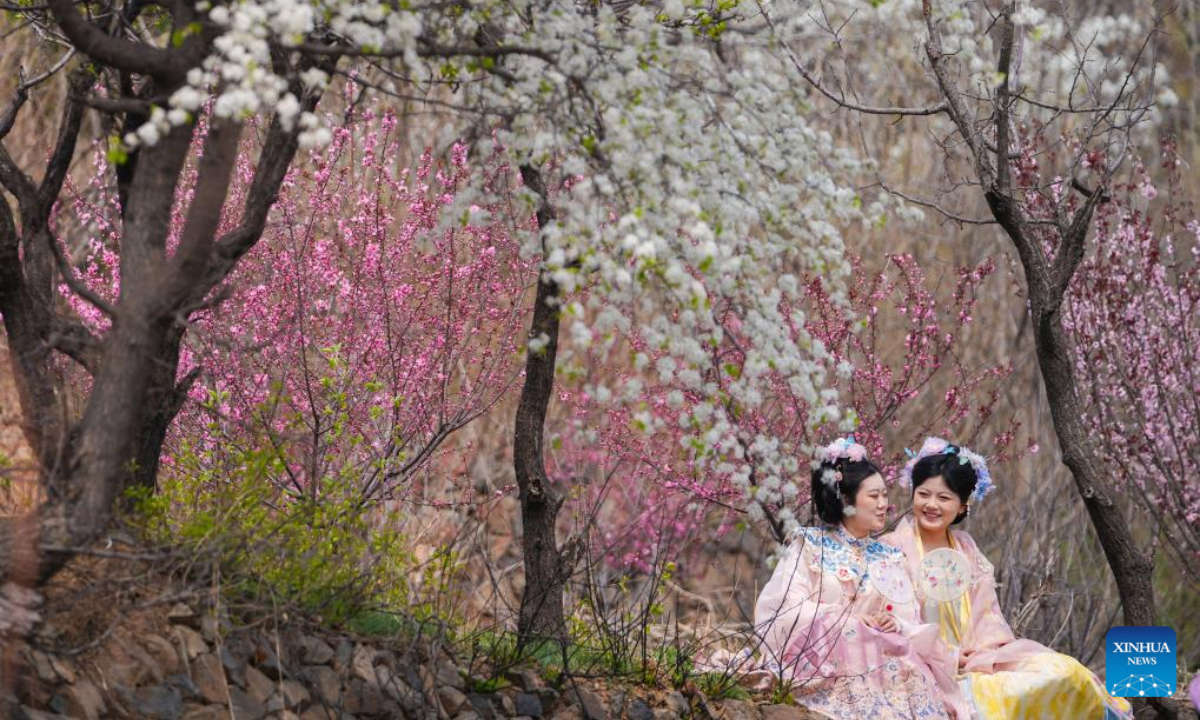
Photo: Xinhua
Riding the wave of the warm spring weather, the 2026 Qingming Festival holidays sparked a nationwide cultural tourism boom, with museum tours and outdoor Taqing, or "Spring outings," emerging as hot trends.Kicking off on Saturday, the public's passion for travel was already evident on the first day of the three-day Qingming Festival holidays. In Central China's Hubei Province, for example, its class-A tourist attractions received 2.6 million visitors on the first day of the holidays, a year-on-year increase of 15.41 percent.
Despite being known for winter tourism, Northeast China's Liaoning Province and Harbin in Heilongjiang Province retained their appeal during the holidays. On Day One, Liaoning Province recorded 4.32 million visitors, up 12.79 percent year-on-year, while Harbin's iconic sites, including the Harbin Central Street and the Sun Island scenic spot, also drew large crowds.
Urumqi, in Northwest China's Xinjiang Uygur Autonomous Region, known for its ethnic minority cultural charm, has also become a popular touristic destination. The Xinjiang Museum in the city has been particularly bustling with visitors.
Zhang Lei, a staff member of the museum, told the Global Times that it makes 10,000 tickets available per day and, "within a very short period of time, the booking rate reached 80 to 90 percent."
"During the Qingming Festival holidays, most of our visitors are travelers. Also, it is almost impossible to book tickets and visit on the same day, so ticket reservation is greatly needed," Zhang remarked.
Other museums across the country also saw a surge in visitors. In Southwest China's Sichuan Province, the Jiangkou Chenyin Museum, currently in its trial operation phase, increased its daily free reservation quota threefold to "3,000 slots per day," Zhao Lixian, a member of the museum, told the Global Times.
Meanwhile, the Emperor Qinshihuang's Mausoleum Site Museum in Northwest China's Shaanxi Province, renowned worldwide for its Terracotta Warriors, also raised its daily ticket allotment to 70,000 during the holiday period.
Other museums have gone a step further by extending their opening hours to accommodate as many visitors as possible. At the Luoyang Museum in Henan Province, the opening hours were extended until 7 pm. A nighttime tour agenda was also launched to allow interactive engagement between the museum's collections and visitors.
To help visitors experience the cultural essence of Qingming tradition, many institutions rolled out themed activities. Across all museums in Jilin Province, 46 themed exhibitions and social education events are currently underway. In keeping with the festival, they are combining the sacrificial cultural connotations of "Qingming" with red education that commemorates the country's martyrs.
Zhang also told the Global Times that it has launched an educational activity that combines the traditional intangible cultural heritage (ICH) technique of cloisonné with distinctive Qingming customs such as ancestral worship rituals to attract young visitors. "Through this activity, we aimed to create a holiday memory for them that is enriched by traditional culture," Zhang remarked.
"The enduring holiday appeal of museums comes down to this: They tap into each festival's cultural essence and reinvent it in culturally logical ways that always feel new," cultural sociologist Chu Xin told the Global Times.
The unique Qingming tradition of Taqing, combined with the pleasant spring weather, made flower-viewing a popular activity during the holidays.
In Beijing, municipal parks such as the Temple of Heaven Park and Yuyuantan Park have jointly established 15 flower-viewing routes, allowing visitors to fully enjoy the beauty of peach blossoms, crabapple flowers, lilacs, and more.
"For other holidays, I prefer to take my children to experience nature outside the big city. But we stay in Beijing for almost every Qingming Festival, because we can feel the vitality of nature right around our home," Deng Tian, a 49-year-old Beijing resident, told the Global Times. Besides Beijing, cities such as Jinan in Shandong Province have integrated spring outings and flower viewing experience with local cultural landmarks, allowing people to interact with the region's cultural heritage. At its tourism landmark Baotu Spring, for example, visitors can not only admire flowers and willows but also explore nearby ICH markets and taste tea brewed with spring water.
In pilot cities, including Shenzhen, and provinces such as Zhejiang and Sichuan, the Qingming Festival holidays coincided with the first-ever implementation of spring break in many primary and secondary schools in China. As a result, family travel became one of the hottest trends of the 2026 Qingming cultural tourism season. "Including the impact of spring break, the booming cultural tourism during the Qingming holidays has actually gotten the entire spring tourism market off to a good start. Zhuang Feixu, a tourism industry professional, told the Global Times.
"If this momentum can be maintained, it will perfectly fill the usual lull in the tourism market before the next big surge in the upcoming May Day holidays," Zhuang noted.
RELATED ARTICLES