KMT chairperson Cheng kicks off mainland visit; invitation signals dialogue remains open to Taiwan forces opposing 'independence', says mainland expert
Invitation signals dialogue remains open to Taiwan forces opposing 'independence': expert


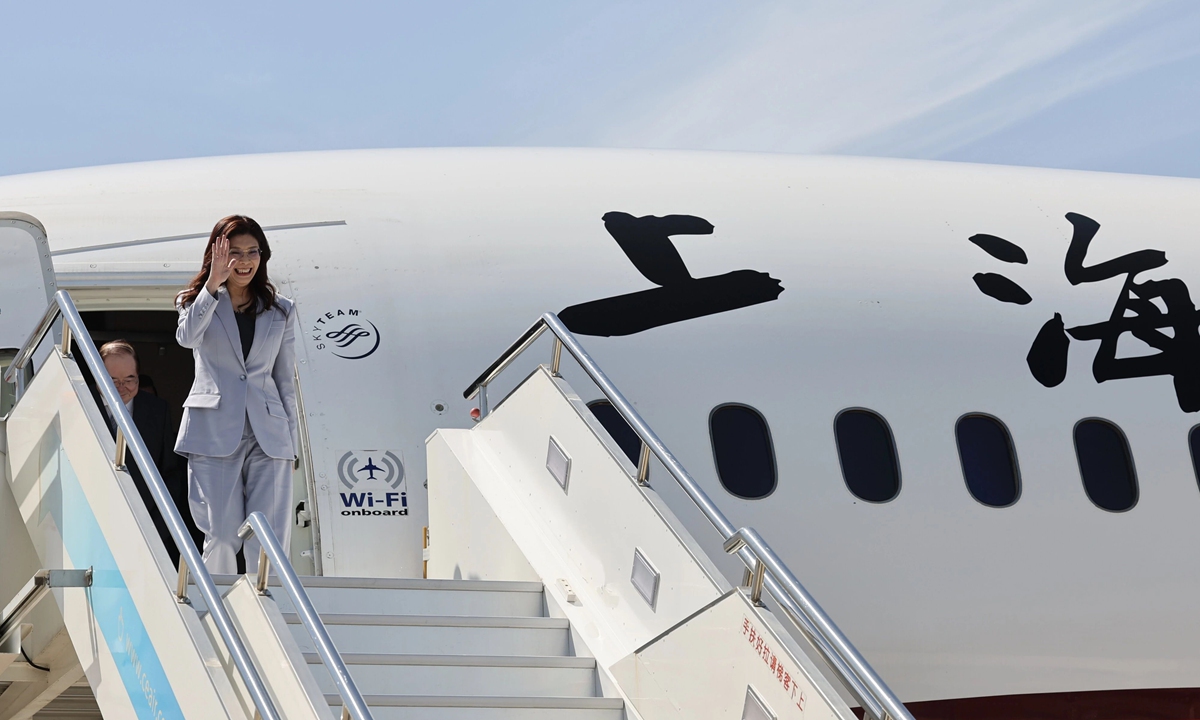
Kuomintang (KMT) chairwoman Cheng Li-wun arrives at Shanghai Hongqiao International Airport on April 7, 2026 for her mainland visit. Photo: Xinhua
Smiling and waving as she stepped onto the tarmac at Shanghai Hongqiao International Airport on Tuesday, Kuomintang (KMT) Chairwoman Cheng Li-wun arrived in Chinese mainland on Tuesday to kick off a closely watched six-day tour. Broadcast heavily across the Taiwan Straits, her midday arrival unfolded against the backdrop of rising tensions in the Taiwan Straits since Lai Ching-te took office.
Cheng's itinerary—sweeping through Shanghai, Jiangsu Province, and finally Beijing before concluding on Sunday—carries profound weight. The visit is regarded as an important part of the exchanges and dialogue between the KMT and the CPC under the new circumstances.
Strengthening exchanges and dialogue between the two parties will have a significant and positive impact on maintaining peace and stability in the Taiwan Straits and promoting the peaceful development of cross-Straits relations, according to a spokesperson for the State Council Taiwan Affairs Office, per a Xinhua report on Tuesday.
Song Tao, head of the Taiwan Work Office of the Communist Party of China (CPC) Central Committee, greeted Cheng and the delegation on the airport tarmac, according to Xinhua News Agency and Taiwan media outlet United Daily News (UDN).
The KMT delegation headed directly to Nanjing after arriving in Shanghai. Song hosted a welcome banquet in Nanjing on Tuesday evening for Cheng and her delegation. In her speech, Cheng stated that adhering to the 1992 Consensus and opposing "Taiwan independence" remains a solid and enduring political foundation, serving as the "anchor" that stabilizes cross-Straits relations, according to a video released by Shenzhen-based news service Zhinews on Tuesday.
She continued that over the past more than 30 years, Taiwan society has experienced multiple changes in ruling parties. Historical experience has proven that when the 1992 Consensus is upheld, the two sides of the Straits can engage in exchanges and dialogue; otherwise, the Taiwan Straits falls into turbulence and instability, she said.
At the welcoming banquet, Song Tao said that compatriots on both sides of the Taiwan Straits are fully capable and wise enough to resolve their home affairs. "We are willing to work together with the KMT to uphold the 1992 Consensus, oppose 'Taiwan independence,' and jointly safeguard peace and stability in the Taiwan Straits," Song said, according to Zhinews.
Highlighting peace
Speaking at a press conference ahead of her departure on Tuesday, Cheng said that first and foremost, the trip is to demonstrate to the world that both sides of the Taiwan Straits hope to resolve all potential differences and bring about the benefits of peace through peaceful means, dialogue, communication, and exchange. Therefore, this determination for peace is the most important message of the trip, according to a report from UDN.
Cheng said that whether there will be war or peace depends on the path people choose to take. In Taiwan, she said, they must make every possible effort to prevent war from breaking out, while also seizing every opportunity and possibility to expand the foundation for peace. It is with this aspiration, she said, that they are departing from Taipei today, ET Today reported.
Against the backdrop of heightened cross-Straits tensions, Cheng's mainland visit is a positive step for the peaceful development of cross-Straits relations. It signals the KMT's willingness to revive inter-party dialogue, conveys support on the island for the one-China principle, and helps reduce the risk of conflict, Xin Qiang, director of the Taiwan Studies Center at Fudan University, told the Global Times on Tuesday.
The mainland's invitation, including Cheng's trip to Beijing, sends a clear signal that as long as political forces in Taiwan uphold the common political foundation of one China and oppose "Taiwan independence," the door to dialogue, exchanges and cooperation remains open, Xin said.
The delegation consists of about 30 people. In addition to three vice chairpersons - Chang Jung-kung, Hsiao Hsu-tsen and Lee Chien-lung - Yin Nai-ching, spokesperson for the KMT's culture and communications committee is also among the delegation, according to Taiwan media outlet SETN.
According to the itinerary released by UDN, on the morning of April 8, Cheng will pay tribute at the Mausoleum of Sun Yat-sen, founder of the KMT, in Nanjing before returning to Shanghai for follow-up visits and activities. She is scheduled to travel to Beijing on the afternoon of April 9. On April 11, the delegation is expected to meet with enterprises from the mainland and the Taiwan region.
Former KMT chairperson Lien Chan also paid tribute at the Sun Yat-sen Mausoleum in his landmark 2005 visit. Such an arrangement itself embodies the historical memory of the development of cross-Straits relations, Zheng Jian, a professor of Taiwan studies at Xiamen University, told the Global Times.
Close attention across Taiwan
Cheng's visit has drawn wide attention across the Taiwan Straits. Media outlets including UDN, SETN and the "China Times" have prominently featured coverage of her mainland trip on the front pages of their websites, making related reports easily accessible to readers.
Taiwan regional media "China Times" cited Li Ci-ze, associate Professor of National Changhua University of Education, as saying that if the KMT and the CPC are able to resume high-level dialogue, it would suggest that the KMT retains communication channels and political credibility on cross-Straits affairs. Although such dialogue would be unlikely to resolve structural contradictions in the short term, he said it could serve as a starting point for future policy repair and a moderation of the overall atmosphere.
Quoted by Taiwan media outlet idn.com.tw, KMT legislative caucus whip Fu Kun-chi said that amid global turmoil and rising regional security risks, Taiwan needs calm and foresight, not emotion and confrontation. He said Cheng's visit is a crucial opportunity to ease cross-Straits tensions and open a path forward for Taiwan.
In recent days, the DPP authorities have intensified smears against Cheng's visit. According to UDN, on Tuesday, DPP spokesperson Wu Cheng claimed Cheng's trip was entirely "orchestrated" and lacked equality and dignity. He also claimed the KMT had obstructed this year's general budget in the "Legislative Yuan" and attempted to delay consultations on the "arms procurement bill," which he said would "weaken Taiwan's self-defense resilience" but yield to the mainland.
The DPP's reaction reflects a sense of panic and anxiety, because its political mobilization has long relied on an "anti-China" information cocoon. Any cross-Straits exchange, especially high-level interaction, can have a "broken-window effect" by exposing people in Taiwan more directly to the reality of the mainland's policies, development and society. Once that long-standing narrative begins to crack, the DPP will face growing political pressure, Zheng said.
By choosing dialogue over confrontation, Cheng and the KMT reflect a mainstream call in Taiwan for peace, development, exchanges and cooperation. Bringing those voices to the mainland helps deepen mutual understanding across the Straits and foster cooperation between constructive forces on both sides, Zheng said.
Commenting on the visit's significance for cross-Straits ties, Lai Cheng-i, honorary chairman of the General Chamber of Commerce of Taiwan, told the Global Times on Tuesday that Cheng's trip to the mainland could serve as an "ice-breaking journey" similar to former KMT chairman Lien Chan's 2005 visit, which opened a new chapter in cross-Straits people-to-people exchanges.
Lai Cheng-i said recent policy positions adopted by the DPP authorities have strained cross-Straits relations, stalled exchanges, and hurt Taiwan's business opportunities and overall development. Against this backdrop, he said, "we have high expectations that it will help pave the way for the future recovery of cross-Straits economic and trade cooperation, as well as people-to-people exchanges."
RELATED ARTICLES