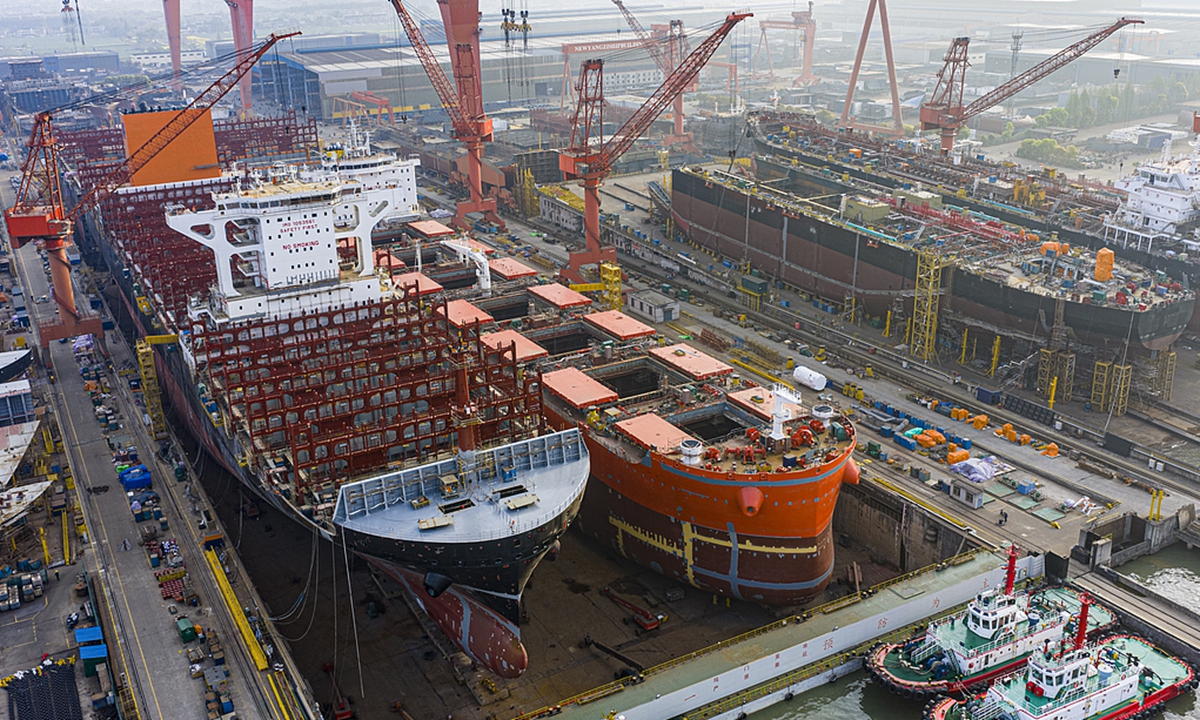
A view of a shipyard of Jiangsu New Yangzi Shipbuilding Co in Taizhou, East China's Jiangsu Province, on April 6, 2026. Photo: VCG
Multiple Chinese shipbuilding companies have recently secured new orders spanning various ship types and capacities, highlighting the strength and competitiveness of the domestic shipbuilding sector, according to a report published on Tuesday on the official WeChat account of the China Association of the National Shipbuilding Industry (CANSI).
An industry expert said this trend shows that amid ongoing global supply chain uncertainties, China's comprehensive industrial and supply chain system enables domestic shipbuilders to maintain stable production and delivery schedules.
According to the CANSI, Shanghai Waigaoqiao Shipbuilding Co, a subsidiary of China State Shipbuilding Corp, together with China Shipbuilding Trading Co, recently signed a contract with Greece-based Venergy Maritime for the construction of two Suezmax crude oil tankers.
This agreement is the first partnership between Waigaoqiao Shipbuilding and Venergy Maritime. For Waigaoqiao Shipbuilding, it represents an important milestone in expanding its global customer network, while for Venergy, it constitutes a key step in advancing its fleet upgrade strategy, said the CANSI.
Guangzhou Shipyard International Co, in cooperation with China Shipbuilding Trading Co, recently signed a contract with Venergy Maritime for the construction of two 157,000-deadweight-ton Suezmax crude oil tankers.
This project represents another high-quality order secured by GSI by seizing market opportunities. The vessels to be built are next-generation Suezmax tankers independently designed and developed by GSI.
Qingdao Beihai Shipbuilding Heavy Industry Co, in cooperation with China Shipbuilding Trading Co, officially signed a contract with South Korean shipowner Pan Ocean for the construction of a 319,000-deadweight-ton very large crude oil carrier (VLCC) with ammonia-fuel provision. Pan Ocean is a long-term partner of Beihai Shipbuilding and currently has four 210,000-ton bulk carriers on order with the yard.
The VLCC to be built is part of Beihai Shipbuilding's independently developed "Venus" series of liquid cargo vessels. The design features high-efficiency energy-saving equipment to significantly improve vessel fuel efficiency and includes provisions for future ammonia fuel installation, allowing for two 6,000-cubic-meter ammonia fuel tanks, providing strong potential for green, low-carbon upgrades.
The recent surge in orders reflects both the market demand for new vessels and the shipping industry's push for a green transition, with some ships featuring environmentally friendly energy designs, Chen Jiahai, deputy secretary-general of the Zhejiang Association of Shipbuilding, told the Global Times on Tuesday.
For example, in North America and certain other regions, strict emission standards apply to vessels calling at ports. Ships that continue to use conventional heavy fuel oil would face more restrictions, Chen said.
Zhejiang Province, a key shipbuilding region in China and a barometer of the country's shipbuilding industry, reflects the development trends and dynamics of the sector. In 2025, Zhejiang's shipbuilding enterprises held orders totaling 24.595 million deadweight tons, representing a substantial increase of 41.4 percent, according to media reports.
Also last year, Zhejiang received new shipbuilding orders totaling 13.712 million deadweight tons, placing it among the top in the country, according to the Zhejiang Association of Shipbuilding.
Amid ongoing uncertainties in the global supply chain, China's complete industrial and supply chain system ensures the stable production and delivery schedule of domestic shipbuilders, effectively enhancing the reliability of the global energy transportation network and playing an increasingly important role in the shipment of crude oil and other bulk commodities, Chen added.
"Shipping fundamentally drives the efficiency of the entire logistics system. Compared with land transportation, it can reach areas that are inaccessible by rail or road, and its overall cost and transport efficiency are significantly superior to those of rail and other modes of transport," Chen said, highlighting the strong potential for a global market boom.
Global Times
RELATED ARTICLES