Xinjiang turns renewable potential into economic gains amid global energy shake-up
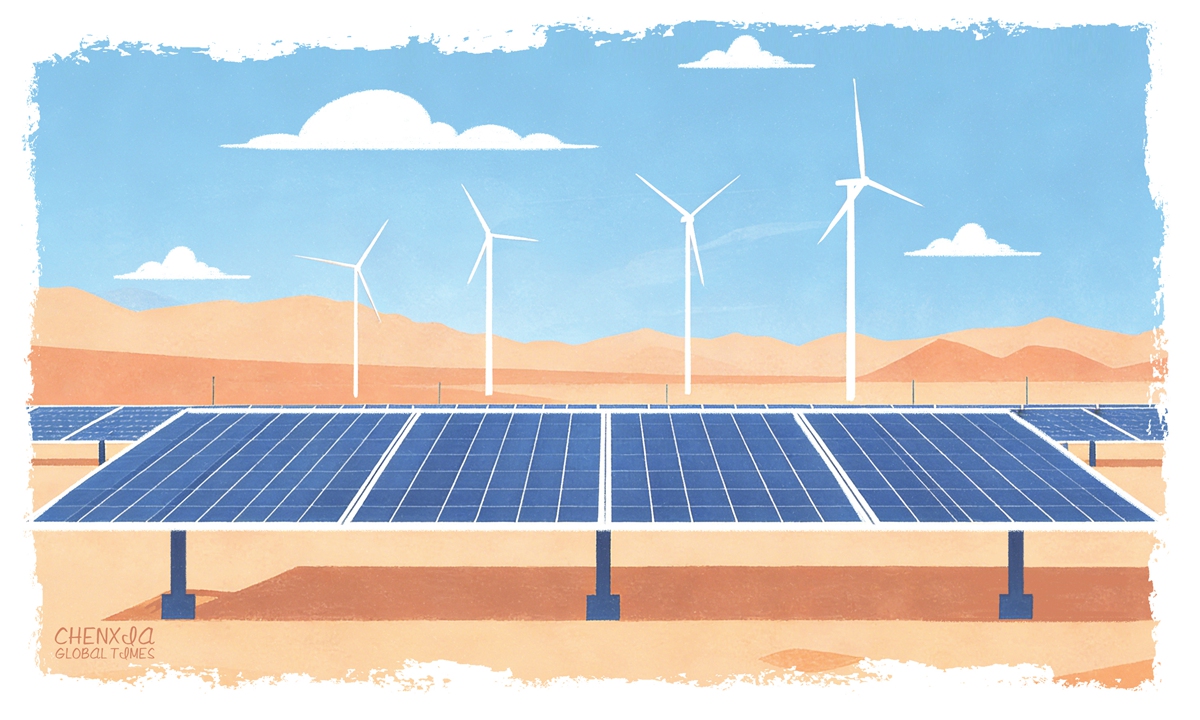
Illustration: Chen Xia/GT
In the first quarter of 2026, Xinjiang's power grid generated 38.1 billion kilowatt-hours of new energy, up 28.3 percent year-on-year, underscoring the region's growing capacity to harness and efficiently utilize renewable resources, China News Network reported on Tuesday.With its extensive wind and solar potential, Northwest China's Xinjiang Uygur Autonomous Region offers a valuable perspective on the development of China's renewable energy sector, providing insight into the broader shifts driving the country's transition to a more sustainable energy future.
Unlike fossil fuels, renewable energy is inherently sustainable, offering economies a long-term alternative to non-renewable resources. China is increasingly tapping into its abundant wind and solar potential, not only to meet domestic energy demand but also to foster economic growth and industrial transformation. Xinjiang, with its rich renewable resources, exemplifies how regions can harness green energy to boost local economies. Its experience offers valuable insights for other areas seeking to use renewable energy as a catalyst for development.
Xinjiang's green electricity sector is playing an increasing role in driving economic growth through multiple channels. First, the construction of green electricity bases in the region has attracted substantial investment and created local jobs. These developments support large-scale infrastructure projects, while simultaneously providing employment opportunities for the local workforce.
Second, Xinjiang's green electricity directly supports local and regional industries by providing a stable and cost-effective energy supply. This is particularly beneficial for energy-intensive sectors, where more predictable electricity costs enable businesses to upgrade their operations and adopt more sustainable practices. Such developments are driving the transition to green manufacturing and aligning with China's broader goals of structural optimization and high-quality economic growth. In this way, green electricity is not just a source of power, but a catalyst for industrial transformation.
Third, the growth of green electricity is promoting industrial clustering, driving technological innovation, and increasing the added value of local industries. The implementation of renewable energy projects generates economic activity across the entire industrial chain - from equipment manufacturing to construction, operations, and maintenance.
Additionally, the direct integration of green electricity is accelerating the adoption of renewable energy technologies. This, in turn, is stimulating the growth of related sectors, such as energy storage and power electronics, and enhancing Xinjiang's role in the broader energy technology landscape.
From the wind turbines in the Gobi desert to ultra-high-voltage transmission lines, Xinjiang is gradually turning its abundant wind and solar resources into an important industrial asset. By tapping into its renewable energy potential, the region is supporting China's green energy objectives while also driving local economic growth.
While some Western countries continue to use fossil fuels as a geopolitical tool to preserve their long-standing advantages in traditional energy sectors, more forward-thinking economies are recognizing that the long-term energy landscape will increasingly shift toward diversification and low-carbon development.
The traditional dominance of oil is being gradually challenged, with renewable energy expected to play a larger role. In this context, the development of new energy should be viewed more objectively. Rather than being labeled as overcapacity, the growth of the renewable energy sector presents emerging economic opportunities, driving innovation, job creation, and industrial transformation.
From this perspective, international cooperation in the renewable energy sector is essentially focused on economic opportunities. This helps explain why collaboration in Xinjiang's renewable energy industries is gaining momentum and achieving consistent progress.
The development of Xinjiang's green electricity sector presents opportunities for collaboration with economies participating in the Belt and Road Initiative. These projects provide not only green energy solutions but also support for industrial upgrading and share valuable experience in sustainable development.
Through equipment exports, technical collaboration, and the joint development of renewable energy industrial parks, these efforts help strengthen local industries' ability to transition to low-carbon operations while enhancing the resilience of energy systems.
For example, the Akmola wind power project cluster in Kazakhstan, invested and built by a Chinese enterprise, is already feeding green electricity into the local grid, improving power supply and supporting green growth. In Uzbekistan, the Buka solar project, constructed by Chinese companies, has been connected to the grid, delivering clean electricity locally.
The facts demonstrate the mutual benefits of renewable energy cooperation and its positive impact on economic development. Energy remains an important issue at any time, and today, renewable energy has the potential to make a substantial contribution to the economic growth of both local and global economies.
The author is a reporter with the Global Times. bizopinion@globaltimes.com.cn
RELATED ARTICLES