China's state assets regulator establishes new bureau to manage overseas state-owned assets
Move to strengthen prevention, resolution of risks of investment: expert
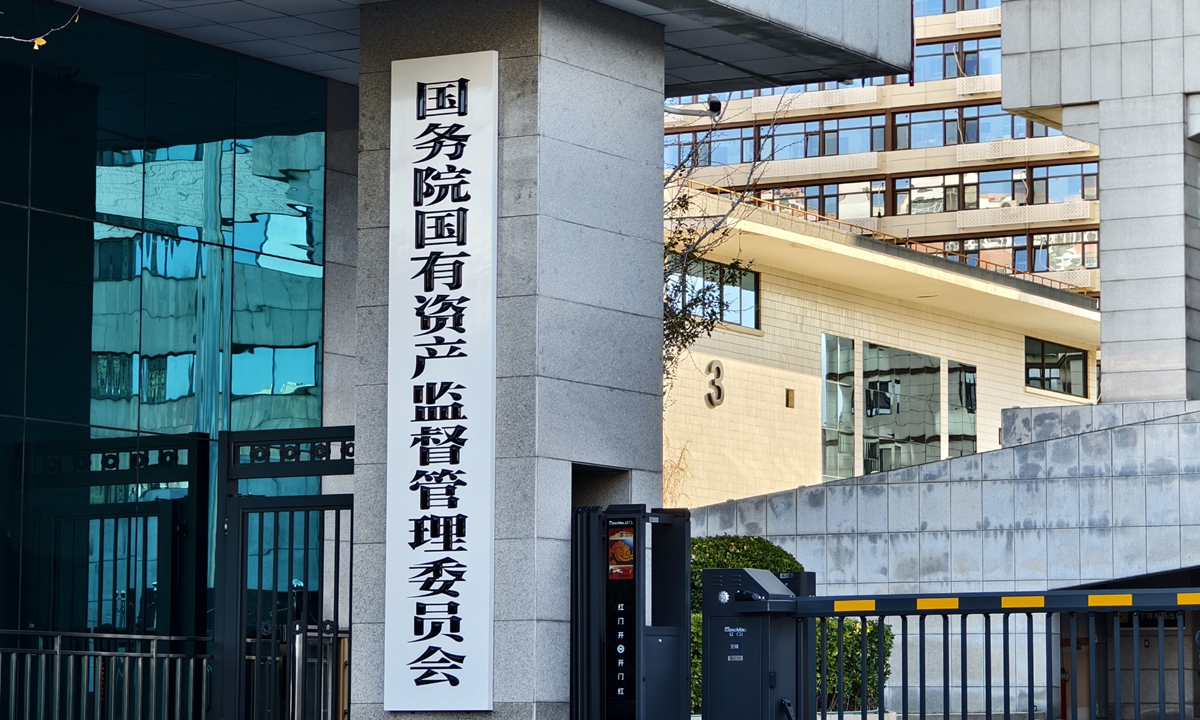
China's State-owned Assets Supervision and Administration Commission of the State Council Photo: VCG
China's State-owned Assets Supervision and Administration Commission of the State Council (SASAC), the country's state assets regulator, has newly established the bureau of overseas state-owned assets, the Xinhua News Agency reported on Wednesday.
According to the official website of the SASAC, the main responsibilities of the new bureau include guiding the supervised enterprises in their international operations and optimizing the layout, structure, and adjustment of overseas assets; undertaking supervision of overseas assets of the supervised enterprises; strengthening risk prevention and mitigation in areas such as overseas investment and operations; and handling matters related to overseas emergencies and crisis response.
The bureau has established internal divisions including the international operations division, the risk prevention and mitigation division, the supervision and governance division, and the emergency management division, according to the official website.
"One responsibility of the new bureau primarily is to respond to changes in the current international situation, including recent tensions in the Middle East. By establishing this bureau, China can strengthen the prevention and resolution of risks related to overseas investment and operations.
"In particular, when sudden incidents or crises occur abroad, the agency will be able to promptly handle relevant matters and prevent major losses of state-owned assets in overseas investments," Yang Delong, chief economist at Shenzhen-based First Seafront Fund, told the Global Times on Wednesday.
China's central state-owned enterprises maintain more than 8,000 institutions and projects in more than 180 countries and regions worldwide, with overseas assets exceeding 9 trillion yuan ($1.31 trillion), according to Li Zhen, deputy head of the SASAC.
As the high-quality development of international cooperation initiatives such as the Belt and Road Initiative continues to advance, central state-owned enterprises (SOEs), acting as the main force, have built up overseas assets amounting to several trillion yuan. However, the previous decentralized management model has become inadequate to cope with the complex international environment, Li Jin, chief researcher at the China Enterprise Research Institute in Beijing, told the Global Times on Wednesday.
Li Jin added that in recent years, the global geopolitical landscape has undergone profound adjustments, placing unprecedented pressure on central SOEs' overseas projects in terms of investment security and asset preservation. "There is an urgent need for a dedicated institution to coordinate and manage these efforts," Li Jin noted.
As to enterprises, Yang said that the bureau will guide the specific operations and strategic direction of overseas investments, making the investment layout more scientific and rational, thereby improving the success rate of investments and avoiding potential risks. This represents an important measure to achieve the preservation and appreciation of state-owned assets, Yang noted.
"This new bureau not only responds to the practical needs arising from the internationalization of central enterprises, but also strengthens the bottom line for safeguarding state-owned assets, while serving the nation's overall opening-up strategy," Yang said.
In the outline of the 15th Five-Year Plan (2026-30) for national economic and social development, it noted efforts to improve the state-owned assets supervision system and better leverage the role of state-owned capital investment and operating companies.
The outline said that efforts should be made to implement outbound investment management, strengthen the overseas comprehensive service system, promote the integration of trade and investment, and guide the rational and orderly cross-border layout of industrial and supply chains.
In addition, it stressed the need to improve the mechanisms and legal frameworks for monitoring, preventing, controlling, and addressing risks in outbound investment, and encourage enterprises to enhance their risk prevention and control capabilities as well as compliance management.
RELATED ARTICLES