SPORT / MISCELLANY
Arsenal academy chief Mertesacker calls for patience in youth football development

Illustration: Liu Xiangya/GT
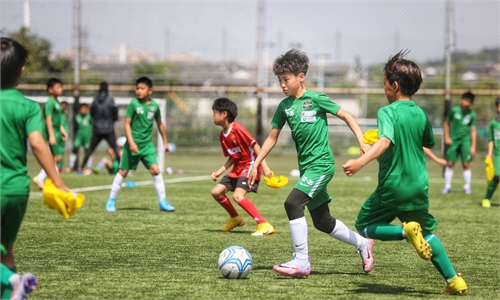
Arsenal Academy manager and German World Cup winner Per Mertesacker has underscored that youth football development demands unwavering long-termism and a deliberate focus on shaping resilient characters alongside raw talent.Leading the club's Under-15 side in the Premier League's Next Gen Beijing Cup being held at the National Olympic Sports Centre in Beijing from Monday to Saturday, the 41-year-old former defender described the trip as a practical illustration of Arsenal's philosophy in action.
The tournament pits Arsenal's U15s against fellow Premier League academies such as Aston Villa and the Wolverhampton Wanderers, alongside top Chinese youth sides including Beijing FA's U15 selection, Shijiazhuang Gongfu U15, Shanghai Shenhua U15, Zhejiang FC U15, and the Hong Kong U16 Elite Selection Team.
Mertesacker, who retired as a player in 2018 after a distinguished career that included 156 Premier League appearances for Arsenal and the 2014 FIFA World Cup triumph with Germany, has spent the past eight seasons transforming the club's Hale End academy into a production line for "Strong Young Gunners."
Under his stewardship, the academy has produced first-team stars such as Bukayo Saka and Emile Smith Rowe, while continuing to feed the senior squad with exciting prospects. Most recently, 16-year-old Max Dowman etched his name into Premier League history in March by becoming the competition's youngest-ever goalscorer.
Mertesacker directly linked such breakthroughs to years of patient work.
"We start our academy at under-9 and recent successes in our first team has been cultivated for years and years of work on realistic development," he explained.
Arsenal's U15 squad in Beijing, he noted, is at a critical stage of their journey.
"We absolutely believe in the talent that we have. But also we need to cultivate characters who are able to learn and adapt at that different level. This experience will make sure they get through adverse moments, which is really important for development," Mertesacker said.
For Mertesacker, talent alone is insufficient. Character development, the ability to cope with setbacks, adapt to new environments, and grow through both victory and defeat, forms the bedrock of Arsenal's approach.
"Long-term development is about dealing and coping with winning and losing on the way," he stressed. "And individual development within that team is key to us."
Pathways to the first team vary widely, he added. Some players, like the current 16-year-old making an impact, break through early, while others bloom later, debuting at 20 or 21. The academy's role is to support every individual trajectory.
Running an operation of this scale is no small feat. Mertesacker revealed that the Arsenal academy employs roughly 150 staff members, including around 90 full-time personnel, who look after approximately 200 young players. He likened the role to managing a large company.
The development program is deliberately holistic, encompassing technical football expertise, physical conditioning, mental resilience and broader life skills.
"It is long term. It is holistic. It is preparing youngsters for the next level," Mertesacker noted.
This philosophy has paid dividends, with multiple academy graduates contributing to Arsenal's senior squad in recent seasons. Yet Mertesacker is quick to credit the collective rather than any single individual, including himself.
He described learning to "park your ego" and "chuck your ego out of the window" as one of the biggest personal challenges after transitioning straight from the playing squad to academy leadership.
Beyond Arsenal's internal success, Mertesacker used the Beijing platform to offer candid advice to Chinese football stakeholders.
He urged the creation of a strong domestic youth culture that provides young players with a secure social environment, family, friends, and community support, before considering overseas moves.
"Ideally, you would get a kind of youth development that you feel like can foster our young players here in China. I think that's that should be the main target first and foremost," he said.
International exposure, such as trips to Europe or China for Arsenal's younger age groups, is valuable for building adaptability, but only after a solid foundation at home.
For aspiring youth coaches, particularly former professional players, Mertesacker's message was unequivocal: passion and long-term commitment are essential.
"You gotta be passionate for youth development. Otherwise, it's gonna be like a real struggle and really difficult," he noted.
"It is not only like I can turn up once a week and everything gets better. It is constant hard work. And you have to be resilient and have to be able to do all your qualifications. Making sure that you do the hours and the years in order to give something to the next generations is crucially important."
That message resonates strongly with the tournament's parallel initiative, the Premier League's Next Gen Coach program.
Running alongside the matches, the four-day grassroots coach-development project is training 40 Chinese coaches under the guidance of Premier League staff and experts from Burnley and Chelsea.
The program includes workshops, masterclasses, and practical sessions designed to elevate local coaching standards and support China's youth football ambitions.
RELATED ARTICLES