Illustration: Xia Qing/GT
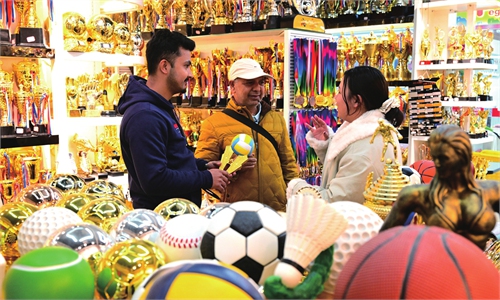
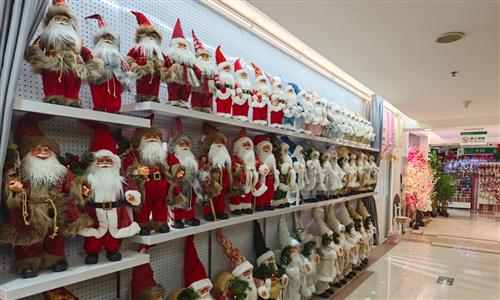
Christmas may still be months away, but the Christmas goods section of the Yiwu International Trade Market in East China's Zhejiang Province is already buzzing with activity. According to Yiwu Fabu, vendors report that international buyers have been arriving at least a month earlier than usual. "The change is noticeable," remarked the manager of a factory producing Christmas apparel and gifts in Yiwu.This trend is also reflected in export figures. Local customs data show a 23.3 percent year-on-year increase in Yiwu's Christmas goods exports during the first two months of the year. This early uptick further reflects changes in the timing of Yiwu's Christmas sales, pointing to a gradual shift toward earlier purchases.
Yiwu is an important representative of the global Christmas goods market, given its prominence as a major hub for small commodities trade. According to a report from the Xinhua News Agency, Yiwu exports more than 20,000 categories of Christmas products, accounting for nearly 80 percent of the global market and reaching more than 100 countries and regions.
Despite ongoing uncertainties in global trade, Yiwu's Christmas product exports have continued to grow, with a 22.9 percent year-on-year increase, reaching 5.17 billion yuan ($756.99 million) in the first three quarters of 2025, according to Xinhua. This sustained growth highlights both the enduring global demand for Christmas products and Yiwu's role in the supply chain.
Given Yiwu's crucial role in the global Christmas goods market, the move toward an earlier procurement season is becoming increasingly understandable. According to Yiwu Fabu, the trend of placing orders earlier is not incidental, but rather the result of a complex interplay between global trade dynamics and the evolving industry landscape. In response to fluctuations in shipping capacity and uncertainties at ports, international buyers are placing greater emphasis on risk management by adjusting their procurement timelines.
This trend further underscores the deep integration between Yiwu and the global Christmas goods market, emphasizing the impracticality of any potential "decoupling." With the market's broad product range, rapid adaptability, and a highly efficient trade model, Yiwu's Christmas goods have become an integral part of the global holiday economy, consistently setting trends in the small commodities trade worldwide.
Yiwu's deep integration with the global market is driven by a range of key factors. First, innovation is central to the enduring global competitiveness of Yiwu's products. By continuously incorporating emerging technologies and introducing new products that exceed customer expectations, local manufacturers maintain fresh and dynamic offerings.
Second, Yiwu's competitiveness in international markets is bolstered by a diversified distribution network, which helps mitigate risks arising from external uncertainties. For example, in the first three quarters of 2025, exports to Latin America grew by 17.3 percent and exports to the EU grew by 45 percent, together accounting for more than 60 percent of Yiwu's total Christmas product exports, according to official data.
Here is a case in point. According to the Yiwu Cross border E-Commerce Association, some Yiwu manufacturers developed singing Santa Claus toys, leading to a surge in orders. These products are available in four foreign languages, and each additional language effectively opens up a new market.
These factors, along with China's robust industrial and supply systems and others, have cemented Yiwu's long-standing and resilient connections to the global market. This bond has evolved over time and is likely to endure for the foreseeable future. In this context, the trend toward earlier procurement of Yiwu's Christmas goods is hardly surprising.
When placed within a broader context, Yiwu's story offers insights into the current state of global trade. The realignment of global supply chains is driven by market forces, not by political agendas. When international buyers use various means to secure a stable supply from China, they are making pragmatic business decisions that gradually counter the political narratives surrounding "decoupling."
At the same time, China's industrial and supply chains are actively adapting to the evolving dynamics of global trade. In Yiwu, innovation is evident across various sectors - whether in product development, trade practices, international logistics, or digitalization. This flexibility has allowed Yiwu's goods to reach further across the globe, fostering a closer two-way exchange between foreign buyers and Chinese producers.
History has shown that trade protectionism rarely addresses underlying issues and often exacerbates uncertainty. The early arrival of Yiwu's Christmas export season offers a tangible example of how global trade continues to adapt in an unpredictable environment. Yiwu's ability to navigate these complexities highlights the resilient forces driving progress in global supply chains.
The author is a reporter with the Global Times. bizopinion@globaltimes.com.cn
RELATED ARTICLES