SPORT / MISCELLANY
Chinese table tennis team to face high stakes at London world championships
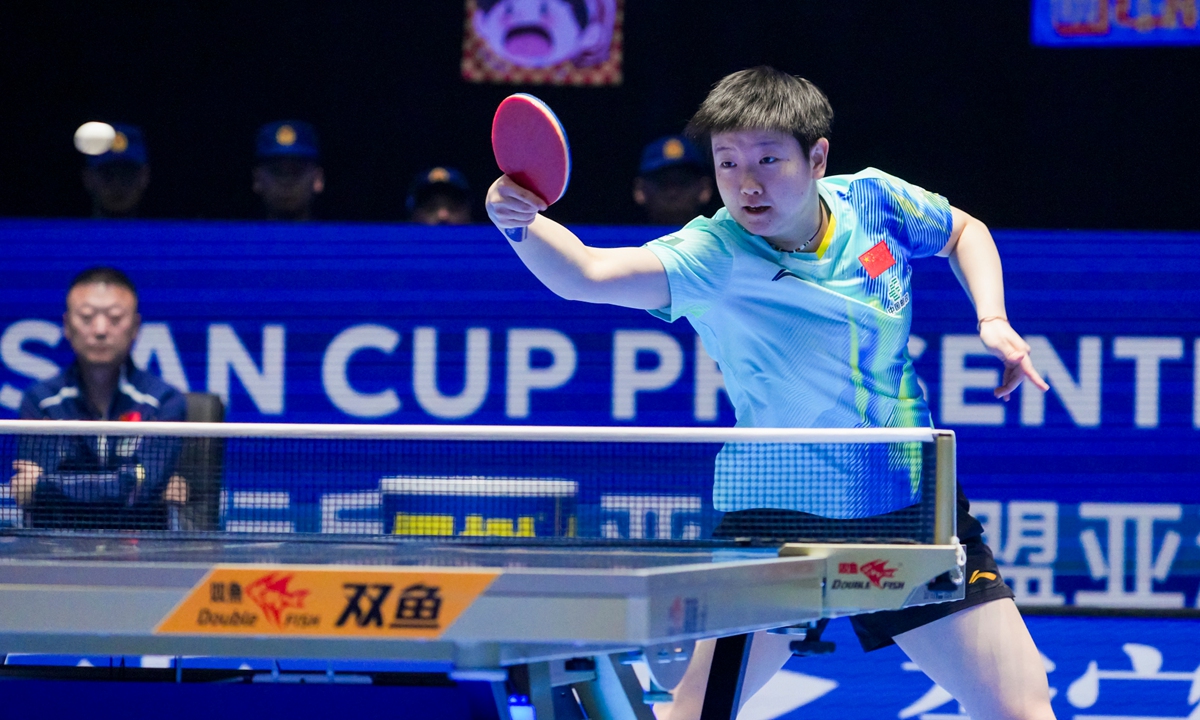
Sun Yingsha hits a return during the women's singles group match between Sun Yingsha of China and Yeh Yi-Tian of Chinese Taipei at the ITTF-ATTU Asian Cup Haikou 2026 table tennis tournament in Haikou, South China's Hainan Province, Feb. 4, 2026. Photo: VCG
The Chinese Table Tennis Association (CTTA) on Wednesday unveiled the national team roster for the ITTF World Team Table Tennis Championships in London, the UK, set to run from April 28 to May 10.The Chinese men's team is chasing an unprecedented 11th consecutive title, while the women's squad aims for a sixth straight crown. Yet this campaign arrives under unusual strain.
Star player Fan Zhendong, a three-time Olympic champion with an unblemished record in major team events outside the individual spotlight, voluntarily withdrew due to personal reasons after the CTTA proactively consulted him, reported the Table Tennis World magazine under the China Sports Daily, which is affiliated with the General Administration of Sport.
His absence may reshape the narrative from dominance to adaptation, forcing the team to confront vulnerabilities that has been exposed at international competitions.
On paper, the men's team remains formidable: Wang Chuqin, Lin Shidong, Zhou Qihao, Xiang Peng, and Liang Jingkun.
Wang, the current world No.1, anchors the squad, while Lin provides youthful firepower. But Fan's exit slashes the margin for error.
Without the veteran who has repeatedly delivered in decisive moments, the team lacks a proven mid-generation stabilizer. Zhou and Xiang, though talented, were eliminated in the group stage of the recent World Cup in Macao, exposing gaps in high-stakes experience. Liang steps in as a reliable veteran, but the overall configuration tilts younger and less battle-tested in team formats.
The squad must now pivot from its traditional reliance on a single superstar to a more distributed, flexible model of team play. It tests the depth of China's famed national table tennis system, which has long thrived on collective strength but now faces the reality of transitioning without its reliable star Fan.
The women's team, by contrast, projects continuity and stability with a lineup of Sun Yingsha, Wang Manyu, Chen Xingtong, Kuai Man and Wang Yidi.
Sun remains the undisputed leader, a player whose consistency and mental fortitude have defined recent triumphs. Wang Manyu and Chen bring a proven big-match pedigree, while Kuai and Wang Yidi add layers of versatility.
While the unit appears balanced on the surface, the pressure of defending a long winning streak can amplify small lapses. In team events, where momentum swings on every set, the ability of emerging players to absorb pressure without cracking will be decisive. China's women have dominated, but sustained excellence demands more than talent, as it requires an almost superhuman composure under high expectations.
The external threats are also unmistakable.
Japan looms as the most immediate danger with a young squad. Sora Matsushima, the teenage sensation who pushed Wang Chuqin to a grueling seven-game final at the recent World Cup before falling just short, embodies this new wave. With the pair of Tomokazu Harimoto, long a thorn in China's side, and Shunsuke Togami, Japan possesses explosive speed and tactical cohesion.
Beyond Japan, other contenders add layers of complexity. France, seeded highly and featuring the dynamic Lebrun brothers, brings European flair and rising star power capable of springing upsets. South Korea's doubles specialists and Germany's experienced campaigners, including veterans who have troubled China in recent World Cup group play, ensure no match can be taken lightly.
China enters the world championships as the overwhelming favorites, yet the absence of Fan and the emergence of hungry rivals demand a recalibration of the team. The World Championships represent more than another title defense for China; it is also a stress test for the sustainability of Chinese supremacy. It must channel the pressure into purpose, proving that its dominance stems not from any single player but from an unbreakable collective ethos. The rich winning legacies of Chinese table tennis are not automatic, they are earned in moments when young players must step into the void and deliver.
The author is a reporter with the Global Times. life@globaltimes.com.cn
RELATED ARTICLES