Burial of real car during sacrificial ritual suspected of violating law: local govt
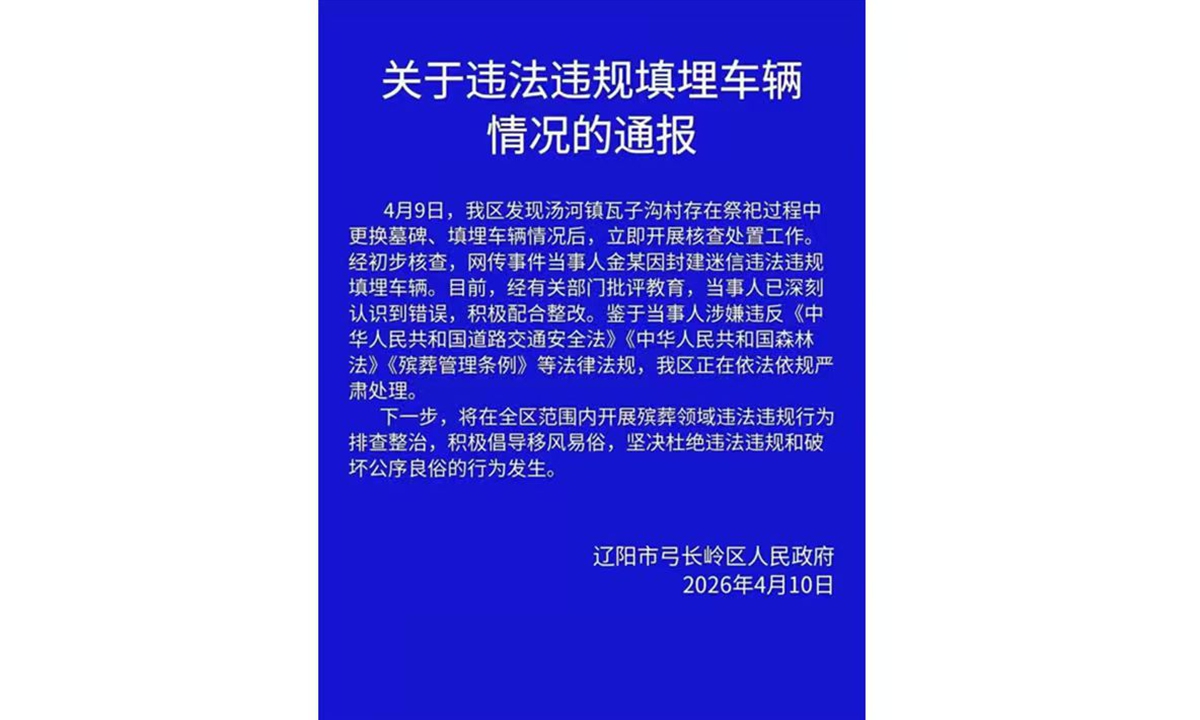
A notice issued by local government in Gongchangling district in Liaoyang city, Northeast China's Liaoning Province on April 10, 2026 Photo: Screenshot of notice on public WeChat account "Gongchangling1027"
Local government in Gongchangling district in Liaoyang city, Northeast China's Liaoning Province issued a notice on Friday about a sacrificial ritual suspected of involving burying a real car, saying that the district government is handling the case seriously in accordance with the law regarding the individual's suspected violation of relevant laws and regulations.
The brand of the car was not identified in the notice.
The notice came after a video clip of a funeral suspected of involving a Mercedes-Benz S450L with a rare license plate being buried as a grave good in Liaoyang aroused heated discussions on the social media platform Sina Weibo on Thursday, according to a report by Chang'anjie Zhishi, a social media account run by the official newspaper Beijing Daily.
After noticing acts such as replacing tombstones and burying a car during sacrificial activities in Wazigou village, an immediate investigation and response was launched, according to the notice posted on the public WeChat account "Gongchangling1027," the account of Gongchangling Convergence Media Center, a media platform of the local government.
"According to preliminary verification, the person involved, surnamed Jin, buried the car illegally due to feudal superstition. Following criticism and education from relevant government departments, the individual has fully recognized his mistakes and is actively cooperating with the rectification," read the notice.
Given that the individual is suspected of violating relevant laws and regulations, the Gongchangling district government is handling the case seriously in accordance with laws and regulations, it said.
In the next step, the district will carry out investigations and rectifications of illegal acts in the funeral and interment field throughout the region, actively advocate changing outdated social mores, and resolutely prevent acts prohibited by laws and regulations or those that violate public order and good customs, according to the local government's notice.
RELATED ARTICLES