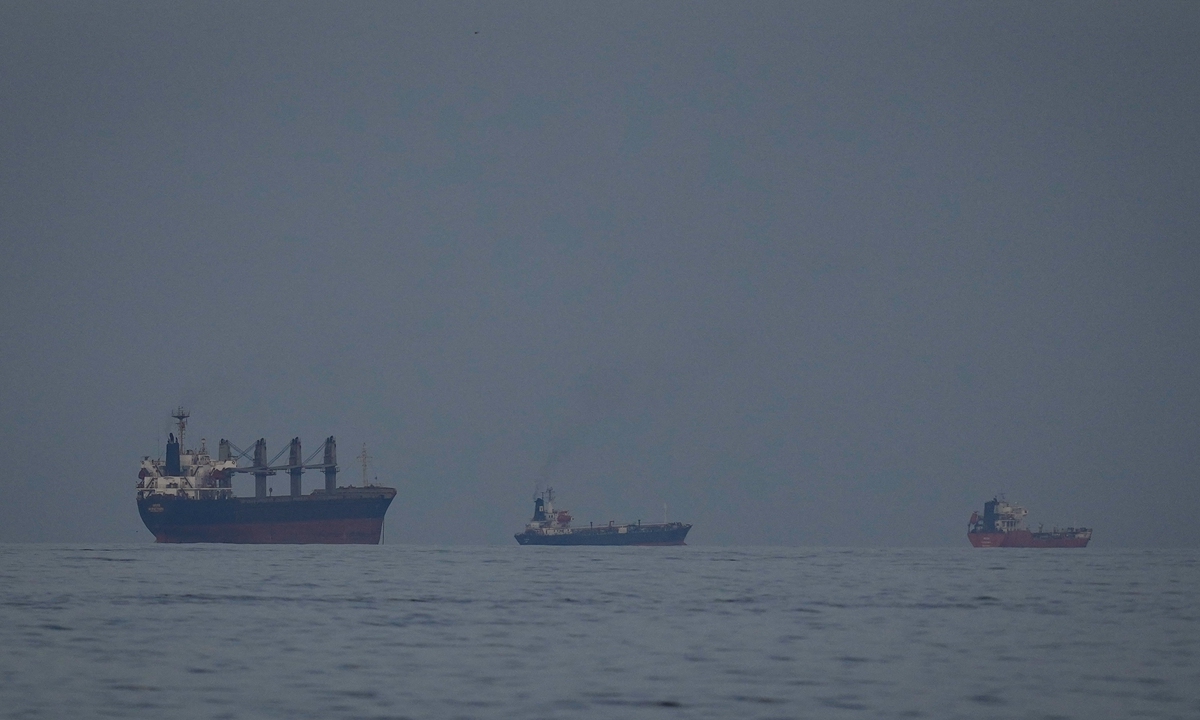
Oil tankers and ships line up in the Strait of Hormuz as seen from Khor Fakkan, United Arab Emirates, on March 11, 2026. Photo: VCG
Amid intensifying regional tensions and wild swings in global oil prices, the cost of shipping is on the rise — not only for air freight but also for international express delivery services. Major global logistics players including DHL, FedEx, and SF International have all adjusted their fuel surcharge policies in recent weeks, with most implementing notable increases as they pass on higher energy costs.
DHL Express announced in an official notice that its fuel surcharge for Time Definite, domestic, and international scheduled services will rise from 46 percent for April 13-19 to 47.75 percent for April 20-26. It will be the fourth consecutive increase since February.
The company said in the notice that fuel price volatility directly drives up global transportation costs, forcing the introduction of floating fuel surcharges that rise, fall, or are suspended in line with market fuel prices.
FedEx has also raised its charges. Between April 6 and May 3, its international fuel surcharge has been raised from 29.75 percent to 31.5 percent, the second round of increases since February.
SF International has adjusted the fuel surcharge rate for its international express services to 40 percent for shipments billed outside of Europe and the US starting April 13, up from 39.25 percent previously. The fuel surcharge for shipments billed in Europe and the US now stands at 19 percent, up from 18.5 percent previously.
A customer service representative told the Global Times on Sunday that the move was a response to persistent high volatility in international oil prices, which have directly lifted international logistics costs, and the move was a normal market adjustment to align with energy price movements.
Behind these coordinated hikes lies a sharp rise in jet fuel and diesel costs due to the ongoing conflict in the Middle East. Experts warn the wave of oil price hikes will amplify cost-push inflation across the global economy.
Cong Yi, a professor at the Tianjin School of Administration, told the Global Times on Sunday that rising oil prices create cost-push inflation, with the most direct effect being higher freight costs, which exert a clear short-term shock on international air logistics and the broader logistics industry.
"The current oil price surge is driven by geopolitical risks in the Middle East, which have disrupted energy supply expectations," he explained. "Higher fuel costs hit international air cargo especially hard. This not only raises retail prices but can also dampen cross-border consumer demand."
The duration of oil price volatility remains highly uncertain, and geopolitical conflicts continue to increase market unpredictability, Cong said.
All transport sectors — aviation, shipping, and road freight — face near-term cost escalation risks, Hu Qimu, a deputy secretary-general of the Forum 50 for Digital-Real Economies Integration, told the Global Times on Sunday.
"These higher expenses will ultimately be passed on to end-consumers. While consumer price inflation will feel the pinch, upward pressure will be more pronounced in the producer price index, as cost increases originate mainly in industrial and logistics segments," Hu said.
The conflict in the Middle East has led to "the world's daily oil flow cut by some 13 percent, and its LNG flow by some 20 percent," IMF Managing Director Kristalina Georgieva said in a speech at the 2026 Spring Meetings on Thursday, according to a readout on the website of the IMF.
RELATED ARTICLES