US-Iran negotiations end without deal; mistrust, gap in terms among major obstacles: observers
By Published: Apr 12, 2026 11:08 PM

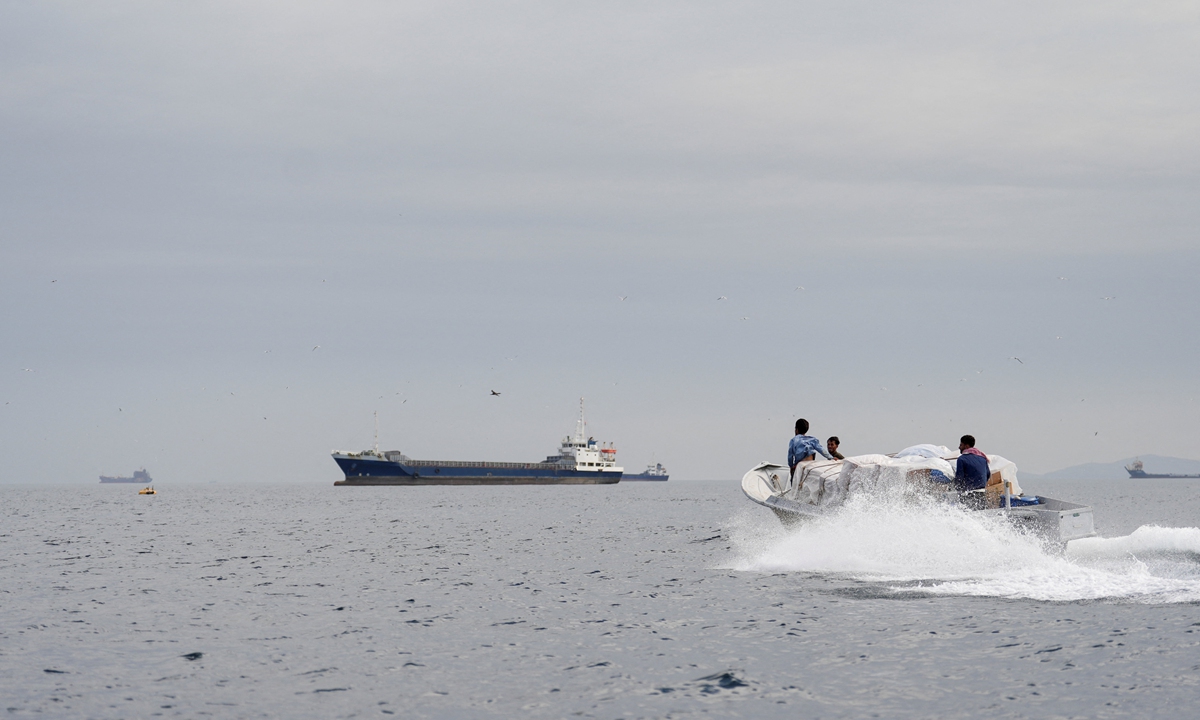
Vessels sail at the Strait of Hormuz, off the coast of Oman's Musandam province on April 12, 2026. Photo: IC
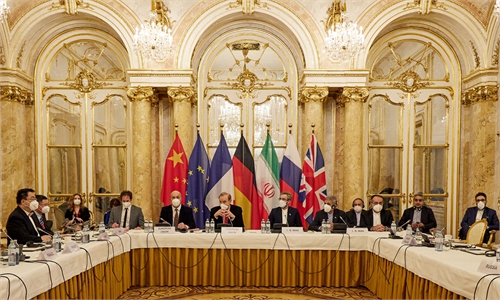
After 21 hours of intense negotiations in Islamabad, the US-Iran talks, which multiple news outlets said to be the highest-level face-to-face meeting between US and Iranian officials since 1979, ended on Sunday without an agreement to halt the monthlong war.
The historic talks, held under a fragile ceasefire, collapsed as delegations from both nations departed Pakistan on Sunday. According to media reports, negotiators traded accusations upon leaving, with each side blaming the other's unreasonable demands for the diplomatic breakdown.
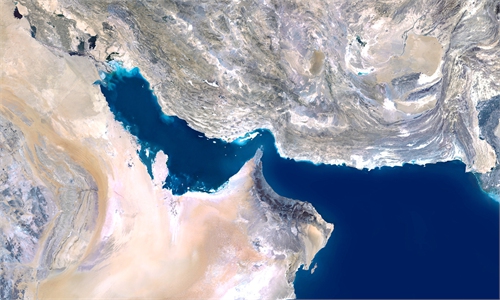
Despite the lengthy talks, deep-seated mistrust - shaped by decades of hostilities and sharpened by the latest conflict - continues to weigh heavily on both sides. Disputes over critical issues, including the Strait of Hormuz and Iran's nuclear program, have further complicated the path forward, making any breakthrough far from swift or straightforward, Chinese analysts said.
Mutual accusation
US Vice President JD Vance, who led the US delegation, left negotiations with Iranian delegation with an "understanding that is our final and best offer," per NBC News.
The Iranian delegation included Foreign Minister Abbas Araghchi and Mohammad Bagher Ghalibaf, the speaker of Iran's Parliament, per media reports.
Ghalibaf said his delegation raised "forward-looking" initiatives during ceasefire negotiations in Pakistan, but the United States failed to gain the trust of the delegation in the talks, per Al Jazeera.
Per the Newsweek, Vance had arrived in Pakistan with cautious optimism but claimed Iran's unwillingness to meet the administration's core demand - a firm commitment to not develop nuclear weapons or the tools to quickly achieve them - ultimately doomed the talks.
The Al Jazeera pointed out on Sunday that in the 10-point framework proposed by Iran, there was no mention of a complete surrender of nuclear ambitions. But what the US is essentially asking Iran now is that they give up their right to any nuclear program, even for medicinal purposes, it said.
Newsweek magazine in an article published on late Saturday night US local time said that "the collapse of talks marks a significant setback in US efforts to broker a diplomatic resolution to a war that has destabilized the Middle East and rattled global energy markets since the US and Israel launched military operations against Iran in late February."
The strategic mutual distrust between the US and Iran is an important factor affecting the negotiation process. Besides, the more fundamental issue lies in the fact that the negotiating leverage and demands of the two sides are severely asymmetrical, with a huge gap in their opening positions, Qin Tian, a deputy director of the Institute of Middle East Studies of China Institutes of Contemporary International Relations (CICIR), told the Global Times on Sunday, and his view was shared by multiple other Chinese observers.
Liu Zhongmin, a professor at the Middle East Studies Institute at Shanghai International Studies University, told the Global Times the negotiations were hastily launched under highly unfavorable conditions in the first place. "While the conflict had not yet fully subsided, the talks were rushed into motion, which led to major disagreements over the preconditions right from the very beginning of the negotiations."
According to TASS news agency on Sunday, Iranian Foreign Ministry Spokesman Esmail Baghaei also revealed that the negotiations "were held in the atmosphere of mistrust and suspicions."
"Mutual understanding was reached on a number of issues, but the sides disagreed on 2-3 important questions, and, as a result, the negotiations failed to produce an agreement," the Tasnim news agency quoted him as saying. "Some new topics were added during these talks, such as the Strait of Hormuz issue, and each of them has its own peculiarities," he added.
A strained diplomatic history also casts a shadow over the talks. Twice in the past year, Iran was deep in indirect negotiations with the US when talks fell apart, and the US and Israel attacked, the NYT wrote on April 9.
Iran's semi-official Tasnim news agency on Sunday cited an informed source as saying that "Iran has put forward reasonable initiatives and proposals in the negotiations. The ball is in America's court to look at the issues realistically." The source also warned that nothing would change in the Strait of Hormuz "until the US agrees to a reasonable agreement."
"Iran is no hurry," the Tasnim agency cited the source as saying. A time and place for the next round of possible negotiations have not yet been set, it said.
Ball in whose court?
"It would be unrealistic to expect a single round of negotiations to resolve the more than 40 years of accumulated contradictions between the US and Iran - especially after the recent conflict. The mere fact that the two sides were able to sit down for face-to-face talks represents a significant breakthrough in itself. We cannot expect one negotiation to solve all the problems at once," Ding Long, a professor at the Middle East Studies Institute of Shanghai International Studies University, told the Global Times on Sunday.
At present, the core issues under discussion mainly revolve around several key sticking points: the safe navigation through the Strait of Hormuz, Iran's nuclear program, the ceasefire between Lebanon and Israel, and the unfreezing of Iran's overseas assets, Ding said. "It will be extremely difficult for the two parties to reach a one-time agreement on these fundamental and principled differences."
Following the failed Islamabad talks, Russian President Vladimir Putin has expressed readiness to help peace efforts in a call with Iran's President Masoud Pezeshkian, per Kremlin's readout cited by Interfax news agency in Russia. The European Union also weighed in, as its foreign affairs spokesperson Anouar El Anouni said diplomacy is "essential" for finding a peace deal in the Middle East conflict, AFP reported.
Though the US and Iran are technically in a Pakistan-brokered two-week ceasefire, the situation remains fragile, Qin Tian from CICIR said on Sunday, amid reports from Al Jazeera that Israel has launched air raids against several towns in southern Lebanon and Hezbollah claims of two attacks on Israeli forces.
However, once the "two-week" deadline expires, the risk of the US and Iran resuming hostilities will rise sharply, Qin said.
"If the thorny issues cannot be resolved at the negotiating table, it is very likely they will return to the battlefield to settle it, with the Hormuz Strait being a possible flashpoint as the US could seek to open the key channel with force," Qin warned.
The Iranian deputy parliament speaker Haji Babaei has said that the strait is a "red line" and is entirely under Iranian control, with passage fees payable in rials, BBC reported on Sunday.
Just following the fall-through of the Islamabad talks, Trump reposted an article on his social media, which said "If Iran refuses to accept the final deal the US offered Saturday, Trump could bomb Tehran back to the 'Stone Ages' as he vowed."
In response, Iran embassy in Austria said on X: "A simple explanation for those concerned: A blockade blocks. It cannot "open" the Strait of Hormuz - only restrict it."
Trump then posted that the US forces will immediately "begin the process of BLOCKADING any and all Ships trying to enter, or leave, the Strait of Hormuz".
Pakistani Ministry of Foreign Affairs on Sunday released an official statement regarding the conclusion of the Islamabad talks, saying that "We hope that the two sides continue with positive spirit to achieve durable peace and prosperity for the entire region and beyond." It also urged "it is imperative that the parties continue to uphold their commitment to ceasefire."
According to Al Jazeera, none of the US delegation stayed behind in Pakistan following talks with Iran, a US official says, leaving nobody in the Pakistani capital Islamabad to pursue back-channel discussions.
RELATED ARTICLES