FM endorses peace efforts in Middle East as Trump claims victories while threatening escalation
Winning rhetoric serves domestic politics while advancing energy interests: expert
By Sun Langchen and Published: Apr 02, 2026 11:51 PM

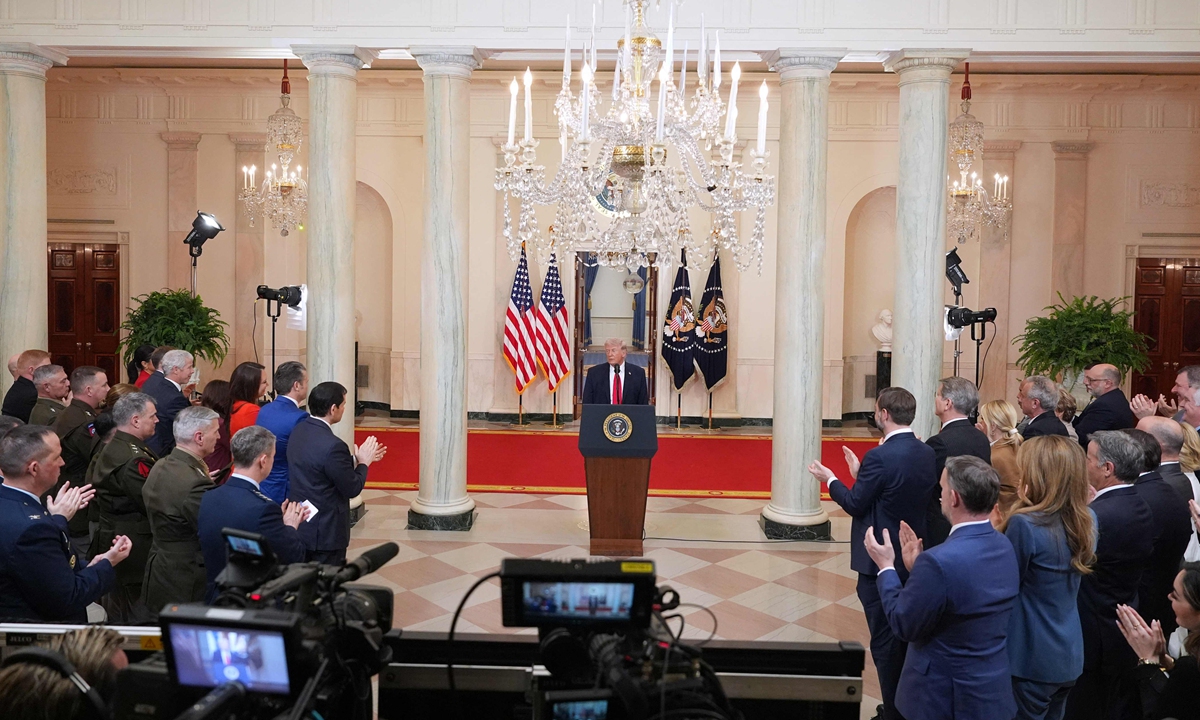
Guests applaud as US President Donald Trump concludes his televised address on the conflict in the Middle East from the Cross Hall of the White House in Washington, DC on April 1, 2026. Photo: VCG
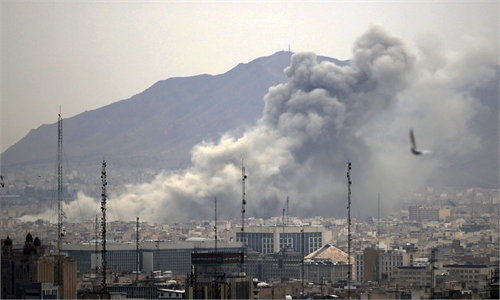
The US-Israeli war against Iran has entered its 34th day. When a genuine and lasting ceasefire in this regional conflict — which spans geopolitics, energy security, and multiple other domains — can be achieved has become a major focus of international attention.
Just hours after US President Donald Trump declared "overwhelming victories" against Iran while simultaneously threatening to escalate the war, the Chinese Foreign Ministry spokesperson fielded seven questions on the Iran situation during the regular press briefing in Beijing on Thursday.
Analysts pointed out that Trump's speech appeared to be more about reassuring his supporters and the market rather than signaling any genuine willingness to de-escalate. At the same time, Global Times reporters noted that the word "peace" was among the most frequently used terms in the spokesperson's responses.
On Thursday night as of press time, Chinese Foreign Minister Wang Yi held three separate phone calls over Middle East situation with Saudi Arabian Foreign Minister Faisal bin Farhan Al Saud, German Foreign Minister Johann Wadephul, as well as the High Representative for Foreign Affairs and Security Policy of the European Commission, Kaja Kallas.
The sovereignty and security of the Gulf states should be respected, and civilians and non-military targets must receive the necessary protection, said Wang during phone call with Wadephul, adding that the safety of shipping lanes, as well as energy and infrastructure facilities, should also be safeguarded, per Xinhua.
The issue of navigation through the Strait of Hormuz is a spillover effect of the current conflicts, noting the Strait of Hormuz remains unstable if the war doesn't end, the Chinese top diplomat told Saudi Arabian Foreign Minister.
Victories declared, escalation still possible
At the beginning of his 20-minute televised address on Wednesday local time, President Trump claimed the US has achieved "swift, decisive, overwhelming victories", claiming Iran's navy, air force and missile and drone capabilities have been severely degraded.
"I can say tonight, we are on track to complete all of America's military objectives shortly, very shortly," Trump said, noting that regime change "was not our goal." "We never said regime change. But regime change has occurred because of all of their original leader's death," he said.
However, the US president also warned that the next phase of the campaign could intensify significantly. "We're going to hit them extremely hard over the next two to three weeks," Trump said. He also issued a direct threat tied to ongoing negotiations. "If there's no deal, we're going to hit each and every one of their electric generating plants very hard and probably simultaneously," he said.
In response to Trump's claims of the possible escalation if a deal was not reached, Chinese FM spokesperson Mao Ning said on Thursday that "military means do not address the fundamental issue. Escalating the conflict does not serve any party's interest."
"Once again we urge parties to the conflict to immediately stop military operations and start peace talks as soon as possible to resolve issues through dialogue and negotiation and prevent more serious blows to the world economy and global energy security," Mao said.
In the eyes of Western media, Trump's speech did not alleviate the concerns of the international community and the market, with several saying that the speech highlighted military gains but offered little clarity on how the conflict would end.
Reuters noted that Trump signaled continued military action without giving a clear timeline, raising market concerns, while the Washington Post reported the address framed the war as "nearing completion" but stopped short of outlining an exit strategy. The Guardian similarly pointed out that the speech stressed US dominance and battlefield "success", yet provided little detail on a concrete endgame.
"It's clear that the speech was less about signaling to the outside world than about consolidating domestic political support, portraying US actions as consistently successful," Li Haidong, a professor at China Foreign Affairs University, told the Global Times on Thursday.
"He made no mention of the setbacks and failures in the war, while suggesting that after such a long period of conflict, any problems were simply inherited from previous administrations," Li said.
Li analyzed that Trump in fact did not signal any real intention to halt the fighting, instead making clear that any end to the conflict would hinge on a deal on his terms - while Iran has so far shown little willingness to compromise.
According to Press TV, a spokesperson for the Khatam al-Anbiya Central Headquarters, Iran's highest operational command unit, said the US and Israel have a limited understanding of Iran's military capabilities, warning that assumptions about destroying its strategic assets would only deepen the conflict. The statement stressed that the war would continue until the "enemy is fully humiliated" and forced to retreat.
A war that should end
"Since the ongoing conflict in Iran broke out, China has been actively working for peace. China supports all efforts for peace," Chinese Foreign Ministry spokesperson Mao Ning said at a regular press conference on Thursday, when asked to comment on reports that Iran has sought security guarantees from China and that a ceasefire between the US, Israel and Iran could be possible if such guarantees are provided.
"We stand ready to enhance communication and coordination with all sides and work for restoring peace and stability in the Middle East," Mao added.
This came after China has sought to advance its own diplomatic track, following talks in Beijing between Chinese Foreign Minister Wang Yi and Pakistan's Deputy Prime Minister and Foreign Minister Mohammad Ishaq Dar, where two sides put forward a five-point proposal, calling for an immediate ceasefire, the swift launch of peace talks, protection of civilians and non-military targets, ensuring navigation safety in the Strait of Hormuz, and upholding the authority of the UN Charter.
"When the US is focused on transferring the benefits of energy to itself and further targeting Iran, China has consistently advocated for a ceasefire and the restoration of normalcy in the Strait of Hormuz," Li said.
During his speech on Wednesday, Trump blamed recent fuel price increases on Iranian attacks on oil shipping and stressed the importance of keeping key maritime routes open. He also underscored US energy independence, saying the country "doesn't need" Middle Eastern oil and urging other nations to take greater responsibility for protecting critical shipping lanes.
According to ABC News, almost three dozens countries on Thursday sought to find ways of reopening the Strait of Hormuz during an online meeting chaired by UK Foreign Secretary Yvette Cooper. The US was not among the countries attending Thursday's meeting. Trump has said securing the waterway is not America's job, and told US allies to "go get your own oil."
In response to a media inquiry over President Trump's recent remarks suggesting that some countries should directly go to the Strait of Hormuz to "take the oil", Mao Ning said that "the root cause of the disruption at the Strait of Hormuz is the US-Israel illegal military operation against Iran. Only by ending the military actions and restoring peace and stability in the Gulf can the international shipping lane be open and safe."
When asked whether China is considering or will consider international cooperation to ensure the safe passage of oil shipments through the Strait of Hormuz with regard to global energy supply, Mao reiterated that the key lies in stopping military action.
"An early ceasefire and restoration of peace and stability in the Strait of Hormuz and surrounding waters is what the international community hopes to see, and all parties should work for this end. China is ready to continue to play a constructive role," Mao said.
"The only thing that really matters is whether the Strait of Hormuz will open soon. Trump's speech doesn't imply this is likely to happen as quickly as the markets were expecting," said Prashant Newnaha, senior rates strategist of TD securities, Singapore, per Reuters.
"Here you see Trump's final objective—to emphasize that this war is beneficial to the US. This ties into global energy dynamics: in the event of oil shortages, countries would turn to the US for supply, while key energy-producing regions are weakened, shifting dependence in the global energy market toward the US—as long as it serves US interests," Li noted.
RELATED ARTICLES