China steps up diplomatic push as US-Israeli war against Iran hits two weeks
By and Li Yu Published: Mar 14, 2026 12:28 AM

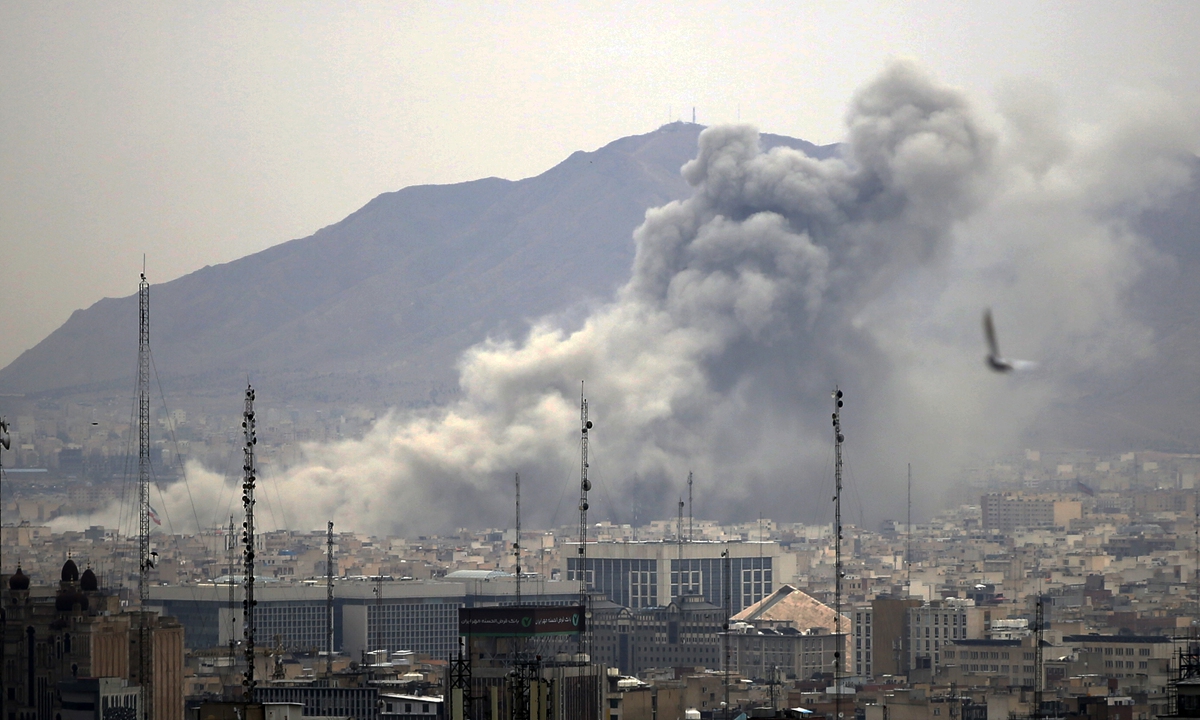
Smoke rises after airstrikes in Tehran, Iran on March 13, 2026. Photo: VCG
As the US-Israeli war against Iran entered the two-week mark on Friday, global concerns are mounting with almost no signs of relief, along with growing causalities, soaring oil prices and tumbling stocks.
Yet, amid no indication of any end in sight, China continues its shuttle diplomacy to push for de-escalation and a political settlement.
According to a release by the Chinese Foreign Ministry on Friday, Zhai Jun, special envoy of the Chinese government on the Middle East issue, on Thursday met with Bahraini Foreign Minister Abdullatif bin Rashid Al Zayani at Manama, Bahrain.
Zhai said that the current escalation of tensions in the region is not in the interests of any party, and the urgent priority is to immediately cease military actions and prevent the conflict from spreading further. The envoy added that China is ready to maintain close communication and coordination with Bahrain and play a constructive role in promoting peace and stability in the region.
Earlier, Zhai visited Saudi Arabia and the United Arab Emirates (UAE), and held talks with their respective foreign ministers. The Chinese envoy also held talks with Secretary General of the Gulf Cooperation Council Jasem Mohamed Albudaiwi in Riyadh.
In parallel diplomatic efforts, Chinese Foreign Minister Wang Yi had a phone conversation with Egyptian Foreign Minister Badr Abdelatty on Thursday, calling on all parties to urge those involved in the current conflict in the Middle East to cease military operations as soon as possible and prevent the situation from deteriorating further.
From March 1 to 12, Wang has held 12 phone calls with his counterparts from countries including Russia, Oman, Iran, France, Israel, Saudi Arabia, the UAE, Kuwait, Bahrain, Pakistan, Qatar and Egypt, in which he called for de-escalation of the situation in the region, according to publicly available information.
Wang also exchanged views on the Iran situation with Afghan Foreign Minister in a phone call on Friday.
Tian Wenlin, a research fellow at the China Institutes of Contemporary International Relations, told the Global Times that China consistently upholds the principle of promoting peace through dialogue, urging reconciliation, handling international issues based on merits and facts. Meanwhile, it also maintains good ties with Gulf Arab nations and possesses a high level of international credibility.
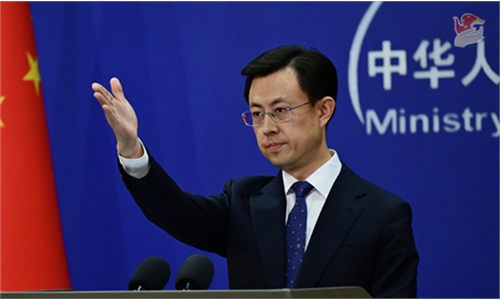
Chinese Foreign Ministry spokesperson Guo Jiakun said on Friday that the Red Cross Society of China has decided to provide the Red Crescent Society of Iran with $200,000 in emergency humanitarian assistance as special funds to support the bereaved parents of students from Shajarah Tayyebeh primary school, which, according to media reports, was struck by the US as a result of a targeting error.
Tougher stance, greater losses
China's concentrated actions underscore the urgency for all parties to jointly address the escalating situation, as both sides are now adopting even harder-line stances.
Following Iran's new Supreme Leader Mojtaba Khamenei's Thursday message, in which he called for the continued closure of the Strait of Hormuz and pledged to open new fronts in his country's conflict with the US and Israel, US President Donald Trump said the US has "unparalleled firepower, unlimited ammunition, and plenty of time", in a Friday post on Truth Social.
According to Iran's Fars news agency, Iran's Islamic Revolutionary Guards Corps (IRGC) has announced its 44th wave of attacks against Israeli and US forces in the region, targeting multiple Israeli cities and US bases in the region and the US Fifth Fleet.
IRGC said in a statement early Friday that a missile and drone attack caused significant damage to the USS Abraham Lincoln aircraft carrier, according to Anadolu Agency. Meanwhile, two US officials told CBS that the US side has fired at an Iranian vessel which sailed too close to the USS Abraham Lincoln.
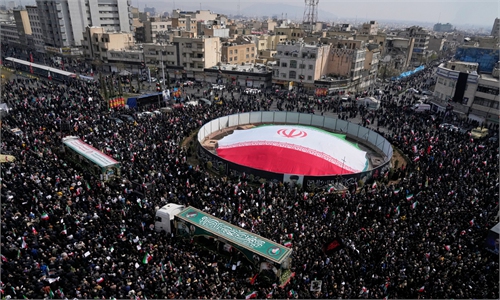
In Tehran, one person was killed by a US-Israeli air strike on Friday after multiple explosions were heard around the al-Quds Day march, where thousands were taking part in annual rallies held in solidarity with Palestinians, according to Al Jazeera
The US Central Command said Thursday that the military had struck 6,000 targets inside Iran since the war began on February 28.
Citing a Pentagon official on Tuesday, US media reported that seven US troops had been killed and about 140 service members wounded in the conflict so far. However, sources with knowledge of the situation told ABC news that the number of wounded troops appeared to be significantly higher than what had been publicly disclosed.
Iran's Health Ministry said on Friday that at least 1,444 people have been killed and 18,551 injured by US-Israeli attacks on Iran since February 28, according to Al Jazeera. The media outlet also reported that at least 2,975 people have been injured in the attacks since February 28, citing Israel's Health Ministry.
Chinese experts reached by the Global Times believed that the conflict is escalating in intensity, displaying an upward trajectory.
Tian noted that the US and Israel are exhibiting a political gambler's and military adventurist mentality. Having failed to topple the Iranian regime, they are compelled to double down on their bets to recoup earlier losses.
Liu Zhongmin, a professor at the Middle East Studies Institute of Shanghai International Studies University, told the Global Times on Friday that the US, driven by the need to save face, is intensifying strikes on Iran in hopes of compelling Tehran's submission. Likewise, after selecting a new Supreme Leader, Iran seeks to demonstrate a stronger resolve to strike back in order to enhance its authority, rally domestic support, and consolidate national unity.
Both parties now stand at a pivotal moment in a multi-dimensional strategic contest, but a sustained high-intensity confrontation is ultimately untenable for either side, according to Liu.
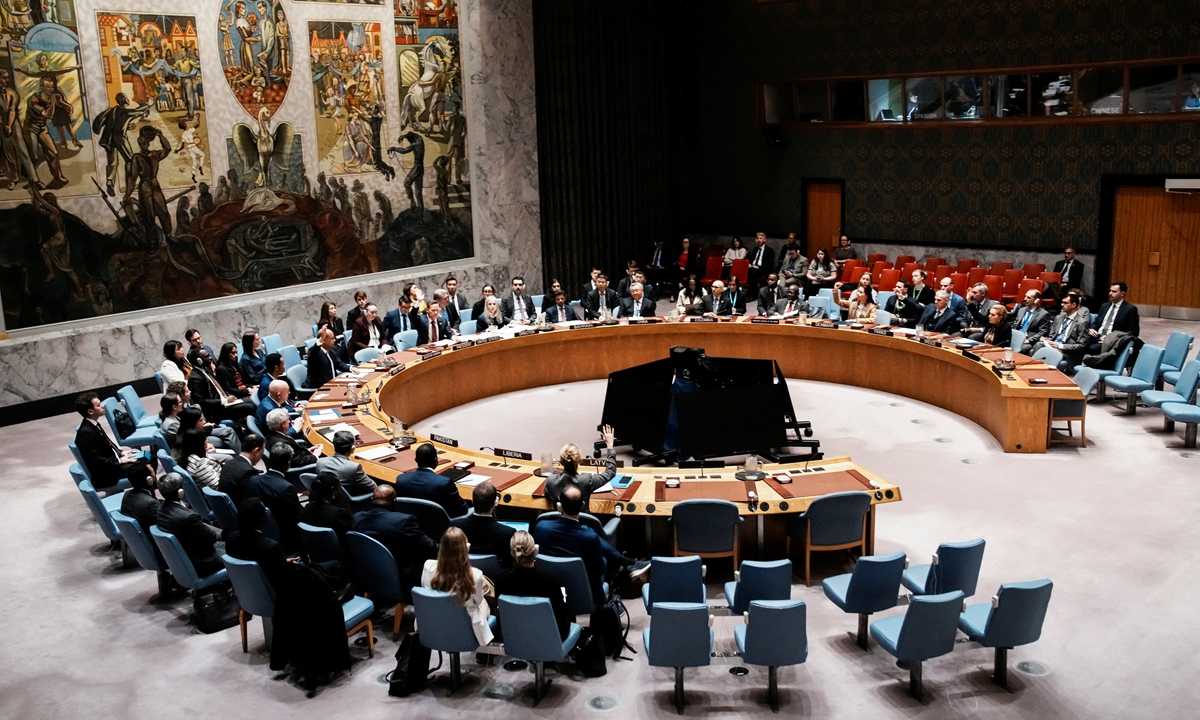
Members of the UN Security Council vote in favor of a sanctions resolution regarding the situation in Iran and the Middle East at UN headquarters in New York City, US, March 12, 2026. At a meeting of the 15-member UN Security Council, which is chaired this month by the US, Russia and China voted to halt the so-called 1737 Committee, which was established to oversee compliance with sanctions on Tehran. Photo: IC
Tumbling stocks, soaring oil pricesAlthough both the International Energy Agency and the US Energy Department announced it was releasing hundreds of millions of barrels of oil from emergency stockpiles, efforts have failed to stop the soaring oil prices and tumbling stocks amid the escalating conflict.
According to CNBC, on Thursday local time in the US, the Dow Jones Industrial Average, S&P 500, as well as the Nasdaq Composite, all posted closing lows for 2026, and the 30-stock Dow ended the session below the 47,000 threshold for the first time this year. Meanwhile, West Texas Intermediate futures rose 9.72 percent to settle at $95.73 per barrel. Brent crude futures settled up 9.22 percent to $100.46 per barrel, its first close above $100 since August 2022.
In a Fox Interview aired on Friday, Trump said the US would escort vessels through the Strait of Hormuz if needed, adding that the US would strike Iran "very hard over the next week," Reuters reported.
Despite the US Central Command saying Thursday that the US military has damaged 30 mine-laying vessels, Iran's Deputy Foreign Minister Majid Takht-Ravanchi told AFP on Thursday that "it is not true" that Iran was mining the strait and that Tehran has cooperated with some countries regarding passage through the waterway.
On Friday, Turkish Transport Minister Abdulkadir Uraloglu told local media that a Turkish-owned ship has passed the Strait of Hormuz after receiving approval from Iran.
The International Maritime Organization will convene a session next week to discuss threats to shipping in the Middle East and particularly in the Strait of Hormuz, the agency said Thursday, per CBS News.
According to Liu, a sustained closure of the Strait of Hormuz would constitute a double-edged strategy. On the one hand, it could generate significant turbulence in the American economy and financial markets, thereby increasing pressure on the White House to seek a ceasefire. On the other hand, it would worsen Iran's relations with its Gulf neighbors.
A tit-for-tat confrontation between the two sides over the Strait of Hormuz suggests that a rapid end to the war has become increasingly unrealistic, Liu said.
RELATED ARTICLES