Japan’s ruling LDP adopts 2026 policies, pushing constitutional revision amid domestic opposition
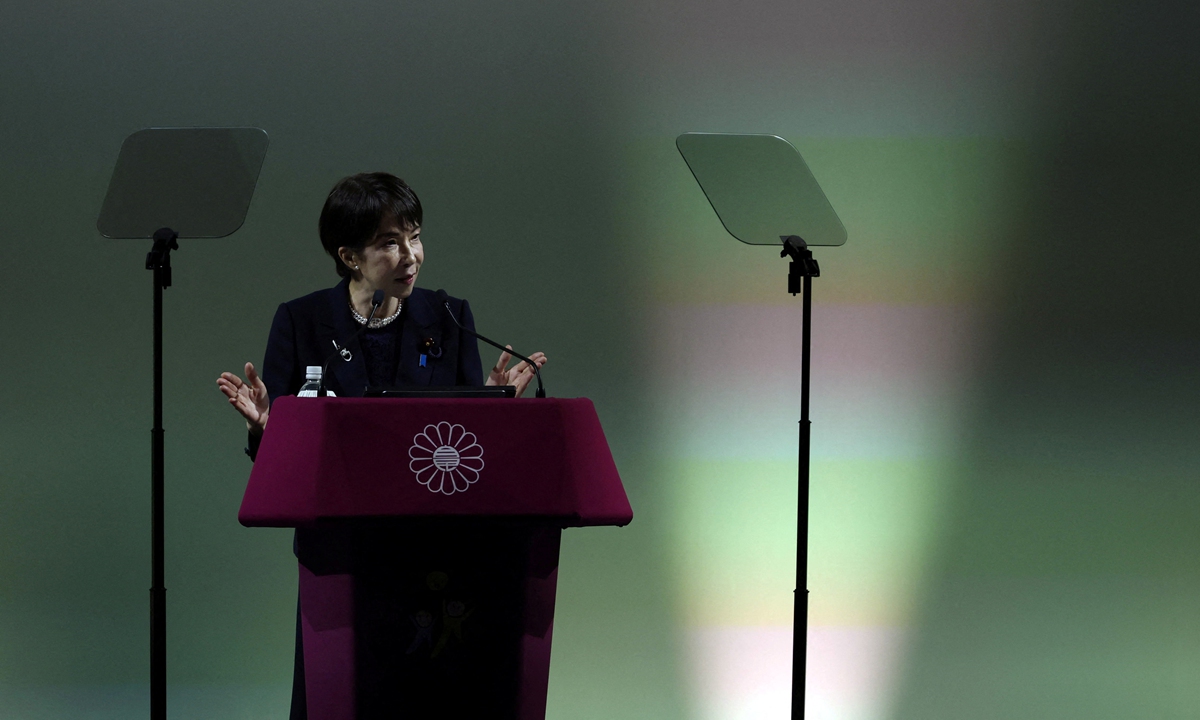
Japanese Prime Minister and President of the Liberal Democratic Party Sanae Takaichi delivers a speech at the party convention held on April 12, 2026, in Tokyo, Japan. Photo: IC
Expressing her intention on constitutional revision, Japanese Prime Minister Sanae Takaichi claimed on Sunday that "Voluntary constitutional revision crafted by the Japanese people is a core party principle. The time has come," the Asahi Shimbun reported on Sunday. A Chinese expert said the move reflects an attempt by Takaichi and Japanese right-wing forces to set a clearer timetable for amending the pacifist Constitution and loosening legal constraints on the Japan Self-Defense Forces (SDF).
Amid domestic opposition, Japan's ruling party, the LDP on Sunday adopted its 2026 policies for its political and campaign activities, including a goal to submit a draft constitutional amendment to the Diet, Japan's parliament.
Beyond claiming that the time has come, Takaichi also claimed that discussions on constitutional revision in the Diet should be accelerated, per Asahi Shimbun.
The process of constitutional revision in Japan requires approval by the Diet before being put to a national referendum. By outlining a roadmap toward initiating such proposals, the LDP aims to advance constitutional debate in parliament, Kyodo reported.
Takaichi also claimed that she hopes to make certain progress in putting forward a motion for constitutional amendment when the party congress is held next year. In addition, the congress issued the "new vision" of the LDP, claiming that constitutional amendment is more important than ever when considering future national security issues.
Takaichi has repeatedly expressed her intention for pushing constitutional revision and has voiced expectations for progress in parliamentary debates. However, her reference to a specific timeline for initiating the amendment process is considered unusual, Tokyo Shimbun reported.
Constitutional revision requires a long process in Japan, and setting up a drafting committee serves as a concrete starting point, Xiang Haoyu, a distinguished research fellow at the China Institute of International Studies, told the Global Times on Sunday.
It could propel the relevant process into its official launch phase while articulating a clear political stance, Xiang said, noting that once the committee produces a draft and submits it to the Diet, the revision process can proceed within a defined framework, providing both direction and justification.
Xiang warned that the ultimate goal behind such moves is to amend Japan's pacifist Constitution, particularly Article 9, which imposes constraints on the SDF. "Such actions carry clear risks, especially considering the potential impact of the SDF on Japan's own security posture and on regional security dynamics beyond Japan," he said, citing previous extreme incidents such as a Japan Ground SDF member breaking into the Chinese Embassy in Japan, threatening to kill diplomatic personnel on March 24.
He added that attempts to revise the pacifist Constitution are not merely a domestic issue for Japan, but also involve questions of historical recognition. "Such backtracking would raise concerns among neighboring countries over possible spillover effects on regional security," Xiang noted.
Article 9 of Japan's Constitution states that the Japanese people forever renounce war as a sovereign right of the nation and the threat or use of force as a means of settling international disputes, Xinhua reported.
The Article 9 also prescribes the renunciation of war, the prohibition of war potential, and the denial of the right of belligerency of the state, according to Japan's Ministry of Defense.
At the convention, the LDP party also unveiled a "new vision" following its 70th anniversary in 2025, stressing that "constitutional revision is a matter of vital necessity," according to Jiji Press.
Earlier, according to Tokyo Shimbun, a rally titled "Emergency Action to Protect the Peace Constitution" was held in front of the Diet on Wednesday evening. Around 30,000 participants, according to organizers' estimates, mainly young people and women, gathered via social media, holding colorful penlights and illuminated placards while calling to block constitutional revision and oppose war.
Participants chanted slogans such as "Prime Minister Takaichi, uphold the Constitution" and "Peace cannot be built through military force." They also recited the Constitution's preamble and Article 9. Coordinated demonstrations were held simultaneously at 137 locations nationwide, Tokyo Shimbun reported.
On February 4, responding to a media question regarding Takaichi's claim on a campaign trail that she wants to change the country's Constitution to explicitly recognize the SDF or the military in other words, Chinese Foreign Ministry spokesperson Lin Jian stated that during World War II, Japanese militarism inflicted untold suffering on Asia and the world. Instruments with legal effect under international law, including the Cairo Declaration, the Potsdam Proclamation and the Japanese Instrument of Surrender, stipulate Japan's international obligations as a defeated country. Fulfilling these obligations is the political and legal prerequisite for Japan to be readmitted to the international community.
The issue of Japan's attempt to revise its Constitution has received constant attention from Japan's neighbors in Asia and the rest of the world. We call on the Japanese side to deeply reflect on its history of aggression, heed the call for peace from its people, stick to the path of peaceful development, and earn the trust of its Asian neighbors and the international community through real actions, Lin said.
RELATED ARTICLES