China’s foreign trade goes off to a strong start in 2026, as Q1 trade volume exceeds 11 trillion yuan
By and Zhang Yiyi Published: Apr 14, 2026 11:36 AM

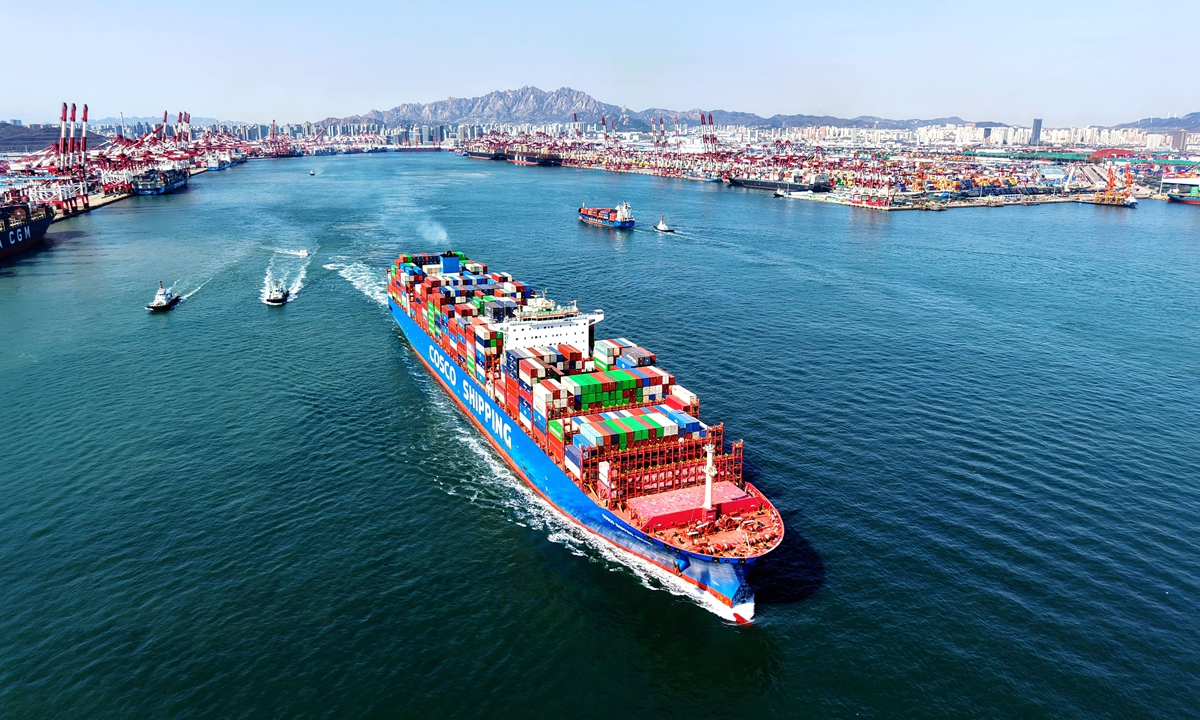
View of a container vessel near Qingdao port in East China's Shandong Province on April 7, 2026 Photo: VCG
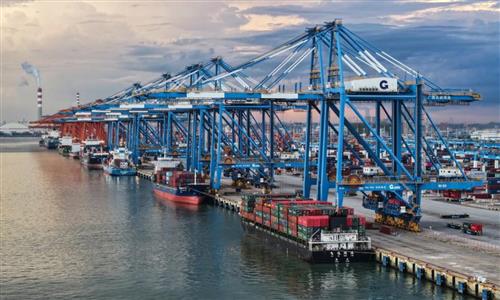
China's foreign trade got off to a robust start in the first quarter, with the value of goods trade jumping 15 percent year-on-year to 11.84 trillion yuan ($1.73 trillion). This marks the first time the country's first-quarter foreign trade has exceeded the 11 trillion yuan threshold, with the quarterly growth rate reaching a five-year high, data from the General Administration of Customs (GAC) showed on Tuesday.
Exports reached 6.85 trillion yuan in the first quarter, up 11.9 percent year-on-year. Imports totaled 4.99 trillion yuan, a record high for the period. Import growth accelerated to 19.6 percent, which was 7.7 percentage points higher than the export growth rate, customs data showed.
Observers said that the robust performance was driven by several positive factors, including the upgrade of manufacturing industries, diversification of trade partners, and China's irreplaceable role in global supply chains. Some analysts and foreign media outlets, in particular, took note of the acceleration in import growth in the first quarter, which they said reflected the deeper expansion of domestic demand and the country's concrete push for high-level opening-up.All of those factors inject impetus into China's trade engines and offer massive opportunities for the world amid increasing global uncertainties, observers said.
"China's foreign trade has gotten off to a very strong start this year," Wang Jun, a deputy head of the GAC, said at a press briefing held by the State Council Information Office on Tuesday to release the trade data. Regarding exports, Wang said that the double-digit growth could be summarized in two phrases: "There is demand from the outside world, and China has high-quality, competitively priced, stable and reliable supply."
In the first quarter, China's new export growth drivers remained strong, customs data showed. Notably, exports of green products - including electric vehicles, lithium batteries, and wind turbines and parts - surged by 77.5 percent, 50.4 percent, and 45.2 percent, respectively.
In the first quarter, China's trade with Belt and Road Initiative partner countries rose 14.2 percent year-on-year and accounted for 51.2 percent of total imports and exports. Trade with ASEAN and Latin America both increased by 15.4 percent, with Africa up 23.7 percent, the EU up 14.6 percent, the UK up 13.1 percent, and other APEC economies up 13.4 percent, the data showed.
"China's trade with most major partners logged double-digit expansion, which beat market expectations. The trend shows that China's economic cooperation with other economies as well as the integration into the global industrial chain has been consolidating and strengthening," Tian Yun, a Beijing-based economist, told the Global Times on Tuesday.
In addition to exports, some foreign media outlets have put China's import growth and trade surplus decline in the spotlight. A CNBC report said on Tuesday that China's import surge in March marked "the strongest growth since November 2021."
The expansion of domestic demand has driven import growth, according to Wang Jun, who stressed that China is not only willing to be the "world's factory," but also aspires to become the "world's market."
In the first quarter, China's imports of energy products and metal ores increased by 4.4 percent and 13.2 percent year-on-year. Imports of mechanical and electronic products were up 21.7 percent, and imports of consumer goods grew 5.4 percent.
Li Changan, a professor at the Academy of China Open Economy Studies at the University of International Business and Economics, told the Global Times on Tuesday that the acceleration in import growth was the result of China's implementation of a balanced foreign trade policy.
"China's 15th Five-Year Plan (2026-30) also creates substantial domestic demand for global commodities," Tian said, although "it can't be ruled out that some Chinese companies are front-loading their demand out of concerns about the external situation."
During the press briefing, Wang Jun warned that the external environment facing China's foreign trade remains complex and severe. "The current international situation remains turbulent and unstable, geopolitical conflicts are intensifying, international oil prices are fluctuating sharply, global demand and production are contracting, and logistics and supply chains have been disrupted," Wang Jun said.
In March, the World Trade Organization (WTO) predicted that global merchandise trade volume growth will slow by 2.7 percentage points to 1.9 percent in 2026. WTO economists warned that the ongoing conflicts in the Middle East could further reduce trade growth if energy prices remained elevated.
"While the external situation will inevitably weigh on China's foreign trade, the country has been taking multiple measures to cope, such as rolling out more policies to stabilize investment and trade. Chinese trade companies and agencies have also taken the initiative to ensure a swift, efficient and stable response to external demand," Tian said.
Wang Peng, an associate research fellow at the Beijing Academy of Social Sciences, told the Global Times on Tuesday that the robust momentum in the first quarter set the tone for full-year trade growth, and it is expected to create a buffer to cope with future external volatilities.
RELATED ARTICLES