China's foreign trade increases 3.6% in Jan-Oct; Steady rise shows resilience amid global headwinds: expert
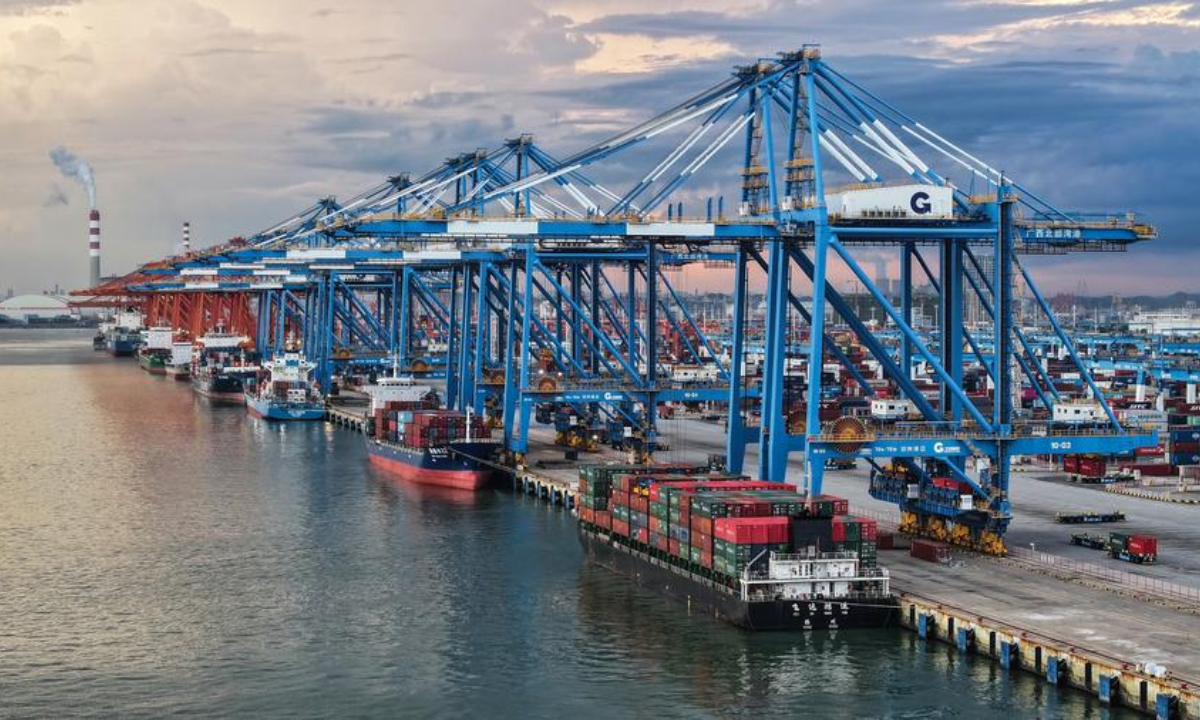
A drone photo taken on Sept. 16, 2025 shows a view of the Qinzhou Port in Qinzhou City, south China's Guangxi Zhuang Autonomous Region. (Xinhua/Zhang Ailin)
China's goods trade posted steady growth in the first 10 months of this year, rising 3.6 percent year-on-year to 37.31 trillion yuan ($5.24 trillion), a trend that shows the country's sustained resilience and vitality in a complex international environment, analysts said.
Exports grew 6.2 percent to 22.12 trillion yuan from January to October, while imports remained largely stable compared to the same period last year at 15.19 trillion yuan, according to data released by the General Administration of Customs (GAC) on Friday.
In October alone, the trade value reached 3.7 trillion yuan, up 0.1 percent year-on-year. Exports dipped slightly by 0.8 percent, while imports rose 1.4 percent, marking five consecutive months of growth.
The customs data showed growth in both general and processing trade during the first 10 months, with processing trade growing more rapidly at 6.5 percent year-on-year, while general trade, which accounts for 63.4 percent of total trade, saw a 2.3 percent increase.
"This is a hard-won achievement, especially against the backdrop of growing global trade uncertainties, persistent tariff risks, and subdued overseas demand," Li Changan, a professor with the Academy of China Open Economy Studies at the University of International Business and Economics, told the Global Times on Friday.
China's ability to navigate these challenges is rooted in strong policy support and a proactive strategy to diversify its trade partnerships and channels, Li said. "By upgrading its export structure and expanding its market reach, China is bolstering economic stability and injecting new vitality into its own growth and that of the global economy," Li added.
In the first 10 months of the year, China's trade with major regional partners demonstrated robust and steady expansion.
ASEAN retained its position as China's largest trading partner during the period, with bilateral trade growing 9.1 percent year-on-year. The second-largest partner was the European Union, with a trade increase of 4.9 percent.
Meanwhile, trade with Belt and Road partner countries, a key driver of growth, rose 5.9 percent to 19.28 trillion yuan.
However, trade with China's third-largest partner, the US, saw a sharp decline amid the US' broad tariff policies. The bilateral trade value dropped 15.9 percent from January to October, according to the GAC.
Li described the situation as a "profound shift" in global trade, where China's growing trade with emerging economies is effectively countering the downturn with the US. "This resilience stems from China's focus on liberalization and diversification, which have fortified its trade sector against external pressures like 'decoupling,'" Li noted.
China's export structure continued to be upgraded in the first 10 months. Electromechanical product exports rose 8.7 percent year-on-year to 13.43 trillion yuan and accounted for 60.7 percent of all exports, led by a 24.7 percent surge for integrated circuits and a 14.3 percent rise for automobiles, the customs data showed.
"The growing share of high-value-added products indicates that China's foreign trade structure is rapidly upgrading toward higher quality and levels, driven by continuous advances in high-end manufacturing," Li said.
China's private sector remains a driving force behind this upgrading trend, with private enterprises accounting for 57 percent of total trade during the period. Their trade volume also expanded by 7.2 percent, solidifying their role as a cornerstone in stabilizing China's foreign trade landscape.
Foreign-invested enterprises saw growth of 2.9 percent in trade volume and accounted for 29.3 percent of total foreign trade, per customs data.
The resilience of China's foreign trade has also been supported by the robust performance of its manufacturing hubs, with multiple industrial centers reporting strong import and export figures for the first three quarters.
China's economy boasts solid foundations, numerous advantages, strong resilience, and immense potential, with its long-term positive supporting conditions and fundamental trends remaining unchanged, while the advantages of its massive market scale and complete industrial system stand out prominently, Wang Jun, deputy director of the GAC, said in October.
"These factors ensure that imports and exports maintain resilience and vitality, providing strong backing for stable foreign trade development in the coming period," Wang said, adding that there will be further trade facilitation, enhanced service levels, and support for high-level opening-up.
Chinese lawmakers in September reviewed a draft revision to the Foreign Trade Law, which incorporates a series of reform measures into national legislation, the Xinhua News Agency reported.
The draft revision seeks to elevate multiple reform measures to national law, including a negative list system for managing cross-border trade in services, as well as reform measures for promoting new forms and models of foreign trade, encouraging digital trade and establishing a green trade system.
RELATED ARTICLES