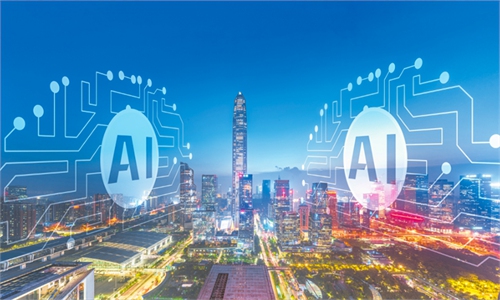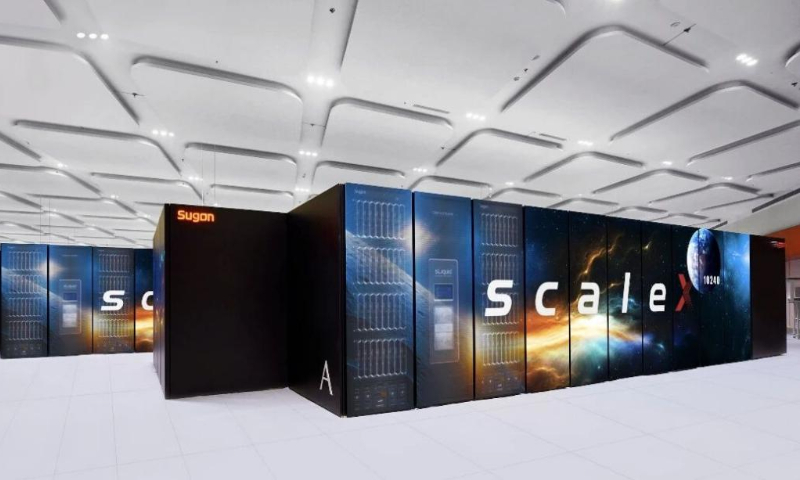
China's largest scientific AI computing cluster is officially put into operation on April 14, 2026 in Zhengzhou, Central China's Henan Province. Photo: CCTV News
China's largest scientific artificial intelligence (AI) computing cluster went live on Tuesday at the National Supercomputing Internet's core node in Zhengzhou, Central China's Henan Province, China Media Group (CMG) reported.
The deployment marks a major breakthrough in China's AI-powered research computing infrastructure and is expected to support the country's push to secure a leading position in industrial AI applications, according to CMG.
On February 5, the core node of the National Supercomputing Internet began trial operations, initially opening a supercomputing cluster powered by more than 30,000 domestically developed AI accelerator chips to provide large-scale AI computing capacity.
On Tuesday, the number of AI accelerator chips was increased to 60,000, transforming the supercomputing internet home to the country's largest scientific AI computing infrastructure and launching the "super scientific computing agent" strategy, CMG reported.
The cluster, powered by 60,000 domestically developed AI accelerator chips, is now the country's largest scientific AI computing infrastructure, said Chen Jing, a vice president of the Technology and Strategy Research Institute. Chen told the Global Times on Tuesday that built entirely on domestic AI chips, it marks a breakthrough in China's ability to deploy homegrown computing clusters at scale.
"It is already large enough to rank among the world's top computing clusters, on par in scale with those operated by international tech giants such as Meta and Google," Chen said. More importantly, all 60,000 chips were domestically developed rather than based on Nvidia's ecosystem.
Chen said that the project represents a key breakthrough in the large-scale commercial deployment of domestic AI chips and reflects progress in China's drive for greater self-reliance in chip development.
The core node has built an integrated domestic ecosystem covering data, computing, models and applications, bringing together diverse datasets and tools as well as more than 1,000 open-source large-language models to enable rapid deployment and development, the CMG report said.
"In addition, the cluster has brought about a disruptive shift in how users interact with computing resources," Chen said.
On the supercomputing internet platform, users no longer need to deal with software configuration or complex IT procedures, CMG reported. Instead, they can simply state their needs in natural language, and the "super scientific computing agent" can automatically break down tasks, call models, allocate computing resources and deliver end-to-end results, significantly shortening the time needed to complete research tasks.
"The cluster is designed primarily to support scientific research, while also serving the commercial development of the AI industry. In this sense, the infrastructure is driven by both research and commercial applications, though its main focus is AI for science," Chen said.
China is accelerating the development of intelligent computing infrastructure as part of broader efforts to support the growth of AI.
The Ministry of Industry and Information Technology said on Friday that it will support national high-tech zones in speeding up the deployment of intelligent computing facilities and high-quality datasets.
The move is aimed at comprehensively enhancing the development level of the AI industry in national high-tech zones, accelerating the formation of new forms of the intelligent economy, and enabling high-tech zones to contribute more to the country's AI development, a spokesperson for the ministry said at a press conference.
The nation's 2026 Government Work Report, for the first time, included "coordination between computing and power" and called for the implementation of new infrastructure projects such as ultra-large intelligent computing clusters and coordinated computing-power development, according to another report by CMG.
China's Outline of the 15th Five-Year Plan (2026-30) sets out an ambitious road map to advance the Digital China initiative and raise the level of digital and intelligent development. It calls for coordinated progress in computing infrastructure, model and algorithm development, and the supply of high-quality data resources, in order to build a stronger foundation for digital and intelligent development.
RELATED ARTICLES