ARTS / CULTURE & LEISURE
Structural health monitoring system deployed at ancient Hanging Temple
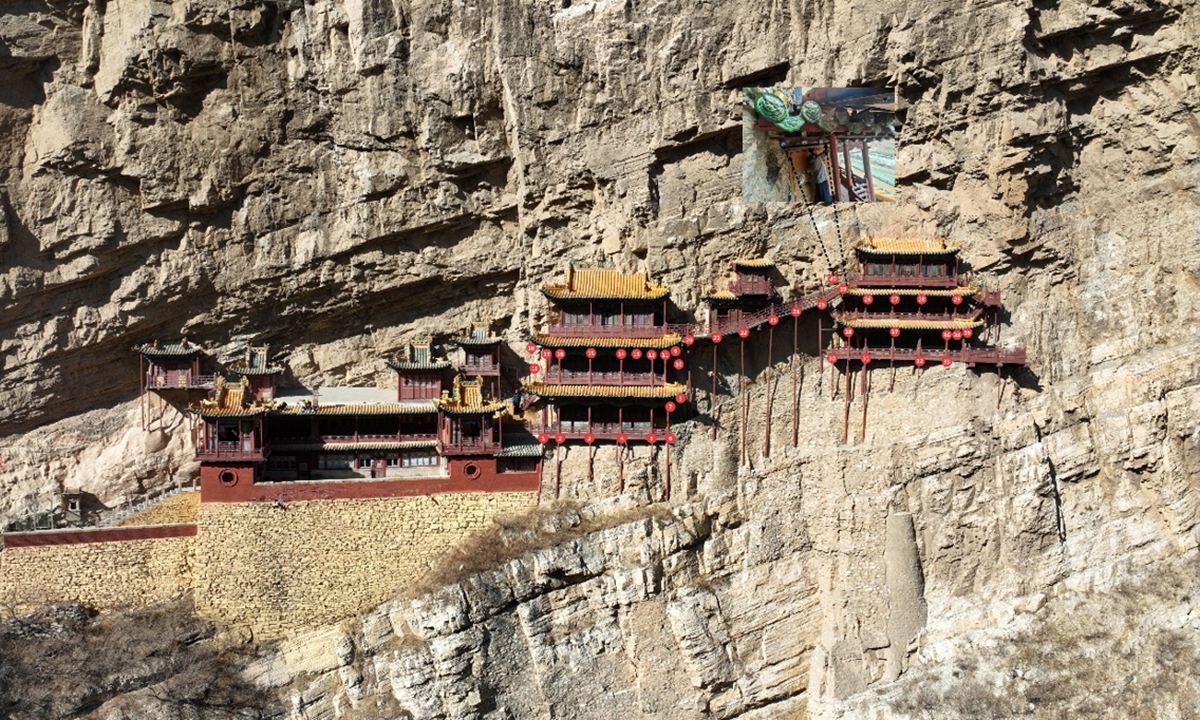
Red markers indicate vibration sensors installed in the Hanging Temple for monitoring structural vibrations. Photo: Courtesy of the Shanxi Earthquake Agency
An optical fiber monitoring system has been installed at the thousand-year-old Hanging Temple in North China's Shanxi Province to track structural vibrations and assess risks from environmental and human activity, according to the Shanxi Earthquake Agency.Installed in late March, the project uses distributed optical fiber sensors placed at 40 key points across the temple's beams, columns and narrow walkways, providing continuous data on how the structure responds to natural forces, human-induced load and nearby industrial activity.
Built over 1,500 years ago, the Hanging Temple, or Xuankong Temple, is notable for its location on a sheer precipice. The structure is held in place with wooden beams inserted into holes chiseled into the cliffs, with the main supporting structure hidden inside the bedrock. Situated in a deep valley, the temple hangs from the side of a cliff beneath a prominent peak, which helps protect it from erosion and sunlight.
Despite its resilience, the temple now faces mounting challenges. Increased visitor traffic, particularly during peak tourism seasons, has led to higher levels of vibration that could affect structural stability, according to the agency. Natural weathering, rainfall and geological processes in the surrounding areas also raise the risk of rockfalls and landslides, posing dangers to both the site and visitors.
After centuries of bearing heavy weight and bracing against strong winds, the structure's wooden components have shown signs of material degradation and structural deformation. The temple is located in a region with an active tectonic setting that has experienced strong earthquakes in the past and remains at risk of potential damage from future seismic activity.
"The system is designed to monitor ambient human-induced vibrations and nearby construction activity," Zeng Jinyan, a professor and head of an innovation team focused on seismic protection of cultural heritage at the agency, told the Global Times on Tuesday. "The results will help determine the maximum safe visitor capacity and provide a scientific basis for preventive conservation."
The monitoring network combines distributed optical fiber technology with seismic instruments to capture vibrations. Sensors placed along pedestrian walkways are spaced roughly 2 to 5 meters apart, while those inside the main structure are installed at critical load-bearing points, including primary and cantilever beams.
Unlike traditional monitoring equipment, the optical fiber sensors are non-invasive and require no active power supply, minimizing impact on the ancient wooden structure. Their high sensitivity allows researchers to detect subtle changes in vibration patterns and structural behavior over time, and analyze changing patterns of structural responses, according to Zeng.
Data collected by the system is transmitted to a centralized monitoring and evaluation platform, which enables three-dimensional visualization of the temple's structural condition and real-time assessment of its status.
"Monitoring vibrations and assessing seismic risks at the Hanging Temple will provide real-world case studies for the preservation of historic architecture. By analyzing the data, we can gain deeper insight into how ancient structures respond to ambient excitations and seismic events, and explore how modern technologies can be applied to retrofit and preserve them," noted Zeng. "The findings are expected to offer a scientific basis and technical support for the conservation of similar heritage sites."
From a seismological perspective, the Hanging Temple has withstood multiple earthquakes over the centuries, remaining remarkably intact. Its distinctive design reflects "an early understanding of seismic forces and sophisticated approaches to earthquake-resistant construction."
Studying how ancient architecture responds to vibrations could also help reveal the structural resilience mechanisms of ancient buildings, offering new insights and inspiration for modern earthquake-resistant designs and advancing research in both seismology and engineering, added Zeng.
RELATED ARTICLES