ARTS / CULTURE & LEISURE
Baer’s pochard reintroduction signals new phase in conservation
Decade in the making
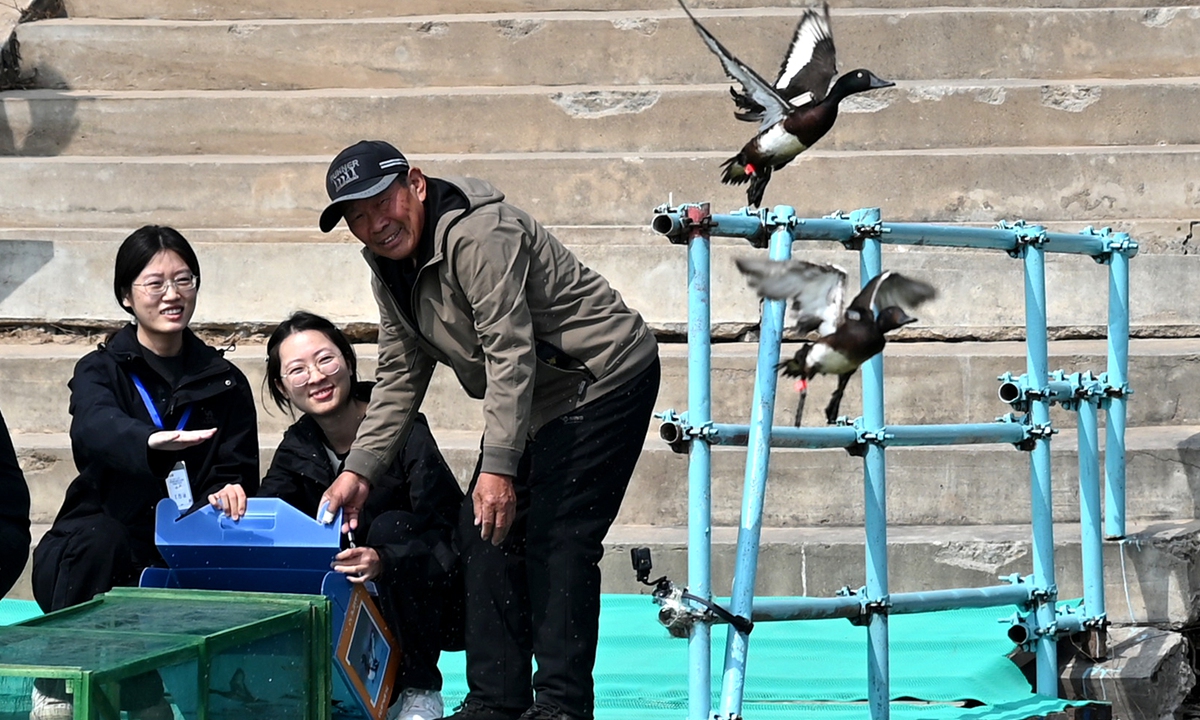
Volunteers release Baer's pochards at the Hengshui Lake in North China's Hebei Province on April 2, 2026. Photo: Courtesy of Ding Changqing
On a causeway at the Hengshui Lake National Nature Reserve in North China's Hebei Province, 12 critically endangered Baer's pochards hesitated briefly at the edge of the enclosure, then beat their wings and plunged into the reed marsh under the watchful eyes of researchers who had waited this moment for 10 years.This recent release in April marked the world's first reintroduction of captive-raised Baer's pochards into the wild, offering a "Chinese solution" for the conservation of globally endangered bird species.
The release marked a new beginning for the conservation of the endangered diving ducks, said Ding Changqing, head of the National Baer's Pochard Conservation Working Group and a professor with the School of Ecology and Nature Conservation at Beijing Forestry University (BFU).
"In 10 years, we accomplished the world's first successful transition of Baer's pochard from artificial breeding to natural reproduction, and from ex-situ conservation to reintroduction into the wild. We look forward to promoting the model nationwide and even globally in the future," Ding told the Global Times.
Listed as a critically endangered species on the International Union for Conservation of Nature (IUCN) Red List and under China's first-class national protection, Baer's pochard has suffered a sharp global population decline since the 1980s due to habitat loss and hunting.
China now hosts the majority of the remaining population, according to a report published by BFU on its official website.
Thanks to joint efforts in protecting the rare species, the population of the diving ducks in China has increased from 1,000 in 2012 to 2,555 as of 2025.
A new chapter
Of the 12 Baer's pochards released, six were fitted with satellite trackers to record their locations and behavioral patterns.
As these individuals migrate with wild populations, researchers hope to identify the species' historical breeding sites in Northeast China and Russia, providing crucial evidence for more targeted conservation efforts.
Ding noted that updating the trackers and helping the ducks adapt to wearing them required several rounds of trials.
At the beginning, he said, some ducks became withdrawn after being fitted with the devices and were even reluctant to enter the water.
"It's a bit like a person carrying a small backpack," he explained, adding that the team was also worried the equipment might catch the birds accidentally in aquatic vegetation.
Through repeated training and adjustments, the ducks gradually adapted to the devices, Ding said, noting that the researchers had worked to minimize any impact on the birds as much as possible.
"The trackers will record the Baer's pochards' migration routes and breeding sites," he said, adding that the team is eager to analyze the data.
According to Ding, the information could help scientists fundamentally improve the species' endangered status and potentially open a new chapter in the conservation of wild birds.
Terry Townshend, a British expert with the Baer's pochard task force under the East Asian-Australasian Flyway Partnership, said after the release that he is "looking forward to tracking the migration routes of the Baer's pochards fitted with trackers. Their journeys will provide people with invaluable insights."
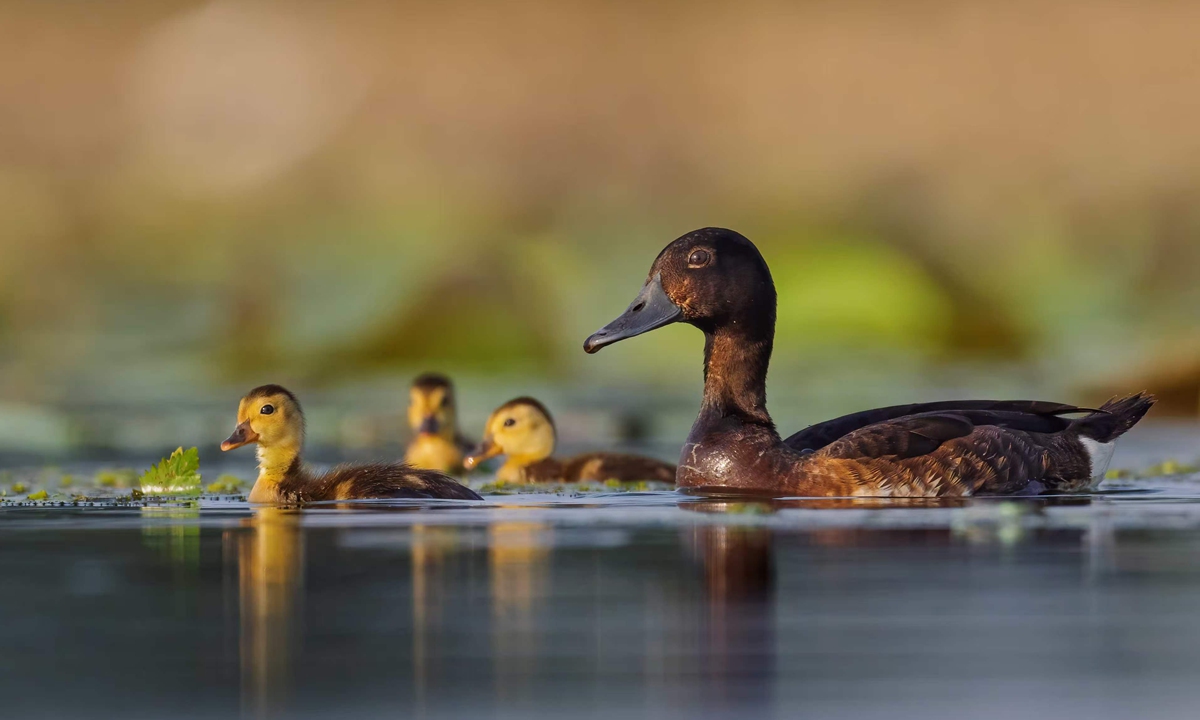
Baer's pochards Photo: Courtesy of Zhou Xingwu
Replicable modelThe conservation efforts began in 2016 with 10 eggs. Ding recalled that the biggest challenge was the sheer rarity of the duck and the urgency in building a captive population.
"We had to start from scratch to understand the Baer's pochard's habits, including its nesting behavior, breeding environment, and the temperature required for incubating its eggs," said the professor.
Finding even a single egg in the wild is extremely difficult; one might spend an entire day wading in the water in chest waders and still come up empty-handed, all while facing the risk of slipping and drowning, he said.
In collaboration with the Beijing Zoo, a captive population of 54 was established in 2019.
"Baer's pochards raised under human care often lack proper breeding behaviors. In some cases, females may even kill their chicks out of stress after hatching. This prompted us to move to the next stage, conducting natural breeding and rewilding training at Hengshui lake," said Ding.
Located on the East Asian-Australasian migratory bird flyway, the Hengshui Lake National Nature Reserve is one of the few intact wetland ecosystems left on the North China Plain. The Baer's pochard population at the lake was first discovered by research teams back in 2000.
Through systematic restoration and protection measures in recent years, it has become a critical stopover, wintering and breeding site for numerous birds.
In 2025, the BFU research team successfully established a naturally breeding population of 23 individuals and completed rewilding training in 10 months.
Rewilding training helps Baer's pochards develop the ability to forage independently in the wild and to avoid predators, Ding said.
Commenting on the rewilding and release of the Baer's pochards, Wan Ziming, deputy director of the Department of Wildlife Conservation of the National Forestry and Grassland Administration, said it was another successful case in China's conservation of endangered species, following the crested ibis and the Milu deer, also known as Pere David's deer.
Establishing the world's first successful model of Baer's pochard protection from artificial breeding, natural reproduction to reintroduction into the wild in just 10 years is a milestone.
"We intend to optimize the model and promote it for the conservation of other endangered birds," Ding said.
RELATED ARTICLES