IN-DEPTH / IN-DEPTH
Local Insights: At the 13th Baku Global Forum, global participants look to China for new path of multilateralism and stability
Hope Amid Disorder
Editor's Note:
In an era of profound global shifts and increasingly complex regional dynamics, a proper understanding of the world must be rooted in "grounded experience" and localized insights. Global Times English edition, in collaboration with the Academy of International and Regional Communication Studies, Communication University of China, is proud to launch "Local Insights," an English-language column dedicated to original, field-based observations.
We invite Chinese scholars and professionals who are studying, conducting exchanges, or working outside China, as well as international students and friends living and studying in China who are familiar with the social contexts of their home countries or third countries, to begin from first-hand field experience and engage with social, cultural, and contemporary issues beyond China. As the first article in the column, a Chinese think tank scholar shares her experience at the Baku Global Forum, highlighting the international community's longing for multilateralism and expectations for China's participation in global governance.
Before I left for Baku, Azerbaijan, I was not sure what kind of conference I was heading into.
Having worked in Track II diplomacy through the Center for China and Globalization (CCG) for several years, I have attended many international forums. Usually, even before departure, one can sense the likely mood of a meeting: who will come, what the tone will be, and whether the gathering will produce anything meaningful. This time, however, everything felt different.
The 13th Baku Global Forum, held from March 11 to 14, under the theme "Bridging Divides in a Transforming World," was taking place at an unusually dangerous moment. The escalating conflict involving the US, Israel and Iran had pushed regional tensions to a new level. Baku, in the South Caucasus, lies close to several geopolitical fault lines. Russia-Ukraine conflict still casts its shadow across the wider region, while tensions surrounding Iran and the Middle East were intensifying. As the forum was approaching, the question was no longer simply whether it would matter, but whether people would even go.
Many around us were pessimistic. At one point, I was too. Under normal circumstances, a gathering of current and former presidents, prime ministers, ministers, senior United Nations officials and leading think tank figures would attract strong attendance. But these were not normal times. Just one week before the forum opened, on March 5 local time, the Azerbaijani Foreign Ministry strongly condemned drone attacks on its Nakhchivan Autonomous Republic launched from Iranian territory. War was no longer a distant headline. It had moved closer - geographically, psychologically and politically. That changed the meaning of the trip, and it changed the meaning of the forum itself.
Arrival: A half-war city, and a forum fuller than expected
When I arrived in Baku, what struck me first was not panic, but tension held just beneath the surface.
Airports often tell the emotional truth of a place better than conference halls do. In the pauses between security checks, in the extra vigilance of personnel and in the expressions of travelers trying to read the room, one senses how a city understands its own moment. Baku did not feel chaotic. It felt alert.
The city was functioning normally on the surface. Traffic moved. Delegations arrived. Hotels operated efficiently. Conference staff prepared badges, schedules and plenary logistics. Yet beneath all of that routine was an unmistakable awareness that the region was living through an exceptionally dangerous moment. That was when the phrase that stayed with me throughout the trip first took shape in my mind: Baku was a "half-war city." It was not a battlefield, but it was no longer fully insulated from war either.
What surprised me most was not the tension. It was the turnout.
Before arriving in Baku, many of us had quietly assumed attendance might be thin. Who would willingly travel to a region overshadowed by war, instability and the risk of escalation? Yet, when I walked into the forum, what I found was not hesitation but presence.
Held under the patronage of Azerbaijani President Ilham Aliyev, the forum drew an extraordinary concentration of political weight. Nearly 200 current and former political leaders, senior officials, diplomats, scholars and policy figures had gathered. Among them were President José Ramos-Horta of Timor-Leste, Željka Cvijanovi, member of the Presidency of Bosnia and Herzegovina, and Francisco Gamboa, vice president-elect of Costa Rica, along with former heads of state, heads of government, foreign ministers and prominent think tank leaders from around the world.
Their presence said something before any formal remarks were made. People had come because the crisis was serious. They had come because the danger felt real. They had come because when the possibility of broader war begins to appear plausible, dialogue takes on a different urgency.
Looking around the room, I realized that what had brought so many people to Baku was not optimism in any easy sense. It was anxiety - deep, accumulated anxiety that the world was moving toward something darker and harder to reverse. The usual vocabulary of "friction," "competition," and "differences" seemed too soft for what many were feeling. People were thinking in harsher terms: escalation, fragmentation, breakdown, systemic disorder, even the possibility of a wider war that no one truly wanted but many feared could happen.
In the corridors: Diplomacy speaks more plainly
What I remember most is not a single speech, but the shift in people's manner.
In more stable times, international conferences often follow a familiar script. Public remarks are polished. Private conversations remain careful. Criticism is wrapped in formal language. At Baku, much of that softening language seemed to fall away.
Whether in plenary sessions or side conversations, delegates spoke with unusual directness. Their words were still diplomatic, but less ornamental, less buffered and less scripted. Time and time again, I heard variations of the same concern: the world was approaching a dangerous crossroads; the current trajectory was unsustainable; great-power rivalry was spilling outward into multiple regions; sanctions, coercion, bloc confrontation and unilateral pressure were pushing the international system toward a deeper crisis of order.
What struck me was not only that people were worried. It was that their worries converged. I did not hear support for unilateral bullying. I did not hear anyone openly defend confrontation for its own sake. I did not see enthusiasm for a world divided into hardened camps. Across countries and political backgrounds, I sensed a broad resistance to further escalation. Many participants did not agree on every issue, of course. But they seemed increasingly united in one conclusion: this path is too dangerous; this level of disorder cannot continue; the world must somehow be pulled back toward rationality.
One of the clearest expressions of this mood was the unusually strong presence of senior figures from the United Nations system and major multilateral institutions. Among those present were senior UN figures including Dr Tedros Adhanom Ghebreyesus, Rebeca Grynspan, Tatiana Valovaya and Anacláudia Rossbach, alongside several former presidents of the United Nations General Assembly and other distinguished former UN officials.
This concentration of UN representation was not accidental. It reflected something deeper: at a time of widening disorder, the demand for genuine multilateralism had become more urgent, not less. In my own conversations with senior international organization figures, I sensed a repeated theme. No one spoke as if the United Nations were flawless. On the contrary, people acknowledged its weaknesses and constraints. But those critiques did not weaken the case for multilateralism. They strengthened it. Because in the minds of many participants, the alternative to an imperfect multilateral system was not a better one. It was a more dangerous one.
A session that revealed a shift: 'China and the Global Governance Initiative'
Among all the discussions at the forum, one of the most revealing for me was the special session on "China and the Global Governance Initiative." For the first time, China's Global Governance Initiative was directly elevated as a core thematic session of the main forum.
The session featured Wu Hongbo, former Special Representative of the Chinese Government on European Affairs; was chaired by Mladen Ivani, former Chairman of the Presidency of Bosnia and Herzegovina; and included Mikayil Jabbarov, Azerbaijan's Minister of Economy, Romano Prodi, former prime minister of Italy and former president of the European Commission, and Borut Pahor, former president of Slovenia.
What I felt in that room was different from the tone that often surrounded China-related discussions in earlier years. In the past, many international conversations about China carried an undertone of suspicion or defensiveness. In Baku, the tone was more open, more substantive and in many cases more respectful than I had expected.
What I sensed was not universal agreement, but expectation. Against a backdrop in which Russia remains deeply enmeshed in the Ukraine conflict and the US is associated in many minds with sanctions, pressure campaigns and ideological confrontation, China is increasingly seen by many as a major country that has consistently emphasized peace, development, sovereignty and dialogue. That does not mean all concerns about China have disappeared. It does mean that more people are listening carefully when China speaks.
The thematic session "Leadership in Times of Strategic Uncertainty," chaired by Eka Tkeshelashvili and featuring Petre Roman, Valdis Zatlers and senior executives from the Atlantic Council, also fed into a broader discussion on China. Many participants were not looking for abstract rhetoric, but for clarity about where the world is heading and what role China may play in a time of deep uncertainty. There was noticeable interest in China's recently concluded "two sessions" and the 15th Five-Year Plan. For many outside China, especially those living in political systems marked by polarization and strategic inconsistency, China's capacity for medium-term planning and its ability to formulate medium-term national development plans carries real significance.
In the end, the consensus I witnessed in Baku was not naive, nor was it based on the illusion that global disorder can be quickly reversed. It was something narrower, but perhaps more important: a growing recognition that the world cannot afford to continue along the current path of unilateral coercion, bloc confrontation and unrestrained geopolitical escalation.
As I left Baku, what stayed with me most was not only the gravity of the crisis, but the clarity it had produced. Baku felt like one of those moments in international politics when instability becomes so acute that the usual diplomatic illusions fall away. On the edge of disorder, people spoke more plainly. Faced with the possibility of wider war, they seemed to understand more sharply the value of restraint.
That is why I left Baku with a paradoxical impression. I had gone to a city overshadowed by war, expecting hesitation and perhaps even emptiness. Instead, I found urgency, attendance, candor and a fragile but unmistakable convergence around peace.
On the edge of disorder, I did not see resignation. I saw the beginnings of a new multilateral instinct.
Mabel Lu Miao is the Co-founder and Secretary-General, Center for China and Globalization (CCG)
In an era of profound global shifts and increasingly complex regional dynamics, a proper understanding of the world must be rooted in "grounded experience" and localized insights. Global Times English edition, in collaboration with the Academy of International and Regional Communication Studies, Communication University of China, is proud to launch "Local Insights," an English-language column dedicated to original, field-based observations.
We invite Chinese scholars and professionals who are studying, conducting exchanges, or working outside China, as well as international students and friends living and studying in China who are familiar with the social contexts of their home countries or third countries, to begin from first-hand field experience and engage with social, cultural, and contemporary issues beyond China. As the first article in the column, a Chinese think tank scholar shares her experience at the Baku Global Forum, highlighting the international community's longing for multilateralism and expectations for China's participation in global governance.
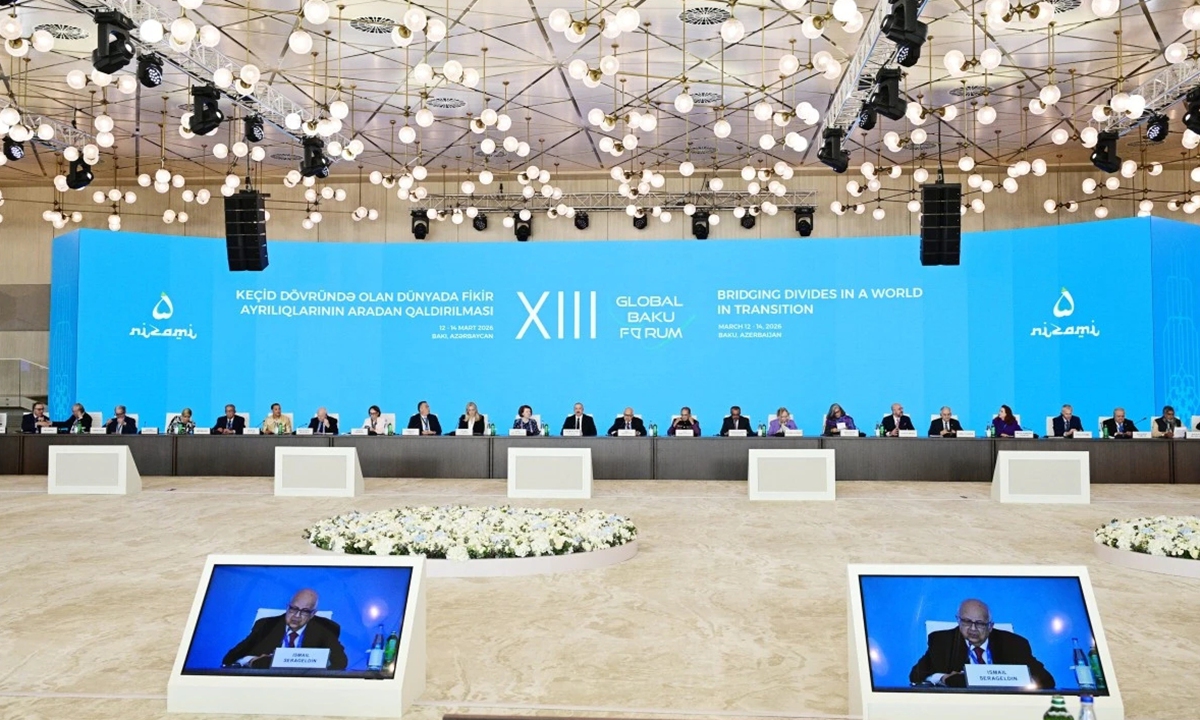
The 13th Baku Global Forum held in Baku, Azerbaijan, from March 11 to 14, 2026 Photo: Courtesy of Miao
Before I left for Baku, Azerbaijan, I was not sure what kind of conference I was heading into.
Having worked in Track II diplomacy through the Center for China and Globalization (CCG) for several years, I have attended many international forums. Usually, even before departure, one can sense the likely mood of a meeting: who will come, what the tone will be, and whether the gathering will produce anything meaningful. This time, however, everything felt different.
The 13th Baku Global Forum, held from March 11 to 14, under the theme "Bridging Divides in a Transforming World," was taking place at an unusually dangerous moment. The escalating conflict involving the US, Israel and Iran had pushed regional tensions to a new level. Baku, in the South Caucasus, lies close to several geopolitical fault lines. Russia-Ukraine conflict still casts its shadow across the wider region, while tensions surrounding Iran and the Middle East were intensifying. As the forum was approaching, the question was no longer simply whether it would matter, but whether people would even go.
Many around us were pessimistic. At one point, I was too. Under normal circumstances, a gathering of current and former presidents, prime ministers, ministers, senior United Nations officials and leading think tank figures would attract strong attendance. But these were not normal times. Just one week before the forum opened, on March 5 local time, the Azerbaijani Foreign Ministry strongly condemned drone attacks on its Nakhchivan Autonomous Republic launched from Iranian territory. War was no longer a distant headline. It had moved closer - geographically, psychologically and politically. That changed the meaning of the trip, and it changed the meaning of the forum itself.
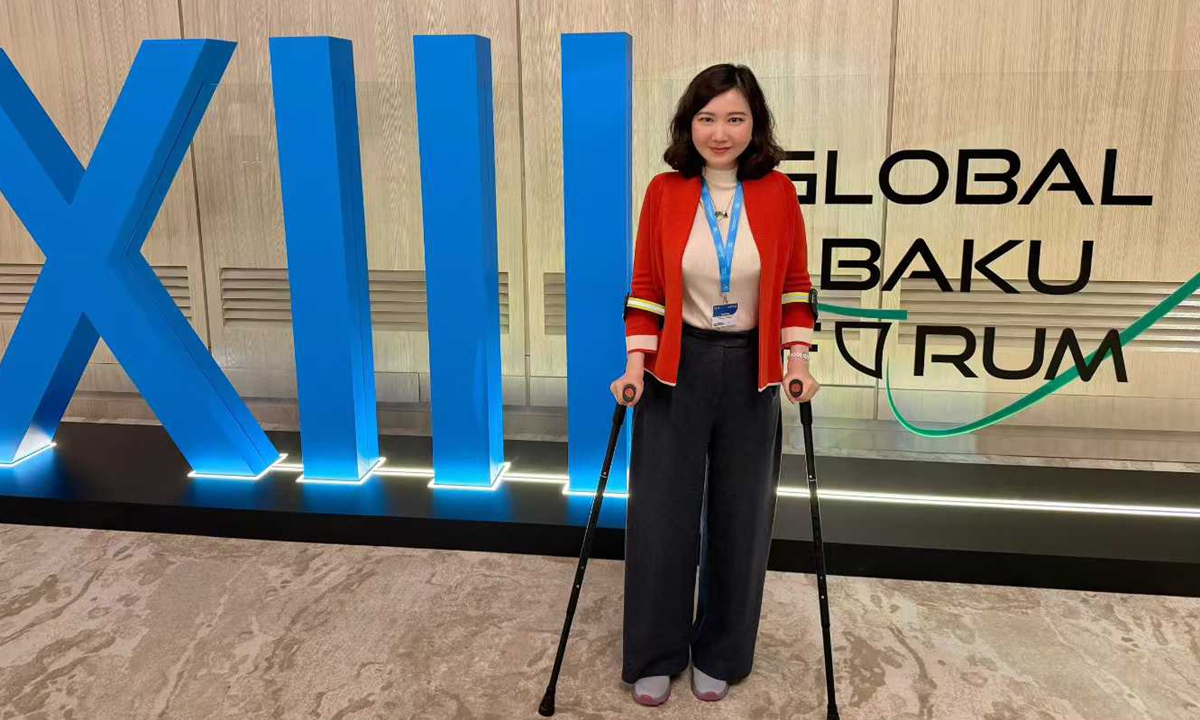
Mabel Miao Lu at the Baku Global Forum Photo: Courtesy of Miao
Arrival: A half-war city, and a forum fuller than expected
When I arrived in Baku, what struck me first was not panic, but tension held just beneath the surface.
Airports often tell the emotional truth of a place better than conference halls do. In the pauses between security checks, in the extra vigilance of personnel and in the expressions of travelers trying to read the room, one senses how a city understands its own moment. Baku did not feel chaotic. It felt alert.
The city was functioning normally on the surface. Traffic moved. Delegations arrived. Hotels operated efficiently. Conference staff prepared badges, schedules and plenary logistics. Yet beneath all of that routine was an unmistakable awareness that the region was living through an exceptionally dangerous moment. That was when the phrase that stayed with me throughout the trip first took shape in my mind: Baku was a "half-war city." It was not a battlefield, but it was no longer fully insulated from war either.
What surprised me most was not the tension. It was the turnout.
Before arriving in Baku, many of us had quietly assumed attendance might be thin. Who would willingly travel to a region overshadowed by war, instability and the risk of escalation? Yet, when I walked into the forum, what I found was not hesitation but presence.
Held under the patronage of Azerbaijani President Ilham Aliyev, the forum drew an extraordinary concentration of political weight. Nearly 200 current and former political leaders, senior officials, diplomats, scholars and policy figures had gathered. Among them were President José Ramos-Horta of Timor-Leste, Željka Cvijanovi, member of the Presidency of Bosnia and Herzegovina, and Francisco Gamboa, vice president-elect of Costa Rica, along with former heads of state, heads of government, foreign ministers and prominent think tank leaders from around the world.
Their presence said something before any formal remarks were made. People had come because the crisis was serious. They had come because the danger felt real. They had come because when the possibility of broader war begins to appear plausible, dialogue takes on a different urgency.
Looking around the room, I realized that what had brought so many people to Baku was not optimism in any easy sense. It was anxiety - deep, accumulated anxiety that the world was moving toward something darker and harder to reverse. The usual vocabulary of "friction," "competition," and "differences" seemed too soft for what many were feeling. People were thinking in harsher terms: escalation, fragmentation, breakdown, systemic disorder, even the possibility of a wider war that no one truly wanted but many feared could happen.
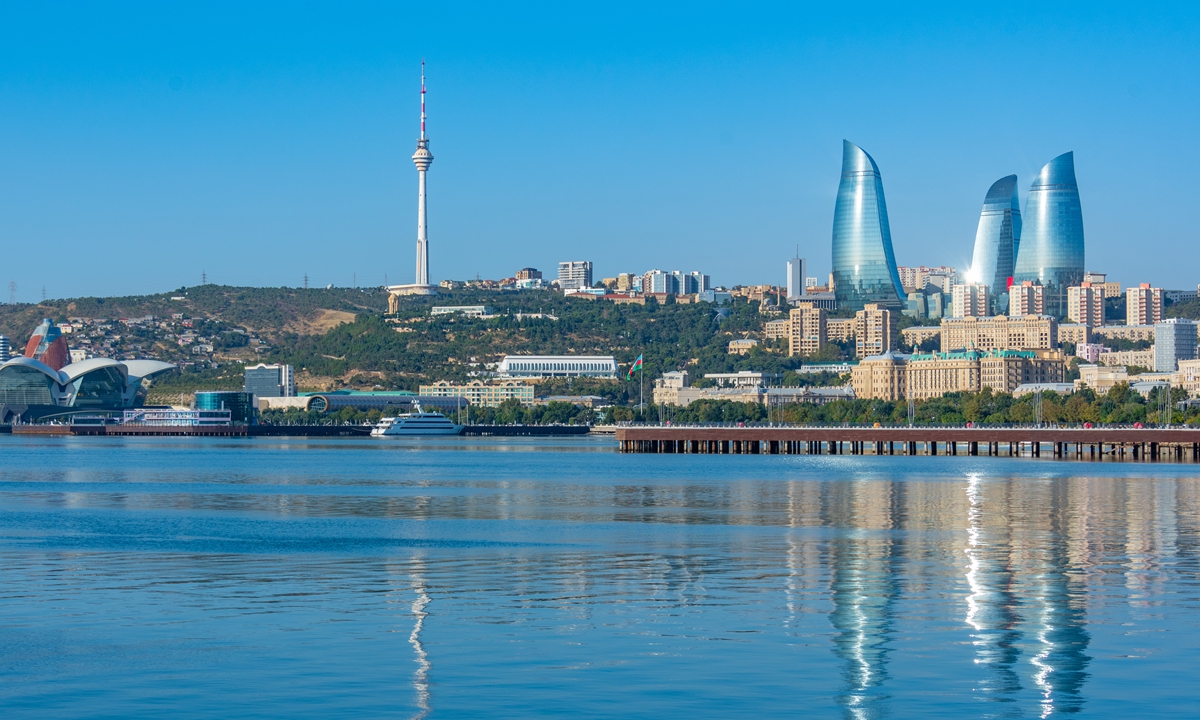
An aerial view of Baku, Azerbaijan Photo: IC
In the corridors: Diplomacy speaks more plainly
What I remember most is not a single speech, but the shift in people's manner.
In more stable times, international conferences often follow a familiar script. Public remarks are polished. Private conversations remain careful. Criticism is wrapped in formal language. At Baku, much of that softening language seemed to fall away.
Whether in plenary sessions or side conversations, delegates spoke with unusual directness. Their words were still diplomatic, but less ornamental, less buffered and less scripted. Time and time again, I heard variations of the same concern: the world was approaching a dangerous crossroads; the current trajectory was unsustainable; great-power rivalry was spilling outward into multiple regions; sanctions, coercion, bloc confrontation and unilateral pressure were pushing the international system toward a deeper crisis of order.
What struck me was not only that people were worried. It was that their worries converged. I did not hear support for unilateral bullying. I did not hear anyone openly defend confrontation for its own sake. I did not see enthusiasm for a world divided into hardened camps. Across countries and political backgrounds, I sensed a broad resistance to further escalation. Many participants did not agree on every issue, of course. But they seemed increasingly united in one conclusion: this path is too dangerous; this level of disorder cannot continue; the world must somehow be pulled back toward rationality.
One of the clearest expressions of this mood was the unusually strong presence of senior figures from the United Nations system and major multilateral institutions. Among those present were senior UN figures including Dr Tedros Adhanom Ghebreyesus, Rebeca Grynspan, Tatiana Valovaya and Anacláudia Rossbach, alongside several former presidents of the United Nations General Assembly and other distinguished former UN officials.
This concentration of UN representation was not accidental. It reflected something deeper: at a time of widening disorder, the demand for genuine multilateralism had become more urgent, not less. In my own conversations with senior international organization figures, I sensed a repeated theme. No one spoke as if the United Nations were flawless. On the contrary, people acknowledged its weaknesses and constraints. But those critiques did not weaken the case for multilateralism. They strengthened it. Because in the minds of many participants, the alternative to an imperfect multilateral system was not a better one. It was a more dangerous one.
A session that revealed a shift: 'China and the Global Governance Initiative'
Among all the discussions at the forum, one of the most revealing for me was the special session on "China and the Global Governance Initiative." For the first time, China's Global Governance Initiative was directly elevated as a core thematic session of the main forum.
The session featured Wu Hongbo, former Special Representative of the Chinese Government on European Affairs; was chaired by Mladen Ivani, former Chairman of the Presidency of Bosnia and Herzegovina; and included Mikayil Jabbarov, Azerbaijan's Minister of Economy, Romano Prodi, former prime minister of Italy and former president of the European Commission, and Borut Pahor, former president of Slovenia.
What I felt in that room was different from the tone that often surrounded China-related discussions in earlier years. In the past, many international conversations about China carried an undertone of suspicion or defensiveness. In Baku, the tone was more open, more substantive and in many cases more respectful than I had expected.
What I sensed was not universal agreement, but expectation. Against a backdrop in which Russia remains deeply enmeshed in the Ukraine conflict and the US is associated in many minds with sanctions, pressure campaigns and ideological confrontation, China is increasingly seen by many as a major country that has consistently emphasized peace, development, sovereignty and dialogue. That does not mean all concerns about China have disappeared. It does mean that more people are listening carefully when China speaks.
The thematic session "Leadership in Times of Strategic Uncertainty," chaired by Eka Tkeshelashvili and featuring Petre Roman, Valdis Zatlers and senior executives from the Atlantic Council, also fed into a broader discussion on China. Many participants were not looking for abstract rhetoric, but for clarity about where the world is heading and what role China may play in a time of deep uncertainty. There was noticeable interest in China's recently concluded "two sessions" and the 15th Five-Year Plan. For many outside China, especially those living in political systems marked by polarization and strategic inconsistency, China's capacity for medium-term planning and its ability to formulate medium-term national development plans carries real significance.
In the end, the consensus I witnessed in Baku was not naive, nor was it based on the illusion that global disorder can be quickly reversed. It was something narrower, but perhaps more important: a growing recognition that the world cannot afford to continue along the current path of unilateral coercion, bloc confrontation and unrestrained geopolitical escalation.
As I left Baku, what stayed with me most was not only the gravity of the crisis, but the clarity it had produced. Baku felt like one of those moments in international politics when instability becomes so acute that the usual diplomatic illusions fall away. On the edge of disorder, people spoke more plainly. Faced with the possibility of wider war, they seemed to understand more sharply the value of restraint.
That is why I left Baku with a paradoxical impression. I had gone to a city overshadowed by war, expecting hesitation and perhaps even emptiness. Instead, I found urgency, attendance, candor and a fragile but unmistakable convergence around peace.
On the edge of disorder, I did not see resignation. I saw the beginnings of a new multilateral instinct.
Mabel Lu Miao is the Co-founder and Secretary-General, Center for China and Globalization (CCG)
RELATED ARTICLES