Where is the world heading? China answers with the ‘four perspectives’: Global Times editorial
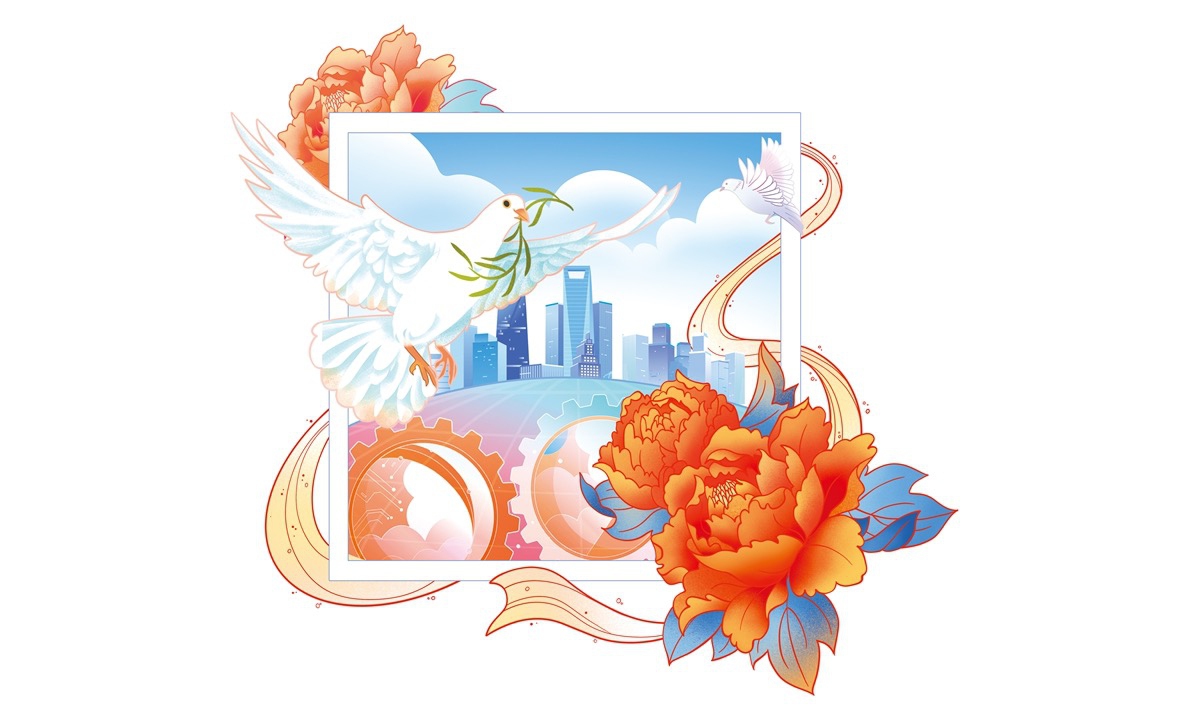
Illustration: Liu Rui/GT
President Xi Jinping on Tuesday morning met in Beijing with Spanish Prime Minister Pedro Sanchez, who is on an official visit to China, and Sheikh Khaled bin Mohamed bin Zayed Al Nahyan, Crown Prince of Abu Dhabi, United Arab Emirates, who is also visiting China, respectively. On the same day, To Lam, general secretary of the Communist Party of Vietnam Central Committee and president of Vietnam, arrived in Beijing for a state visit. Following China's annual two sessions and against the backdrop of the protracted escalation of the Middle East crisis, a steady stream of high-level foreign guests - from Europe and the Middle East to Southeast Asia - has visited China, reflecting the international community's broad expectations for China to play a responsible and constructive role in global affairs.
Amid this round of intensive high-level diplomatic engagements, what we see is not only the steady advancement of China-Europe relations, China-Arab relations, and China's ties with its neighbors, but also, under the profound changes unseen in a century, China's thoughtful response - as a responsible major country - to the defining question of our time: What kind of world to build and how to build it. President Xi stressed in his meeting with Prime Minister Sanchez that the world today is in turmoil, confronted with the contest between the rule of law and the rule of power. How a country treats international law and the international order reflects its worldview, its view of order, its values and its sense of responsibility. These "four perspectives" constitute the fundamental logic and intellectual foundation for China to play a key role and demonstrate the responsibility of a major country in a world marked by instability and transformation.
China's worldview is rooted in the idea of a community with a shared future for humanity. In today's world, geopolitical conflicts are frequent, while unilateralism and protectionism are on the rise. Standing at a historical crossroads, China's worldview remains clear and firm: Humanity lives in a community with a shared future where we rise and fall together.
During the meeting with Sanchez, President Xi reaffirmed the need to advance an equal and orderly multipolar world and an inclusive, universally beneficial economic globalization, and to promote the building of a community with a shared future for humanity. This vision represents a firm rejection of Cold War mentality and zero-sum thinking. True multipolarity should not mean a handful of major powers carving out spheres of influence, but rather an equitable system in which all countries - regardless of size or strength - can find their place and play their due role. True economic globalization should not be about building walls or decoupling and severing supply chains, but about ensuring that the benefits of development are shared by all.
China's view of order is grounded in the rule of international law and multilateralism. One of the underlying reasons for the escalation and protraction of the Middle East crisis lies in certain countries placing their own interests above international norms, dealing a serious blow to the global order.
When meeting with Sheikh Khaled, President Xi put forward a four-point proposal on promoting peace and stability in the Middle East, clearly stressing the adherence to the principle of international rule of law, and the need to uphold the authority of international rule of law, while rejecting selective application to prevent the world from falling back into the law of the jungle. This perspective reflects China's diplomatic stance of upholding fairness without yielding to the rule of power. China has consistently advocated for acting within the framework of international relations based on the purposes and principles of the UN Charter, which serves as the fundamental safeguard against the world descending into a "might-makes-right" arena.
China's values emphasize sovereign equality and shared development. Values shape how countries interact. Rooted in the Five Principles of Peaceful Coexistence, China's values are reflected in its genuine respect for the sovereignty, security, and development interests of all nations, as well as a broader vision of contributing to global well-being.
President Xi has stated that China has firm resolve in advancing Chinese modernization and the broad-mindedness to share development opportunities with the world through high-standard opening up. China will inject confidence and momentum into global economic growth through its own development. This underscores that China does not seek development in isolation, but rather a flourishing of all and enduring global prosperity and stability.
China's sense of responsibility focuses on balancing development and security. A country's responsibility is reflected in whether it can provide constructive solutions for global peace and development. Regarding the current Middle East crisis, China has consistently upheld the principle of promoting peace talks and has played a constructive role. This is a vivid example of China implementing the Global Security Initiative. China advocates a vision of common, comprehensive, cooperative and sustainable security. It is committed to addressing challenges through development, helping countries in the region achieve growth and prosperity, and fundamentally eliminating the root causes of conflict.
China's "four perspectives" are resonating increasingly widely within the international community. Sanchez has explicitly stated that Spain opposes a "new Cold War," decoupling and severing of supply chains, and supports Europe and China in enhancing communication, mutual understanding and cooperation. Sheikh Khaled said the UAE appreciates China's responsible and constructive role in international affairs and it is committed to maintaining close communication and coordination with China to promote a ceasefire among the parties concerned. Key messages emerging from the two meetings, including "jointly resisting the law of the jungle," "jointly maintaining multilateralism," and "the international rule of law must be upheld for peace and stability to prevail in the Middle East," have been repeatedly featured in headlines of major international media reports.
Chinese diplomacy is injecting valuable certainty and stability into this turbulent world. In the contest between the rule of law and the rule of power, China consistently stands on the right side of history and the side of human civilization's progress. In the face of an uncertain future, China will continue to uphold the "four perspectives" and work hand in hand with countries around the world to build an open, inclusive, clean and beautiful world of lasting peace, universal security and shared prosperity.
RELATED ARTICLES