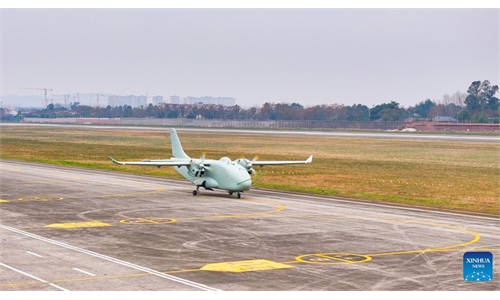
China’s homegrown ‘unmanned flying truck’ HH-200 completes maiden flight on Wednesday
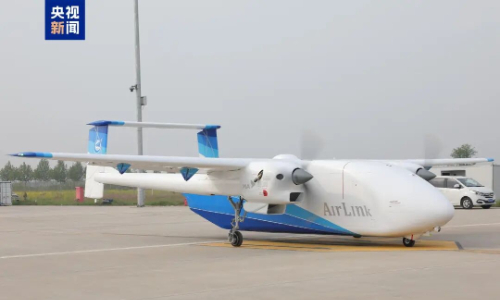
The domestically-developed HH-200 commercial unmanned aircraft successfully completed its maiden flight on April 15. Photo: China Media Group
China achieved a new milestone in making large-scale unmanned transport equipment as the domestically-developed HH-200 successfully completed its maiden flight on Wednesday.
Developed independently by Aviation Industry Corporation of China (AVIC), the aircraft performed steadily with all systems functioning properly, smoothly fulfilling all pre-planned flight objectives, according to Xinhua News Agency.
The HH-200 has a standard cargo hold volume of 12 cubic meters, expandable to 18 cubic meters, with a maximum payload of 1.5 tons, a top cruising speed of 310 km/h and a maximum range of 2,360 km.
The system features innovative structural design and extensive use of composite materials, reducing its weight by 20 percent while lowering operational costs. Built to civil aviation standards, the HH-200 is equipped with fully intelligent autonomous flight and AI-based obstacle avoidance capabilities. It boasts a service life of 50,000 flight hours or 15,000 takeoffs and landings, with a lifecycle operating cost of 4.7 yuan ($0.69) per ton-kilometer.
Its exceptional environmental adaptability allows it to take off and land on 500-meter short runways and plateaus above 4,200 meters, and withstand extreme temperatures ranging from -40C to 50C, enabling it to overcome transportation barriers in mountainous, island, snow-covered and high-altitude regions to build efficient low-altitude logistics channels.
The HH-200 will mainly fly border, coastal and cross-border feeder freight routes, inland point-to-point small cargo logistics, inter-island transport in Southeast Asia, and the air cargo networks of the countries participating in the Belt and Road Initiative. In the future, it can be quickly adapted for multiple missions, including emergency rescue, forest fire fighting, weather modification, aerial remote sensing, and agricultural and forestry crop protection.
This achievement aligns with China’s strategic push to develop its low-altitude economy, which has been positioned as a key growth driver, Wang Peng, an associate research fellow at the Beijing Academy of Social Sciences, told the Global Times on Wednesday.
Wang said that the breakthrough in commercial unmanned aircraft manufacturing is expected to unlock a wide range of low-altitude applications in emergency rescue, aerial remote sensing, modern agriculture and forestry, and logistics, especially for efficient services in remote and hard-to-reach regions.
China aims to basically establish standards system for low-altitude economy by 2027, according to guidelines released by the State Administration for Market Regulation and several other central government departments in February.
The guidelines said that by 2030, more than 300 standards for the low-altitude economy, and a structurally optimized, advanced, reasonable and internationally compatible standards system will be basically formed, providing strong support for the sector's sound development.
The standards system will cover the entire industrial chain, including low-altitude aircraft, infrastructure, air traffic management, safety supervision and application scenarios.
Global Times
RELATED ARTICLES