Issuance of panda bonds in China up over 90% in 2026 as global investors rush for safe havens
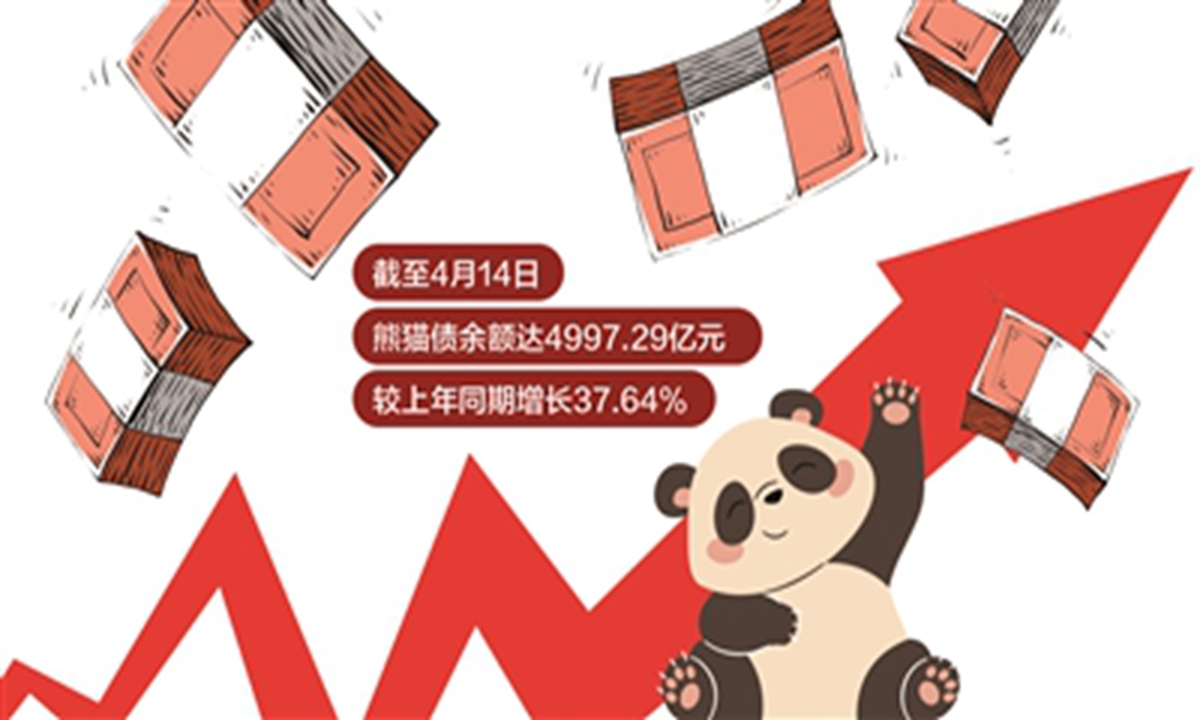
Panda bonds Photo: screenshot of the Securities Daily
The issuance of panda bonds has increased notably so far this year, rising 91.81 percent year-on-year, as global investors seek safe havens amid rising geopolitical uncertainties. Chinese experts said that the surge reflected the joint effect of multiple factors such as advantageous financing costs and the stable performance of yuan-denominated assets, while stressing that this also demonstrates confidence in the development of China's economy and financial markets.
According to data from Shanghai-based financial information provider Wind Information, overseas institutions had issued 52 panda bonds as of Tuesday, with a total scale of 102.24 billion yuan ($14.99 billion), up 91.81 percent year-on-year.
The outstanding balance of panda bonds rose 37.64 percent year-on-year to reach 499.73 billion yuan, the Securities Daily reported on Wednesday.
Panda bonds are yuan-denominated debt securities issued by overseas entities in China, a vital financing channel for international institutions.
The issuance of panda bonds has intensified recently. Kazakhstan's sovereign wealth fund Samruk-Kazyna will issue panda bonds totaling 3 billion yuan with a three-year tenor on China's market, the Central Asian country's first-ever panda bond issue, local media outlet the Astana Times reported on Tuesday.
In addition, the New Development Bank (NDB) announced on April 8 that it had issued 7 billion yuan worth of panda bonds in China's interbank bond market.
"The transaction deepens the bank's presence in the China interbank panda bond market with a cumulative issuance to date of 87.5 billion yuan, and it further strengthens the NDB's role as an innovative and regular issuer in the China interbank panda bond market," said Monale Ratsoma, vice-president and CFO of the NDB.
"The lower financing costs of the yuan versus the US dollar, favorable policies in the issuance of panda bonds, for example, green channels for bond issuance and tax benefits, along with new types of panda bonds tied to innovation and green development, are driving the expansion of panda bond issuance this year," Wan Zhe, a professor at Beijing Normal University, told the Global Times on Wednesday.
Amid rising global economic uncertainties, the yuan-denominated bonds, with their stable yields and high credit quality, are becoming a safe haven asset for global asset allocation, Wan said.
"The surge in the panda bond market underscores the confidence of foreign financial institutions in the prospects of China's economy, as the large economy is resilient and not subject to geopolitical disturbances," Hu Qimu, a deputy secretary-general of the Forum 50 for Digital-Real Economies Integration, told the Global Times on Wednesday.
"(Chinese government debt) is a safe haven in the current environment - a unique combination of global energy supply shocks and China's domestic resilience," said Louis Luo, deputy head of macro investments at Aberdeen Investments, Reuters reported on Tuesday.
China is set to release first-quarter economic data on Thursday, and preliminary figures have pointed to a good start in the inaugural year of the 15th Five-Year Plan (2026-30) period. Official data showed that China's foreign trade grew 15 percent year-on-year between January and March despite rising geopolitical uncertainties, while the purchasing managers' index for China's manufacturing sector rebounded into expansionary territory to reach 50.4 in March.
"As the international monetary system advances toward diversification, China, as the world's second-largest economy, has seen the international status of the yuan continuously rise. The country is consistently promoting the construction of the infrastructure for the yuan's internationalization to meet global demand for yuan cross-border investment and financing," Hu said.
In March, Pan Gongsheng, governor of the People's Bank of China, the central bank, said that as of the end of 2025, overseas institutions and individuals held domestic yuan-denominated financial assets exceeding 10 trillion yuan.
Calculated on a comparable basis, the yuan became the largest settlement currency in China's external payments and receipts, the second-largest trade financing currency globally, and the third-largest payment currency, and it ranked third in the IMF's Special Drawing Rights basket.
RELATED ARTICLES