World’s largest, China’s first 10,000-ton all-electric smart container vessel delivered
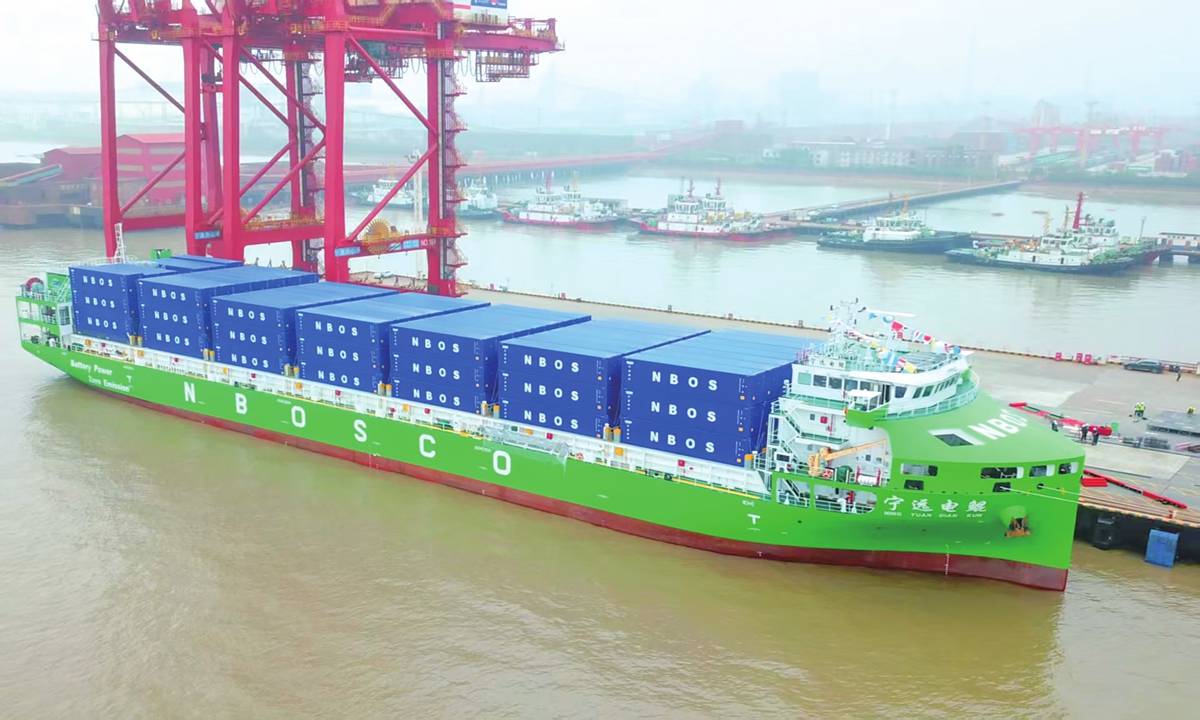
The Ningyuan Diankun, the world's largest and China's first 10,000-ton all-electric intelligent container vessel, sets sail from the Beilun port area of Ningbo Zhoushan Port for the Zhapu port area of Jiaxing Port on April 15, 2026, marking the start of its commercial operations. Photo: Courtesy of Ningbo-Zhoushan Port
The world's largest and China's first 10,000-ton pure electric intelligent container vessel, the Ningyuan Diankun, set sail on Wednesday from the Ningbo-Zhoushan Port bound for the Zhapu Port area in Jiaxing, marking the official start of its commercial operations, and ushering in a new phase of exploration and development for China's coastal container shipping driven by pure electric power and intelligent navigation, Ningbo-Zhoushan Port told the Global Times in a statement.
Developed by Ningbo Ocean Shipping Co, the Ningyuan Diankun measures 127.8 meters in length and 21.6 meters in width, with a carrying capacity of 742 standard containers. The vessel is powered by 10 standardized battery containers with a total storage capacity of about 20,000 kilowatt-hours, equivalent to the combined battery capacity of about 300 household electric vehicles. It is expected to save 580 tons of fuel a year and reduce carbon dioxide emissions by more than 1,400 tons after being put into operation, delivering genuinely zero-emission, zero-pollution voyages, Ningbo-Zhoushan Port said.
"This project is an important step in aligning with the shipping industry's broader green transition and proactively supporting the country's dual-carbon goals," a representative of Ningbo Ocean Shipping Co said in an interview.
Ningbo Ocean Shipping operates 32 green and energy-efficient vessels, accounting for 57 percent of its fleet, and 19 intelligent vessels, or about 34 percent, underscoring solid progress in its low-carbon and smart fleet upgrade.
The Ningyuan Diankun is one of the company's first two all-electric intelligent vessels. Its sister ship, the Ningyuan Dianpeng, is scheduled to begin trial voyages in May and be delivered in June. Once both vessels are put into operation, they will begin scaled-up service on designated routes.
Beyond its green and low-carbon advantages, the Ningyuan Diankun has also achieved a milestone breakthrough in intelligent navigation.
The vessel is deeply integrated with an intelligent platform and smart engine-room system, and is equipped with core autonomous navigation technologies for open waters. It features a full suite of smart functions, including real-time panoramic vessel monitoring, all-weather visual perception, autonomous route planning, automatic collision-avoidance alerts, and seamless switching between manual and intelligent navigation modes.
The system can capture navigation environment data in real time, automatically calculate an optimal route, and proactively identify and avoid navigational risks, reducing the likelihood of human error at the source. The solution fills a domestic technological gap in the intelligent control of 10,000-ton all-electric seagoing vessels and offers a new benchmark for coastal smart shipping worldwide.
Ma Jihua, a veteran tech industry analyst, told the Global Times on Wednesday that China has built a relatively complete and mature industrial chain in new energy, especially in electricity-related sectors. From electric vehicles on the road and drones in the sky and now to electric ships at sea, electric propulsion is expanding into more applications while also driving smarter systems. He said that China's advances in batteries, electric drive systems and motors have created reusable technologies and shared industrial resources for shipbuilding, making the rise of large electric vessels a natural step.
Ma said that the main constraint on large electric vessels at this stage is still battery technology, particularly range, while most other technical challenges are manageable. That means such ships are currently better suited to inland waterways and short-haul coastal shipping, with full electrification of oceangoing vessels still difficult for now.
"The significance of all-electric ships goes far beyond replacing oil with electricity. Like electric vehicles, they could drive a broader intelligent upgrade of ships and reshape how the sector develops," Ma said.
He added that recent global energy strains have accelerated interest in new energy, and as more countries put electric ships on the agenda, China's strengths in both shipbuilding and electrification could give a strong lift to the industry and related exports.
China unveiled a new action plan on March 30 to accelerate the deep integration of cutting-edge technologies such as artificial intelligence (AI) with the shipping industry, aiming to foster new quality productive forces in the sector.
The plan sets out a two-phase development roadmap. By 2027, China aims to achieve the deep integration of AI with core shipping elements, make breakthroughs in key technologies, establish more than three comprehensive smart shipping pilot zones, open more than five pilot routes, develop more than 10 replicable typical smart shipping scenarios and operate more than 100 smart vessels, according to the Xinhua News Agency.
By 2030, the country expects to achieve full mastery of core technologies, establish a new model of coordinated development encompassing technology, industry and governance, and reach internationally advanced levels in smart shipping development, Xinhua reported.
RELATED ARTICLES