China’s Q1 GDP expands by 5%, getting off to a strong start
By Published: Apr 16, 2026 10:14 AM

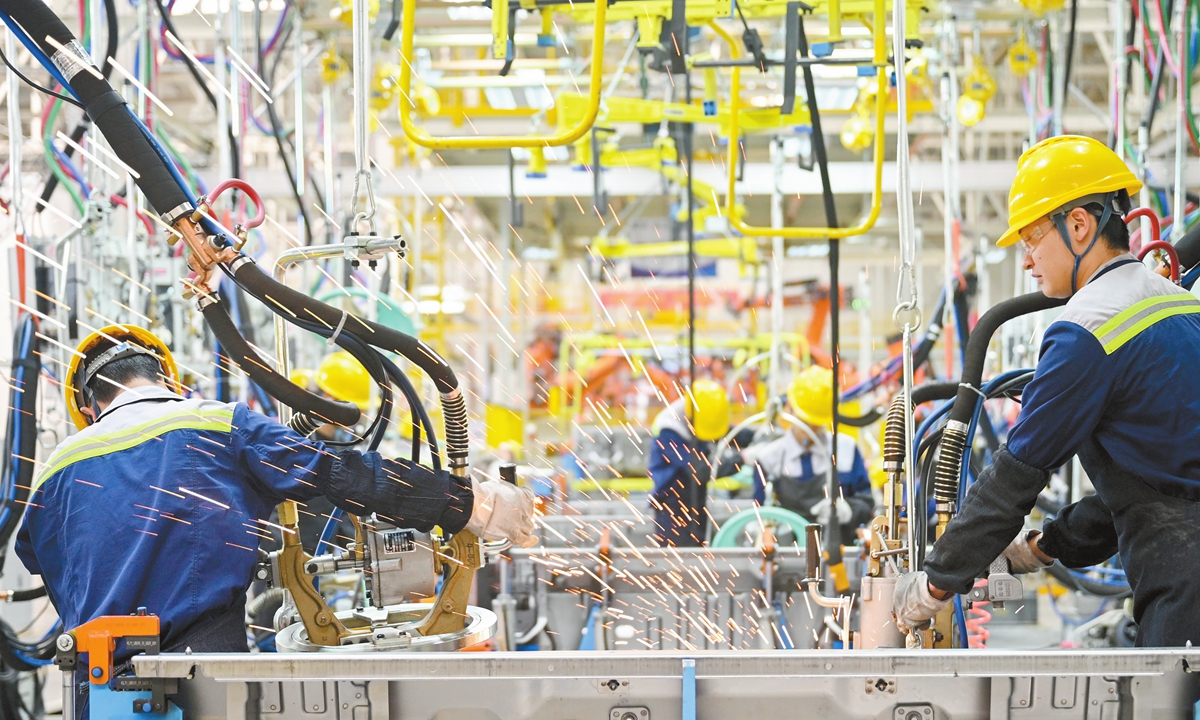
Workers of the Guizhou Changjiang Automobile Co in Gui'an New District, Guiyang of South West China's Guizhou Province, work to produce electric trucks to fulfill orders, on April 16, 2026. Photo: VCG
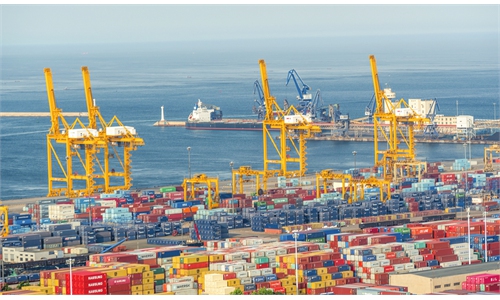
At the state-of-the-art automated terminal of Qingdao Port in East China's Shandong Province, a colossal oceangoing freighter rests at the berth, its deck stacked with brightly colored shipping containers. Ashore, newly minted electric vehicles stand in meticulous formation, awaiting shipment to global markets. Operating with relentless, algorithmic precision, the bustling port terminal serves as a powerful microcosm for the world's second-largest economy, which has just delivered stronger-than-expected results for the first quarter of 2026.China's GDP grew 5 percent year-on-year to reach about 33.4 trillion yuan ($4.9 trillion) in the first three months, getting off to a good start to the year, data released by the National Bureau of Statistics (NBS) showed on Thursday.
The impressive growth rate in the first quarter marks an acceleration from the 4.5-percent GDP growth recorded in the fourth quarter of 2025, underscoring the resilience and dynamism of the Chinese economy against the backdrop of rising global headwinds - in particular the escalating geopolitical tensions in the Middle East which severely disrupt global energy supply, global industrial chain and cast clouds on global economy.
The country has targeted 2026 growth at 4.5 to 5 percent and will strive for better in practice. Such rosy opening also laid a solid foundation for the Chinese economy to achieve the goal, while giving the economy a head start to the 15th Five-Year Plan (2026-30) period, observers said.
China's 5-percent GDP growth in the first quarter, which topped market expectation, has made headlines across multiple international media outlets.
"China's economy grew faster than expected in the first three months of the year, even as countries around the world feel the impact of the US-Israel war with Iran," the BBC reported on Thursday. CNN also said that China's growth exceeded analysts' expectations "even as the Iran war upended global trade and energy markets."
Strong resilience
Mao Shengyong, deputy commissioner of NBS, said at a press briefing on Thursday that the Chinese economy in the first quarter fully demonstrated strong resilience. He noted that it came as "external instabilities and uncertainties have increased markedly since the beginning of this year, with the spillover effects of geopolitical conflicts spreading further."
Hu Qimu, a deputy secretary-general of the Forum 50 for Digital-Real Economies Integration, told the Global Times on Thursday that the set of robust economic data shows that the Chinese economy remains resilient to external shocks - in particular from the rising tensions in the Middle East in February and March.
Observers said that the strong opening carries great importance as this year marks the start year of China's 15th Five-Year Plan period (2026-30), and the better-than-expected performance could boost full-year expectations and produce a positive demonstration effect.
In a breakdown, China's value-added industrial output in the first three months rose 6.1 percent compared to the same period in 2025, while fixed-asset investment jumped by 1.7 percent year-on-year.
China's total retail sales of consumer goods expanded by 2.4 percent year-on-year in the January-March period, according to the latest NBS data.
One of the highlights of the first-quarter GDP growth is that the fixed-asset investment rebounded from the negative territory seen last year to a positive growth, which analysts believe was partly driven by the government's implementation of a more proactive fiscal policy.
"A large sum of government bonds and ultra-long special treasury bonds were issued earlier than planned. And as a result, more funds were made available in the first quarter, enabling infrastructure projects to start quickly," Hu said.
As the Chinese economy goes through profound reshaping, the first-quarter GDP mirrors this momentum, Lian Ping, director of the China Chief Economists Forum, told the Global Times on Thursday.
He cited the significant rise in the production, investment and exports of China's high-tech products in the first three months, which "underscored that China's new quality productive forces are taking shape, acting as a crucial driver of the overall economic growth."
During the press briefing, Mao also gave a set of figures that speak volume for the vitality of Chinese economy. For example, as of March this year, China's daily average token usage has surpassed 140 trillion, up more than 40 percent from the end of last year, underscoring that the advancement of artificial intelligence is empowering thousands of industries.
Stabilizer of world economy
While other major global economies have yet to publish their first-quarter GDP, China is expected to continue ranking among the top of the world's major economies based on estimates of relevant indicators, Mao said.
In a report published on Tuesday, the IMF predicted that global growth is projected to slow to 3.1 percent in 2026, and 3.2 percent in 2027, assuming that the conflict in the Middle East remains limited in duration and scope.
Observers pointed out that China's stable growth will inject much-needed certainty into the global economic outlook. "Unlike certain countries, we are offering the world massive opportunities, rather than creating risks," Hu said.
Lian said that the Middle East tensions have significantly disrupted global energy transport and supply, exerting tremendous pressure on the industrial chains and supply chains. "In this context, when many parts of the world face supply shortages, supply chain disruptions or bottlenecks, China - as a major manufacturing power with a complete range of industrial sectors - is able to provide timely and effective support to the global supply chain," Lian said.
Looking forward, analysts cautioned that the negative impact of an increasingly turbulent external environment may linger this year, creating extra imported inflationary pressure on the Chinese economy.
However, when pressed on how China plans to navigate treacherous global currents to secure its growth targets, Mao delivered a resolute verdict to close the Thursday press conference.
"In such a complex external environment, we have the capability and confidence to meet any risks and challenges. This confidence is built on the path we've traveled over the years, and we are full of confidence about the future," Mao asserted.
RELATED ARTICLES