China trims US Treasury holdings modestly in February, part of reserve diversification: Chinese expert
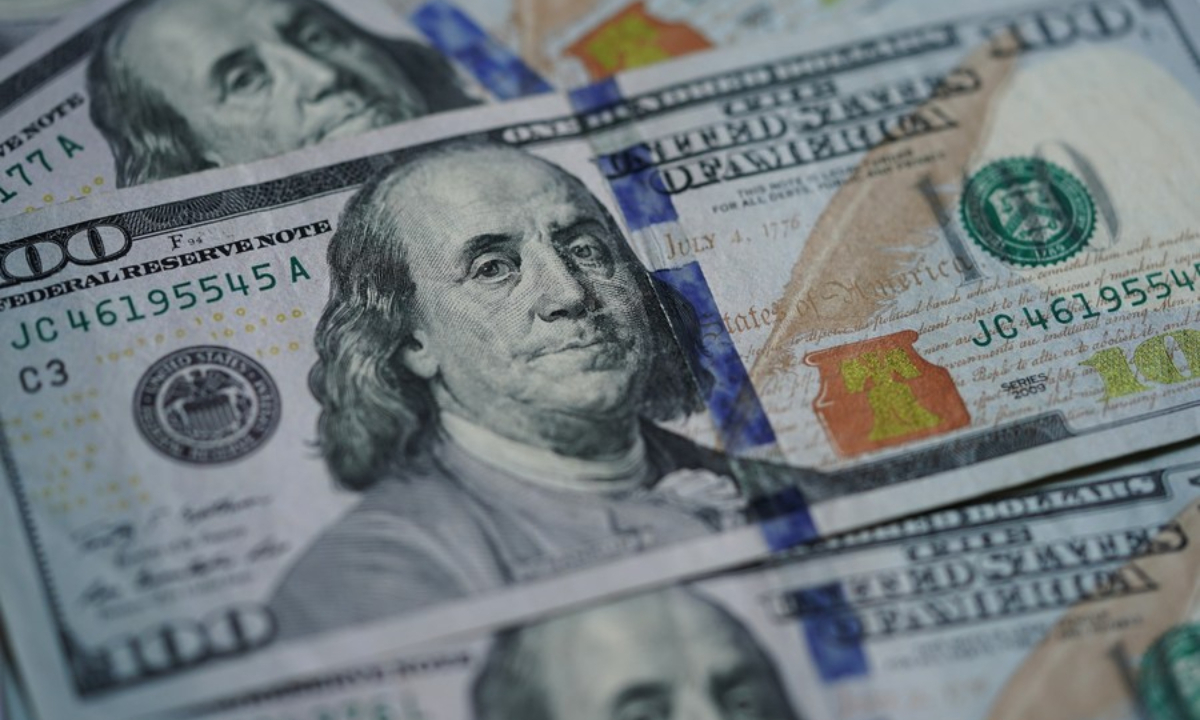
Photo shows US dollar banknotes in Washington, DC, the United States. Photo:Xinhua
China's holdings of US government debt stood at $693.3 billion in February, a slight decrease of $1.1 billion from the previous month, data from US Treasury Department showed on Wednesday. China remained the third-largest foreign holder of US Treasuries, after Japan and the UK.
China's $1.1 billion reduction was a normal and minor market fluctuation, Zhao Qingming, a Beijing-based veteran financial expert, told the Global Times on Thursday. He noted that the move primarily reflected the country's long-term demand for optimizing and diversifying its foreign exchange reserves, as part of a general trend to diversify asset structure and enhance the safety of reserve portfolio.
Additionally, amid rising oil prices in February, market expectations for interest rate hikes picked up, which tended to suppress bond prices. To avoid potential valuation losses and stabilize the value of foreign reserves, the central bank's moderate reduction of US Treasuries was a reasonable measure for market risk management, Zhao said.
Japan remained the biggest non-US holder of Treasuries with holdings rising to $1.239 trillion in February. The UK, the second-largest owner of Treasuries, also raised its holdings to $897.3 billion in February. Holdings by foreigners rose to $9.487 trillion in February, up from $9.289 trillion inthe previous month, the US Treasury Department data showed.
The divergent strategies among countries stem from their different reserve needs. Countries like Japan have limited options for high-quality foreign exchange assets, leading to a higher reliance on US Treasuries, which differs from China's path of structured diversification, Zhao said.
In a related development, China continued to boost its gold reserves as part of its diversification drive. Data from the State Administration of Foreign Exchange (SAFE) showed China's gold reserves rose to 74.38 million ounces by the end of March, up 160,000 ounces from February and marking the 17th consecutive month of increase.
SAFE data also showed that China's total foreign exchange reserves stood at $3.3421 trillion at the end of March, down $85.7 billion, or 2.5 percent, from February. A SAFE official attributed the decline to a stronger US dollar and falling global asset prices, driven by the global macroeconomic environment and major economies' monetary policies and expectations.
"China's economy has maintained a generally stable and progressive momentum, with new progress in high-quality development, which provides solid support for the basic stability of foreign exchange reserves," the official said.
RELATED ARTICLES