Illustration: Liu Rui/GT
Latest data released by the World Travel & Tourism Council (WTTC) and its partners shows that China's travel and tourism economy grew 9.9 percent last year - more than twice the global average. The WTTC also forecasts that China is likely to become the world's top tourism economy by 2030. "China Travel" has become an important window for observing China's economy, while presenting to the world a more confident, open and vivid image of the country.
The robust growth of China's tourism industry highlights the unique development strengths of the world's second-largest economy. With a vast domestic market of over 1.4 billion people, diverse tourism resources ranging from natural landscapes and cultural heritage to modern commercial districts, and continuously improving infrastructure represented by high-speed rail and 5G networks, China's tourism supply capacity has been rapidly and comprehensively enhanced. As a highly integrated sector, tourism drives multiple industries including catering, accommodation, transportation, retail and culture, helping to create jobs and improve people's sense of well-being. Behind the surge in "China Travel" data lies a vibrant and highly attractive country.
According to analyses by international travel magazines, "domestic demand" is an indispensable part of China's impressive tourism performance. Chinese residents made 6.52 billion domestic trips in 2025, a year-on-year increase of 16.2 percent, while tourism spending rose by 9.5 percent. Notably, rural residents saw growth rates of 22.6 percent in domestic trips and 21.4 percent in spending, far exceeding those of urban residents. This indicates that the lower-tier market in tourism consumption has become a new blue ocean, with domestic demand potential continuing to be unleashed. Whether it is the booming domestic travel during short holidays or the rising popularity of inbound "China Travel," both serve as important signals for the steady improvement of China's economy and will support its resilience amid a complex external environment.
At the same time, the vigorous development of China's tourism industry has also been strongly supported by the active participation and contributions of inbound tourists. In 2025, China recorded over 150 million inbound visits, marking a year-on-year increase of over 17 percent. Spending by inbound tourists on dining, accommodation, transport, sightseeing, shopping and entertainment reached 393.98 billion yuan ($57 billion), a 49.5 percent year-on-year increase. The direct outcome of high-level opening-up sends two clear signals to the world: China welcomes you, and China is ready. From continuously optimized visa policies and instant tax refunds for departing travelers to mobile payment systems and multilingual services, the convenience of China's tourism service chain is rapidly improving, turning visitor traffic into lasting retention.
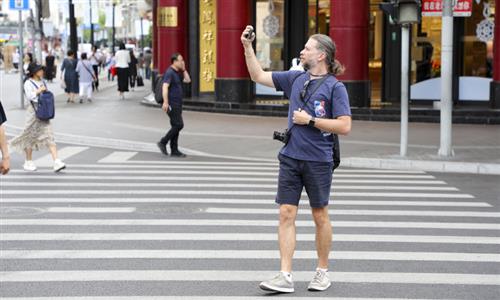
Many foreign tourists are initially drawn to China by its cuisine and history, yet upon setting foot on this land, they encounter surprises that far exceed their expectations. From the efficient and convenient modern lifestyle and the stable, orderly social environment to the profound historical and cultural heritage and the warm, friendly ordinary people, everything contributes to a more authentic, multidimensional, and comprehensive "impression of China." This has also inspired many foreign vloggers to document their observations in China, with some even producing videos that offer practical "essential travel tips for visiting China." "China Travel" has not only continued to captivate international visitors but has also fostered vibrant grassroots interactions between China and the rest of the world. In the comment sections of related videos by foreign tourists, Chinese netizens enthusiastically respond, saying things like, "I love these reviews without a gray filter" and "Welcome back to my hometown." Data released this week by the Pew Research Center shows that the number of Americans with a favorable view of China has nearly doubled since 2023, a shift in which "China Travel" has certainly played a role. This cultural exchange, driven by countless ordinary travelers, is reshaping China's international image at an astonishing pace.
Complementing this grassroots enthusiasm for "going to China," many foreign leaders have inadvertently become "super ambassadors" for "China Travel." Recently, videos of the Spanish Prime Minister and his wife enjoying the spring scenery at Beijing's Summer Palace quickly went viral. Finnish Prime Minister Petteri Orpo, after visiting the Forbidden City, remarked on the striking contrast of "a 600-year-old historical place sitting right in the middle of this gigantic city filled with skyscrapers." German Chancellor Friedrich Merz, during his February visit to China, posted regular updates on social media, sharing his observations and experiences. From the Terracotta Warriors and the Giant Panda Breeding Research Base to humanoid robot factories, foreign leaders' increasingly personalized and customized itineraries have not only enriched the meaning of "China Travel" but also provided a unique, official "guidebook" for global tourists.
"Is it not a joy to have friends come from afar?" This millennia-old Chinese philosophy of hospitality reflects today's China, which remains committed to expanding high-level openness and building friendships worldwide. In a world fraught with distrust and uncertainty amid profound transformations, breaking down barriers and building consensus has never been more crucial. As China embarks on its journey toward the 15th Five-Year Plan, it will continue to share economic and trade opportunities with nations around the globe and deepen cross-cultural exchanges. China sincerely welcomes more international friends to embark on an impromptu "China Travel" adventure.