US to reportedly ‘scale back’ bill restricting chipmaking equipment sales to China; Chinese expert says export curbs fail to slow China’s chip industry

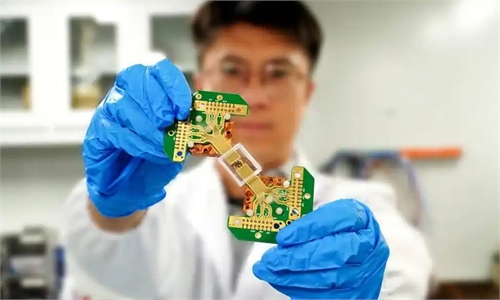
chip Photo:VCG
A US bill to keep more chipmaking equipment from being exported to China has been scaled back, according to a Reuters report on Thursday, though it's reported that the bill includes a new restriction on ASML's deep ultraviolet (DUV) immersion lithography machines. A Chinese expert said the US' move indicates that the US was forced to adjust its restrictions as they failed to halt China's technological development and backfired on American chipmakers.
The bill, called "Multilateral Alignment of Technology Controls on Hardware Act", was initially introduced in the US House of Representatives on April 2 with bipartisan support. It is aimed at protecting the US lead in artificial intelligence (AI) by preventing Chinese companies from obtaining chip manufacturing tools they cannot make themselves, Reuters reported on April 3.
According to Reuters, many of the restrictions in the early April version of the bill have been removed in the latest version, including countrywide curbs on cryogenic etch, a kind of tool for making chips.
Still, the more tailored bill prohibits foreign firms from selling to Chinese chipmakers ChangXin Memory Technologies Inc, Yangtze Memory Technologies, and Semiconductor Manufacturing International Corp for facilities barred by Washington from using American tools - technologies where China relies on imports, such as immersion DUV lithography needed to create chip circuitry, Reuters said. It also requires licenses for servicing equipment in covered facilities, another controversial provision for foreign firms, according to Reuters.
The US House Foreign Affairs Committee plans to vote on the bill next Wednesday, along with more than a dozen others tied to AI, semiconductors and export controls. The vote is one step in the process toward its potentially becoming law, per the report.
As for the potential reasons behind the revisions to the bill, the report noted that the original version of the bill upset the industry, both in the US and abroad, as the bill became what one expert described as a "runaway train" that not only aimed to force allies to align with U.S. controls, but also imposed new countrywide and expansive company-tied restrictions. "Manufacturers say restrictions reduce exports, harming sales," it said.
Ma Jihua, a veteran tech industry analyst, told the Global Times on Friday that looking at the developments over the years, the US' attempts to restrict exports of high-tech products have failed not only to halt the progress of China's chip industry, but also to hinder the upgrading of China's chip sector to high-end products. Instead, they have become a catalyst for the rapid development of China's self-reliant and controllable chip industry, and have caused significant losses to US companies.
Despite China's remaining shortcomings in DUV and EUV lithography machines, the truth is clear - a gradual process whereby China achieves partial success and the US loosens restrictions in phases will likely become the norm, Ma said, adding that as China's chip industry grows and exports increase, US companies risk losing not only the Chinese market, but also the global market.
The "slimming down" of the US "MATCH Act" is hardly a gesture of goodwill, but rather a forced adjustment amid diminishing effectiveness of US efforts to curb China's chip technology. For Washington, being compelled to ease restrictions is not a distant threat, but an unfolding reality: it can neither withstand backlash from its allies nor ignore the massive losses inflicted upon domestic companies. Most critically, the pace of China's domestic substitution has already exceeded American expectations.
China's domestic chip equipment push is gaining momentum. According to data released in January by the China Semiconductor Industry Association, the share of domestically manufactured semiconductor equipment used in China rose from 25 percent in 2024 to 35 percent in 2025, surpassing the 30 percent target set for 2025.
RELATED ARTICLES