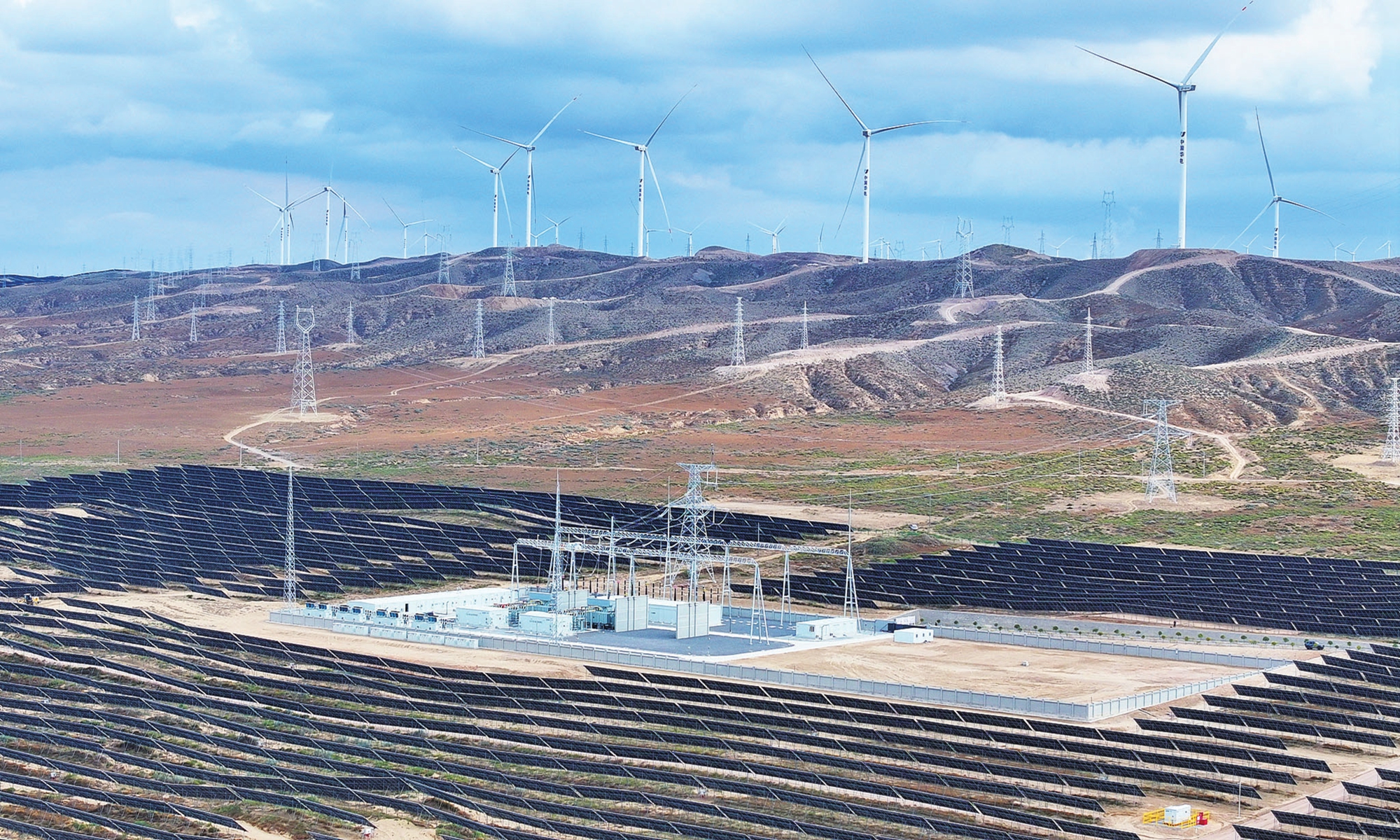
An aerial view shows photovoltaic panels and wind turbines complementing each other at a clean energy power station on October 27, 2025, in Yinchuan, Northwest China's Ningxia Hui Autonomous Region. Photo: VCG
China's GDP grew by 5 percent in the first quarter of 2026. One of the contributors exceeding market expectations was the country's strong export shipments. This high export growth was influenced by multiple factors, including international market demand and China's extraordinary supply capacity.In addition, infrastructure investment saw a notable rebound in the first three months, which was anticipated by various parties.
The overall performance of the economy in the first quarter was slightly better than market expectations. While the pressures facing economic operations since last year still persist, exports have shown a strong growth, investment has seen notable improvement, and domestic consumption has remained largely stable. Meanwhile, the more proactive macro policies — especially fiscal policy — have led to a turnaround in economic performance, with the economic situation steadily improving.
Another highlight in economic operations was the significant increase in industrial production, fixed-asset investment, and export of high-tech products. This demonstrates that China's new quality productive forces are growing rapidly and advancing at a fast pace, becoming an important engine driving China's export growth and overall economic expansion.
Since the beginning of 2026, the external environment has deteriorated rapidly with rising conflicts in the Middle East. However, from the second quarter onward, the tense situation there is expected to gradually ease.
Based on my observation, the external environment in the second half of the year will be milder and to some extent improved compared with the first half. This will bring a progressively better environment for China's economic performance, particularly in the areas of cross-border investment and foreign trade.
However, the negative impact of the external environment cannot be ignored. These effects will continue to emerge in the coming months and may exert some adverse influence on the Chinese economy.
Therefore, from a full-year perspective, the country's macro policies need to be more proactive and effective. It is suggested that efforts should be made to front-load fiscal measures as much as possible into the second quarter — for example, by completing government bond issuances in the second quarter so that the funds can be deployed as quickly as possible in the second and third quarters. This will provide strong and sustained support for economic growth.
Meanwhile, China should maintain an appropriately accommodative monetary policy, and interest rates should not be elevated significantly due to changes in the external environment, such as imported inflationary pressure caused by rising oil prices.
Under the current inflation conditions, the pressure from imported price rises can be mitigated. Therefore, there is no need for the monetary policy to be tightened immediately.
The existing policy stance can be maintained, while other tools and measures can be used to ease any notable price fluctuations that may arise. From the current perspective, such fluctuations remain controllable and do not warrant a significant adjustment to monetary policy.
China will continue to play its role as a stabilizer and a major supply source for the world economy in the remaining three quarters of 2026.
It is important to note that the external environment has been experiencing severe turbulences, as the conflicts in the Middle East significantly disrupt global energy transportation and supply, which also exert tremendous pressure on the world's industrial and supply chains. Issues such as blocked sea transportation, shortages of raw materials, and hindered delivery of intermediate products have placed considerable strain on the global supply system.
In this context, as a major manufacturing powerhouse with a comprehensive range of industrial sectors, China has played a highly positive and constructive role through its strong supply capacity in providing products to the world.
China possesses exceptionally strong supply capabilities and plays an important role in stabilizing global supply chain: when many parts of the world experience supply shortages, supply chain disruptions, or bottlenecks, China has always provided timely and effective support to the global supply chain.
Lian Ping is the chairman of the China Chief Economist Forum and president and chief Economist of the Guangdong Kaiyan Chief Industry Research Institute.
bizopinion@globaltimes.com.cn
RELATED ARTICLES