Humanoid robot breaks human half-marathon record; Drastic improvement reflects systemic advances in China’s robot technologies: expert
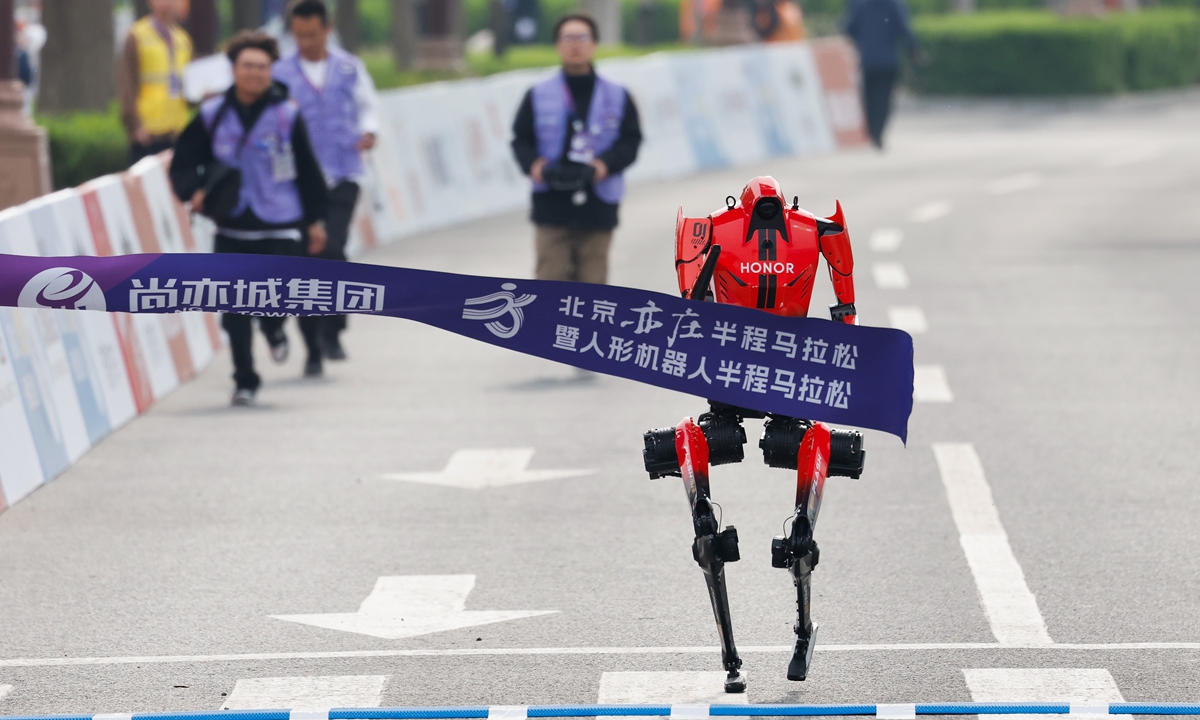
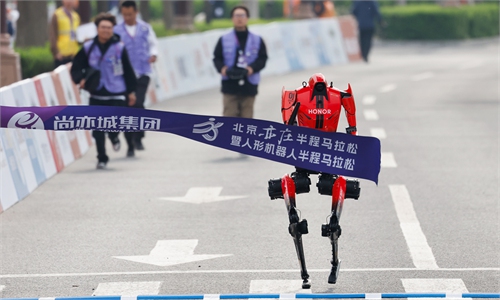
The Robotics D1 humanoid robot, developed by Chinese smartphone maker HONOR and nicknamed "Lightning," crosses the finish line in 48 minutes and 19 seconds in the remote-control category at the second Humanoid Robot Half Marathon in Beijing on April 19, 2026. Photo: VCG
Just a year ago, humanoid robots stumbled awkwardly across the pavement, tripping mid-stride as human handlers rushed in to steady them. But on Sunday at the second Humanoid Robot Half Marathon in Beijing, robots didn't just keep their balance - they rewrote expectations. The winning robot outpaced the human half marathon world record, while the top three finishers completed the course entirely autonomously, signaling a stunning leap in capability.
Charging through the 21-kilometer route in southern Beijing's E-Town, the Robotics D1 humanoid robot - developed by Chinese smartphone maker HONOR and nicknamed "Lightning" - crossed the finish line in 48 minutes and 19 seconds in the remote-control category.
However, under the competition rules, the time posted by remote control robots is multiplied by 1.2, so the ultimate winner was another robot of the same type in the autonomous navigation group, which posted a winning time of 50 minutes 26 seconds, an enormous improvement from last year's winning time of 2 hours and 40 minutes. It also outpaced the man's half marathon world record of 57 minutes 20 seconds recorded by Ugandan runner Jacob Kiplimo in 2026 at the Lisbon Half Marathon.
Participation in the event expanded nearly fivefold, with 102 robot teams, including five international teams, taking part in the second edition. A total of 26 brands and more than 300 humanoid robots competed, according to official data. Of these, 47 teams completed the race - 18 via autonomous navigation and 29 via remote control—resulting in an overall completion rate of over 45 percent.
The marked improvement in the finishing time highlights systemic breakthroughs in China's humanoid robot technologies, including power systems, control, perception and decision-making, Wang Peng, an associate research fellow at the Beijing Academy of Social Sciences who focuses on the tech sector, told the Global Times on Sunday. "The technology has moved beyond barely functional to rapidly approaching practical usability," he said.
Faster and smarter
Global Times reporters watching along the route saw that when the robots set off alongside human runners, spectators burst into cheers, many recording the moment on their phones.
Compared with the inaugural event in 2025, the speed and the running postures of the robots have seen significant improvement. While many robots last year struggled to maintain balance at the starting point, nearly all entrants this year launched steadily and were able to adjust their speed smoothly on the bends, the Global Times noted.
The top three teams all deployed HONOR's "Lightning" model, featuring autonomous perception and navigation as well as high-speed locomotion. Its speed and explosive power proved decisive, according to the company.
Du Xiaodi, a test and development engineer from the championship team "Qitian Dasheng," told the Global Times on site that the robot's design drew on elite human athletes, with leg length approaching one meter.
In addition, the robot's joints are equipped with a liquid-cooling system adapted from consumer electronics such as smartphones. "The system can provide continuous cooling for the entire race," Du said.
Beijing-based Booster Robotics' Model Booster K1 made its marathon debut, finishing in 1 hour and 53 minutes. An engineer told the Global Times that key systems, including joint motors, gait algorithms and battery management, must be tested on real tracks rather than in laboratories.
"We're not here for rankings, but to verify that our robots can operate reliably in any environment," the engineer said.
The race was not without hiccups. Footage from Chinese media outlet chinastarmarket.cn showed a Unitree H1 robot stumbling after crossing the finish line and eventually collapsing, before being carried away by staff.
Unitree announced that its H1 model would participate in the half marathon, while multiple independent teams also entered based on secondary development of Unitree platforms. Ahead of the race, Unitree released footage showing the H1 robot sprinting at a peak speed exceeding 10 meters per second, approaching Jamaican legend Usain Bolt's speed.
Beyond the race, autonomous navigation robots are moving toward real-world applications. Amap, one of China's largest navigation platforms, unveiled its first embodied robot product, the quadruped robot Tutu, during the event.
Without preset routes or remote control, it can navigate autonomously in open environments, perceiving road conditions beyond line of sight. It also supports voice commands, enabling tasks such as buying coffee, picking up deliveries and guiding visually impaired users, according to the company.
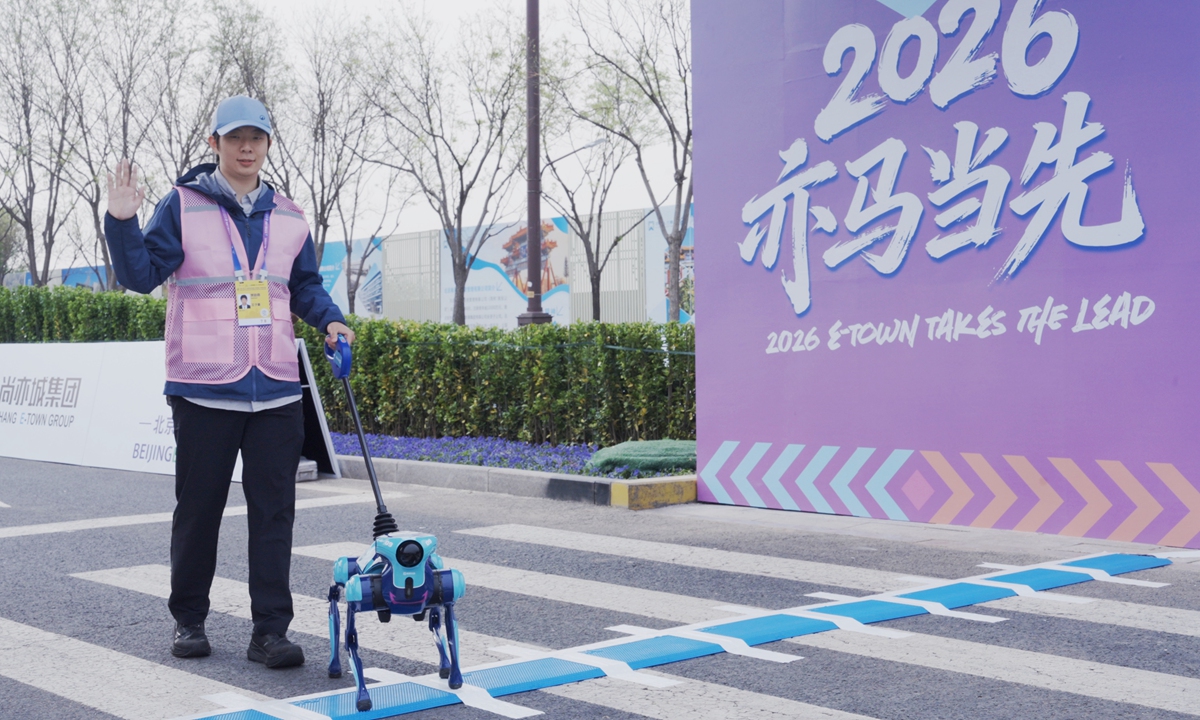
Photo: Courtesy of Amap
Zhao Mingguo, a research fellow from the Department of Automation, Tsinghua University, told the Global Times that both completion times and finish rates of robot runners had improved significantly from last year.
"Transferring navigation technology to robots requires extensive adaptation. This race verified the feasibility, so most autonomous teams completed the course, showing that current technology can support reliable outdoor navigation," he said.
Despite multiple sharp turns, autonomous robots maintained strong performance, navigating bends at high speed with minimal deceleration and stable posture, Zhao noted, highlighting integrated navigation and motion capabilities.
Industrial strength
Reuters reported on Sunday that this year's event for Chinese-made humanoid robots "highlights the sector's rapid technical advances," noting that the surge in participating teams showed a "stark contrast" with last year.
A report from the Associated Press described the significantly shortened record as a "significant step forward" from the inaugural race.
A German team completed the race using the Tiangong Ultra robot from Beijing Innovation Center of Humanoid Robotics in collaboration with Chinese robotics maker UBTech. Team member Julio Rogelio Guadarrama Olvera told the Global Times the robot performed well and proved durable, with no overheating even in hot and humid weather.
The Tiangong series previously won the inaugural robot half marathon and also claimed the 100-meter title at last year's World Humanoid Robot Games held in Beijing in August 2025. This year, the team only upgraded the control system but made almost no hardware modifications basing on the robots' mature configuration, while equipped the robot with size-44 running shoes, the same as his own, which improved softness and breathability, according to another team member Simon Armleder.
In the first edition, only six robots from 20 teams completed the race. This year, 47 of 102 robot teams finished the course with significantly faster times. Zhao said overseas teams' choice of Chinese robots underscores the strength of China's hardware supply chain.
Liu Dingding, a veteran industry observer who watched the event on-site, told the Global Times that HONOR's victory reflects both its own capabilities and the strength of hundreds of suppliers, underscoring the competitiveness of China's manufacturing ecosystem.
Zhang Zihao, a representative from Chinese startup HighTorque Robotics, drew crowds with his remotely operated Pi+ robot, a modified cartoon character, at the event's exhibition area. He said the production process highlights clear progress in domestic manufacturing, especially over the past year.
"Two years ago, humanoid robot joint modules were prohibitively expensive, but rapid iteration over the past year has driven costs down significantly. Individuals can now build humanoid robots themselves, spurring a wave of open-source projects," Zhang told the Global Times.
Asked if the long-distant race for humanoid robots is meaningful, Olvera said "Absolutely."
"It pushes the development of hardware - many companies are working on better actuators, controllers and drivers that can maintain stable performance and endure the entire long-distance run without issues," he said, adding that it gives engineering teams an interesting problem to solve from different perspectives.
He also praised his opponents, and said he was impressed by the scale of the robot industry in Beijing E-Town. "You can see a lot of people dedicated to developing humanoid robots. This kind of industrial cluster is really important and has been driving development extremely fast," he said.
An official from Beijing E-Town said the event aims to promote research, industrialization and application through competition.
Zhao emphasized that robotics is not a single-point technology, adding that motors, software and hardware integration, testing and understanding of competition scenarios all matter. "Improvements in nation's industrial ecosystem have made today's results possible," he said.
RELATED ARTICLES