China's first natural gas hydrogen blending application project at the 100,000-household level officially launches in E. China's Weifang
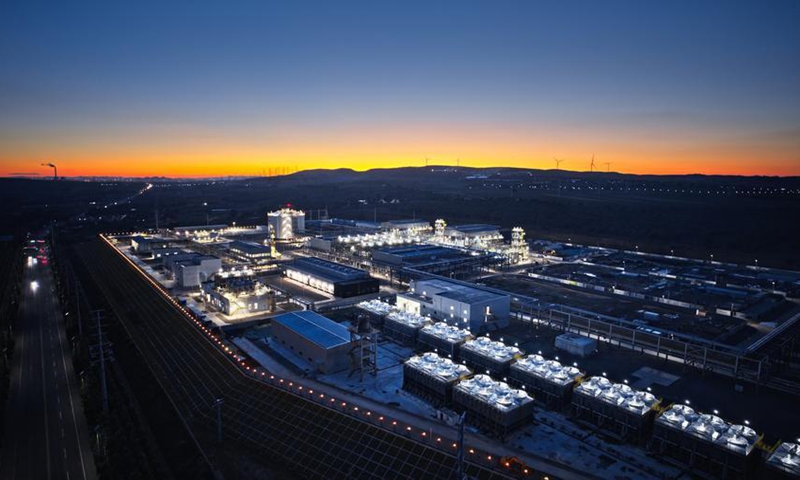
An aerial drone photo taken on July 6, 2025 shows a green hydrogen and ammonia project in Chifeng, north China's Inner Mongolia Autonomous Region. (Xinhua)
China's first large-scale natural gas hydrogen blending application project at the 100,000-household level was officially launched in Weifang, East China's Shandong Province, on Sunday. The hydrogen project covers 100,000 urban households in the city's central urban area, fully encompassing various civil gas usage scenarios such as daily household life and commercial catering, China Central Television (CCTV) reported on Sunday.
The demonstration project employs a 30,000 cubic meter natural gas hydrogen blending facility, capable of adjusting hydrogen blending ratios from 0 percent to 10 percent, the report said. The project leverages Weifang's existing urban natural gas pipeline infrastructure to enable stable hydrogen-blended natural gas transmission and distribution.
The project has built an electrolyzed water hydrogen production facility with a capacity of 5,000 cubic meters per hour. It has also developed China's first urban gas hydrogen transmission pipeline spanning a full length of 5.2 kilometers, and also a leading full-process hydrogen blending and transmission testing platform, which is capable of consuming up to 13 million cubic meters of hydrogen annually.
Pan Fengwen, deputy director of the National Fuel Cell Technology Innovation Center, was quoted as saying in the report that preliminary calculations show that if a 10 percent hydrogen blending ratio is applied nationwide in urban gas consumption, it could replace approximately 15 billion cubic meters of natural gas and reduce carbon dioxide emissions by about 30 million tons per year.
"Through the implementation of the demonstration project, the 'last mile' of hydrogen energy application in the urban gas sector has been linked up, marking the first time in the country that a large-scale, long-cycle, and continuous hydrogen blending demonstration application has been realized," he said. Pan stressed that the application of hydrogen blending in natural gas has significant demonstration effects in areas such as green electricity consumption, energy security assurance, energy conservation, emission reduction, and carbon reduction.
Lin Boqiang, director of the China Center for Energy Economics Research at Xiamen University, told the Global Times on Sunday that the launch of the project is a critical step in China's hydrogen energy industry, which is transitioning from demonstration projects to large-scale commercial application.
"The project will also gather valuable full-process testing data, safety evaluation expertise, and standardized technical specifications, which could lay a solid foundation for subsequent applications involving higher hydrogen blending ratios, dedicated pure hydrogen pipeline networks, and a nationwide rollout," Lin said. He added that the project also represents China's latest efforts in constructing a clean, low-carbon, safe, and highly efficient modern energy system, while serving as an important demonstration model with significant global reference value.
In 2024, China's annual hydrogen production and consumption scale exceeded 36.5 million tons, ranking first in the world, according to a report issued by the National Energy Administration on Sunday.
Global Times
RELATED ARTICLES