From gateway to growth engine, Qingdao boosts BRI with maritime, rail strengths
Qingdao boosts BRI with maritime, rail strengths
By Tao Mingyang, and Zhang Yashu in Qingdao Published: Apr 19, 2026 10:50 PM

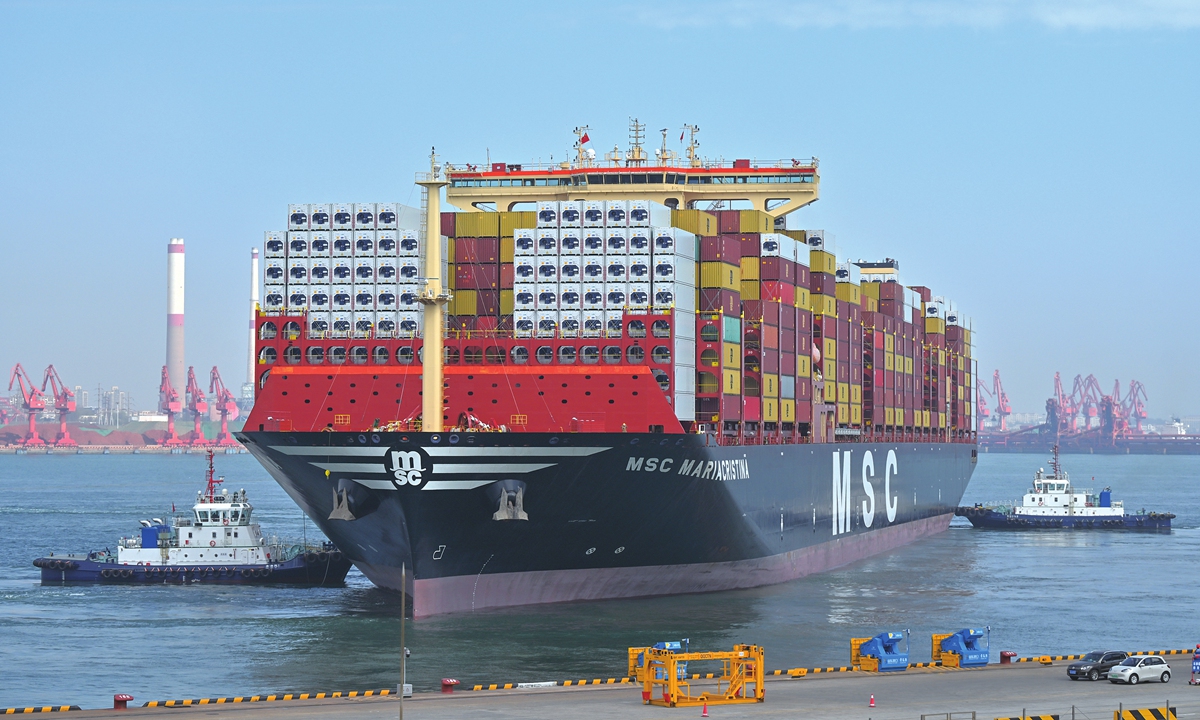
A container vessel leaves its berth at Qingdao Port on April 14, 2026. Photo: Tao Mingyang/GT
Towed by several tugboats, a massive cargo vessel moved steadily toward the berth, docking with precision at the Qianwan container terminal of Qingdao Port, East China's Shandong Province.
On April 4, as the vessel berthed successfully, Qingdao Port, under Shandong Port Group welcomed the maiden voyage of a newly launched Southeast Asia route by Maersk, injecting fresh momentum into the port's connectivity with Belt and Road partner countries in Southeast Asia.
The route runs on a weekly schedule with six vessels of 2,500 TEUs each, ensuring stable capacity. It links key ports in the Philippines, Malaysia and Indonesia, supporting imports of Southeast Asian agricultural products and raw materials, while facilitating exports of Chinese chemical and electromechanical goods, improving two-way trade efficiency, Qingdao Port told the Global Times.
As an important node city along the economic corridor of the New Eurasian Land Bridge and a strategic pivot for maritime cooperation, Qingdao has continued to advance the construction of the China-proposed Belt and Road Initiative (BRI). With upgrades in port capacity, expansion and quality improvement of China-Europe freight trains, and deepening reforms in the China-SCO Local Economic and Trade Cooperation Demonstration Area (SCODA), the coastal city is transforming from a logistics hub into a regional economic engine.
Empowered by the sea
Located in the southern area of Qingdao Qianwan Port is a fully automated container terminal. On site, there is no dust or noise. Automated quay cranes steadily unload containers from giant vessels, while nearly silent electric automatic-guided-vehicles (AGVs) shuttle in an orderly manner between loading points.
Wang Jisheng, deputy manager of the terminal's operations department, said the terminal has a shoreline of 2,088 meters, equipped with 18 quay cranes, 85 AGVs and 94 high-speed rail-mounted gantry cranes. Overall operational efficiency has increased by 30 percent compared with traditional terminals.
"The average loading and unloading efficiency has reached 36.2 TEUs per hour, while the average single-crane efficiency stands at 62.62 TEUs per hour," Wang said. "The terminal has broken the world record for automated terminal efficiency 13 times."
As China's first fully domestically developed automated terminal, with six berths capable of accommodating 200,000-ton container ships, the facility highlights Qingdao Port's infrastructure strength as the world's fourth-largest port and China's second-largest foreign trade port.
At present, Qingdao Port has opened more than 50 Southeast Asia routes, ranking first among northern Chinese ports, forming a high-frequency network covering major ASEAN ports and providing solid support for the stability and smooth operation of regional industrial and supply chains, according to the port.
At the end of March, the first vessel on a new North Africa route exclusively operated by COSCO Shipping completed docking at the Qianwan Port. The ship carried 606 TEUs of domestically produced engineering machinery, auto parts, and electronic appliances, departing for ports in Egypt and Libya.
This route is the only mainstream liner service in the market that directly connects the three major North African ports and links the two key North African markets. Compared with traditional routes, it shortens transport time by nearly 10 days, significantly reducing comprehensive logistics costs for foreign trade enterprises, according to a statement from Qingdao Port.
Data from local customs showed that in the first quarter of 2026, the total import and export value at Qingdao Port reached about 670.5 billion yuan ($98.36 billion), up approximately 6.1 percent year-on-year. Exports to ASEAN and Belt and Road partner countries reached 124.5 billion yuan and 421.74 billion yuan, up about 11.1 percent and 9.7 percent, respectively.
In addition to the newly launched North Africa route, Qingdao Port opened six other routes in the first quarter, covering key regions including Southeast Asia, Australia, Africa, and Central and South America.
A representative for Qingdao Port said the pace of new route expansion far exceeds that of the same period last year, effectively easing booking pressure for import and export enterprises, lowering logistics costs, and stabilizing the resilience of cross-border supply chains.
Qingdao Port now operates nearly 240 foreign trade routes in total, maintaining its leading position among northern Chinese ports. It is connected with more than 700 ports in over 180 countries and regions, achieving precise coverage of Belt and Road partner countries, the RCEP region, and emerging markets, official data showed.
Connection by land
Ataullah Jan Aminzai, a manager with Khwaja Mohammad Amin Co, a trading company of Afghan goods, told the Global Times that he believes that the BRI links China with both developed and developing countries in the region and it provides unique opportunities for traders from different countries to invest.
Aminzai, whose family has operated a booth at the Afghan Pavilion at Qingdao's SCODA since 2008, said as hard and soft connectivity across the region improved, with governments continuing to invest resources, one of the most impressive developments for him last year was that an intergovernmental meeting was held to discuss the possibility of transporting goods from Afghanistan via Gwadar Port in Pakistan and Kashi in China.
Initially proposed in June 2018, the SCODA is becoming an important link in international industrial, supply and trade chains, boosting economic and trade cooperation among SCO countries.
The SCODA also boasts a multimodal transportation service platform, which integrates rail, sea, air and land transport, along with customs and other government departments, and ensures efficient logistics for SCO and Belt and Road partners.
According to Qingdao Customs, in the first quarter of this year, 253 China-Europe freight trains were operated from the SCODA, up 2.43 percent year-on-year, transporting more than 170,000 tons of goods, up 3.10 percent. Both the number of trains and cargo volume hit record highs for the same period, People's Daily Overseas Edition reported on April 13, 2026.
Since its launch in 2018, the SCODA has handled a total of 5,729 China-Europe freight trains, transporting 470,000 TEUs and 3.97 million tons of import and export goods, further strengthening its role as an international logistics hub, according to the report.
In March, seven heavy trucks bearing TIR signage departed from the SCODA Silk Road e-commerce comprehensive service base, marking the launch of the SCODA-Azerbaijan TIR international road transport route.
Carrying nearly 120 tons of high-end Chinese manufacturing equipment, the convoy exited via the Khorgos Port and is expected to reach Baku, Azerbaijan in 13 days, an article published on the Qingdao government's website showed.
The SCODA has now opened five TIR international road routes, with 31 qualified fleets and a total of 779 shipments, ranking first nationwide. Transported goods cover more than 40 categories including food and electronic equipment, serving over 1,000 trade enterprises.
An efficient and convenient logistics network is enabling Chinese goods to reach global markets, while bringing specialty products from countries along the routes into China's vast consumer market.
Over the years, the variety of goods at Aminzai's booth has continued to expand, from carpets and nuts several years ago to bowls made of precious stones and leather jackets, which were added to the shelves last year in part due to improved transportation possibilities.
"Businesses rely on stable connections and efficient transport routes," Aminzai said. "As an Afghan businessman, I see many benefits of the BRI between my country and China. It gives traders the confidence to invest more boldly, which is especially valuable in today's market."
RELATED ARTICLES