Protests against war, constitutional revision held in Japan amid Tokyo's remilitarization push
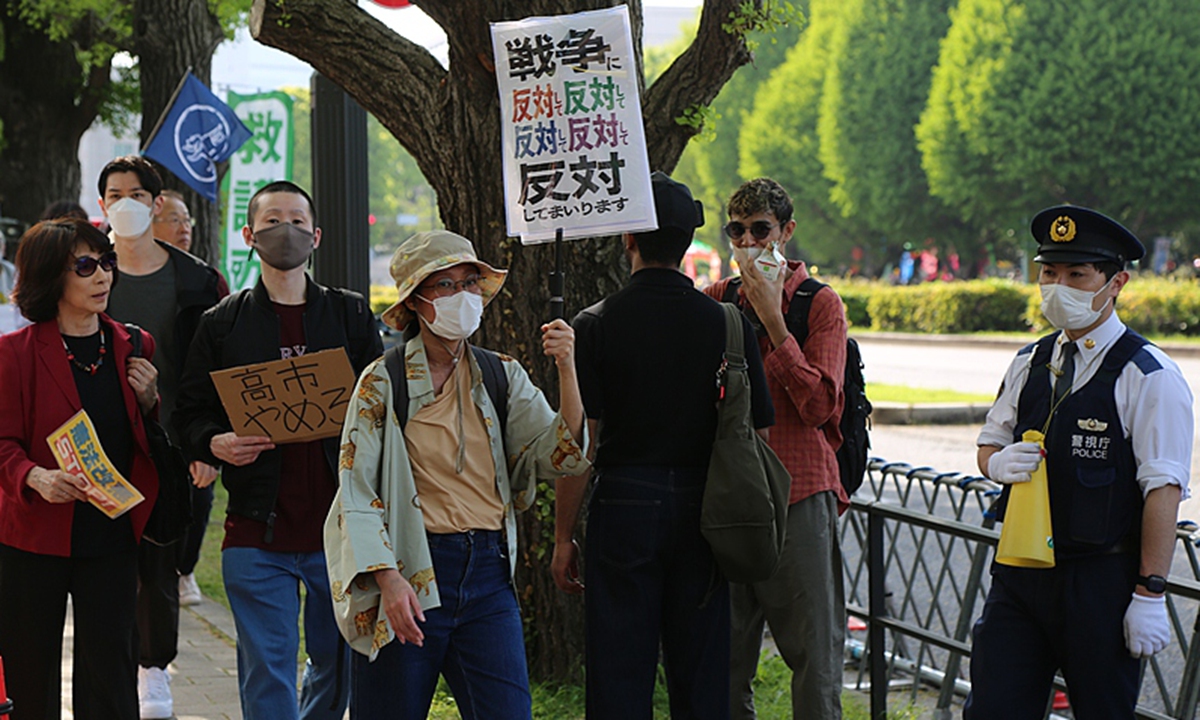
Large numbers of Japanese protesters gather outside the National Diet building, staging large-scale rallies against moves to revise Article 9 of the Japanese Constitution, as well as expressing opposition to war, on April 19, 2026. Photo: VCG
Large numbers of Japanese protesters on Sunday local time gathered outside the National Diet building as well as multiple other locations including Osaka, staging large-scale rallies against moves to revise Article 9 of the Japanese Constitution, as well as expressing opposition to war, Japanese media outlet Asahi Shimbun reported on Sunday.The rallies came amid Japanese government's recent stepped-up moves in accelerating constitutional revision and pushing for remilitarization. One day before the rallies, Australia and Japan signed contracts on Saturday launching a $7 billion deal to supply Australia with warships, Tokyo's most consequential military sale since ending a military export ban in 2014, according to Reuters on Saturday.
A Chinese analyst said the demonstrations reflect a strong sense of crisis among Japan's anti-war and pro-peace forces over the Japanese government's right-leaning shift in its security policy.
The rally held in front of the National Diet was titled "NO WAR! Don't change the Constitution! April 19 Grand Action in front of the Diet's main gate," and was jointly organized by the civic groups. According to the organizers, such rallies have been held on the 19th of every month since the passage of the security-related legislation, calling for the repeal of the laws and opposing constitutional revision, Asahi Shimbun reported.
According to statistics released by rally organizers, reportedly about 36,000 people participated in the rally on Sunday.
Participants held placards and signs, chanting slogans such as "oppose war" and "the Sanae Takaichi administration must uphold the Constitution," per Japanese media reports.
Facing a series of dangerous policy moves under the Takaichi administration, these groups are expressing opposition through concrete actions, including to its push to expand military capabilities and ease restrictions on arms exports, Xiang Haoyu, a distinguished research fellow at the China Institute of International Studies, told the Global Times on Sunday.
A 52-year-old woman from Tokyo, attending a protest for the first time with her seven-year-old son, said she has grown increasingly concerned that moves under the Takaichi administration to revise the constitution and lift restrictions on arms exports could draw Japan into war. "The peace constitution Japan has long upheld is at risk of being lost. By taking part, I want to show my opposition," she said, Asahi Shimbun reported.
The protest also drew attention on social media from Japanese netizens, with Mizuho Fukushima (@mizuhofukushima), leader of the Japanese Social Democratic Party and a member of the House of Councillors, endorsing the demonstration by posting on X: "NO WAR! Don't change the Constitution!"
These protest groups are seeking to expand their influence as much as possible to exert greater impact on public opinion and the governing authorities, indicating that some of the Takaichi administration's dangerous actions have triggered serious divisions within Japanese society and a widening sense of concern, Xiang said.
On April 17, 1895, the Qing government was forced to sign the unequal Treaty of Shimonoseki. On Friday, a Japan Maritime Self-Defense Force (JMSDF) destroyer transited the Taiwan Straits. The PLA Eastern Theater Command announced on Saturday that it had organized joint combat readiness patrols with naval and air forces in relevant areas of the East China Sea.
An expert interviewed by the Global Times said the Japanese vessel's transit clearly carries elements of political probing and provocation, and that the PLA's response demonstrates both precise control and a firm determination to counter it.
RELATED ARTICLES