False claims over Chinese nationality of Kyoto boy murder case suspect spread across Japanese social media, amplified by Taiwan media, 'reflecting troubling anti-Chinese tendency in Japanese society'
By Published: Apr 20, 2026 03:46 PM

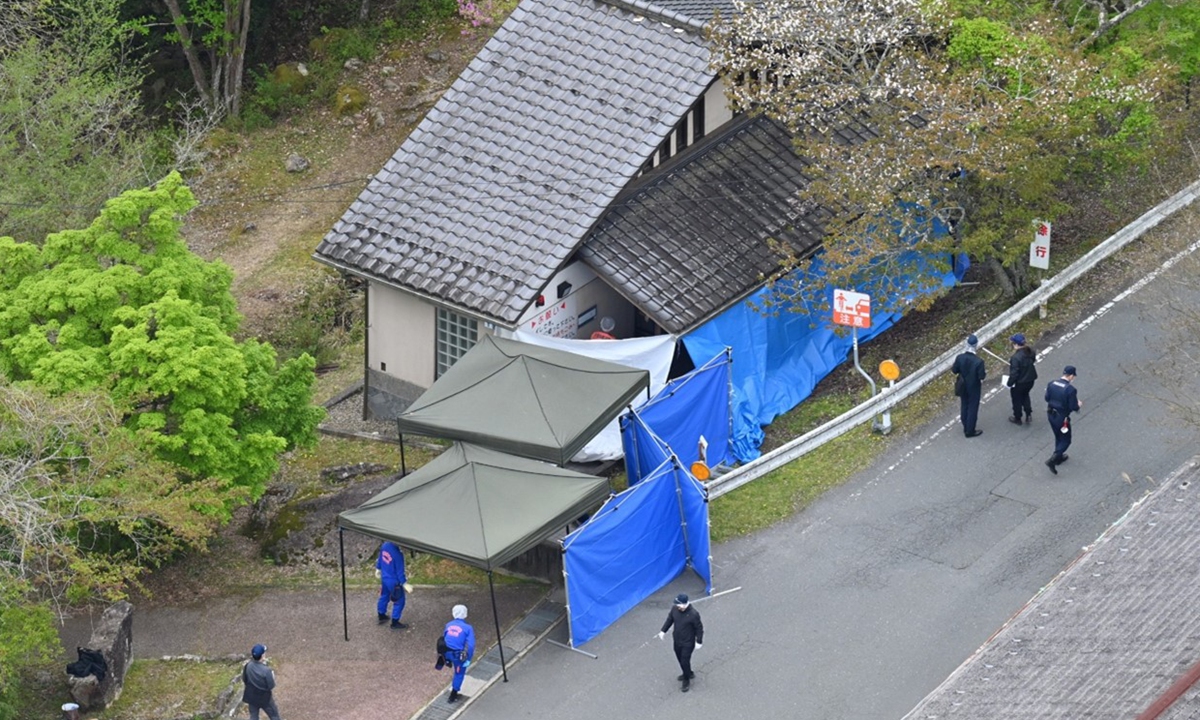
An aerial photo shows Kyoto Prefectural Police investigators searching near a public restroom at Kyoto Prefectural Rurikei Nature Park, a tourist spot, following a child abandonment case in Nantan City, Kyoto Prefecture, Japan, on April 18, 2026. Photo: VCG
Japanese media have revealed more details in recent days about the case of an 11-year-old boy in Kyoto Prefecture who was allegedly murdered by his stepfather, after false claims that the suspect was a Chinese national spread rapidly across Japanese social media and were later amplified by a Taiwan media report before being publicly denied by Japanese police.
A Chinese expert said that some Japanese social media users had groundlessly labeled the suspect as Chinese, reflecting a troubling tendency in Japanese society to direct hostility toward foreigners, especially amid an anti-China sentiment, while also exposing the pro-Japan pandering of certain media outlets in Taiwan island.
Kyodo News reported on Monday that 11-year-old Yuki Adachi, whose body was found abandoned in Nantan, Kyoto Prefecture, had told his classmates that he"hated his father," according to school-related sources. His 37-year-old father has been arrested on suspicion of abandoning the body. Kyoto Prefectural Police said they had received no prior consultations or reports indicating possible abuse and are now investigating background factors, including the family relationship, according to Kyodo News.
When the case was first reported by some Japanese media in late March, it had drawn nationwide attention, with some social media platforms in Japan seeing a surge of unfounded claims about the suspect's identity, including allegations that he was a foreign national.
For example, an NHK report noted on Sunday that there has been a surge in social media posts falsely claiming the suspect in the death of the boy is a foreign national, despite police denying the claims.
Japanese media Mainichi Shimbun reported on April 17 that baseless information about the arrested father's nationality and age had spread across social media. According to the report, Kyoto prefectural police explicitly denied those claims on April 17.
The misinformation on Japanese social media also spilled into media space in Taiwan island. Taiwan regional broadcaster Formosa Television, or FTV, aired a report on April 15, claiming that the arrested stepfather was "Chinese," relying on false information circulating online.
The station later issued an apology on April 17 on its website, acknowledging that its April 15 evening report had wrongly cited false claims from Japanese social media, including the incorrect assertion that Japan's Shukan Bunshun had reported the stepfather was likely Chinese.
Japanese newspaper The Yomiuri Shimbun said false claims circulated online saying that the foster father arrested on suspicion of abandoning the boy's body was a Chinese national and the Taiwan media's claim, which based on content circulating on social media, further accelerating its spread in Japan.
Meanwhile, Nikkansports.com reported on April 17 that Tomoka Igari, a member of the idol group Kamen Joshi who has remained active in a wheelchair after suffering a spinal cord injury in an accident, described how the misinformation spread. She said false rumors about the suspect's nationality first circulated mainly among Japanese social media users, before being picked up and reported by a Taiwan television station as fact. The claim was then further amplified by people who argued that if it had been reported by a Taiwanese broadcaster, it must be true.
"At this point, it's really hard to tell what is true," Igari wrote on X, voicing confusion over the misinformation spiral.
This latest round of misinformation drew criticism on social media, with some users condemning the irresponsible spread of false claims and others questioning the credibility of the media involved.
Hideo Nakayama, whose X account describes him as an MD and dermatologist, wrote on X that "spreading fake news not based on facts and engaging in reporting that denigrates a specific nationality is absolutely unforgivable." He said such behavior severely undermines trust between the Japanese and Chinese peoples and "completely lacks the ethics expected of the media."
Netizen @Seine-Arth wrote that this was "the usual pattern" of Japanese right-wing forces trying to "see through" someone's nationality and becoming excited over it. The user also noted that the Taiwan report claimed Shukan Bunshun had reported the suspect was Chinese, when in fact it had not. The post added that it was not the first time that a rumor had been twisted and then used by some anti-China media in Taiwan island to shift blame onto people from the Chinese mainland.
Some Taiwan netizens also mocked some pro-DPP media, including the FTV outlets for what they described as a habitual tendency to pin wrongdoing on people from the mainland. One user, "opiuy0315," wrote that it was "hilarious" that Japanese media had finally discovered how prone some pro-DPP outlets were to spreading rumors.
Another user, "petersengtseng," said FTV had embarrassed itself internationally by producing false news in an attempt to counter the mainland. User "leopard.931838" wrote that the episode exposed the credibility of some Taiwan media and mocked those still promoting so-called "Taiwan-Japan friendship" while "fawning over Japan."
The case, involving a serious crime against a child, has understandably attracted widespread public attention. Yet on Japanese social media, some users have groundlessly labeled the suspect as Chinese, reflecting a troubling and alarming tendency in Japanese society to direct hostility toward foreigners, especially amid rash anti-China sentiment, Lü Chao, a professor at the Liaoning Academy of Social Sciences, told the Global Times.
In the absence of any official conclusion, leaping to the assumption that a foreign suspect must be Chinese amounts to a clear presumption of guilt against China, Lü said.
Since taking office, the Sanae Takaichi administration has helped fuel this atmosphere by promoting rhetoric that belittles and smears Chinese people in the public sphere, Lü said. It has become a key force behind the erosion of the social foundation for China-Japan friendship, further aggravating hostility and prejudice against Chinese nationals in Japan. This trend not only raises the risk of crimes and malicious attacks targeting Chinese residents and tourists, but, if left unchecked, could also seriously harm bilateral relations and undermine the basis of people-to-people exchanges between the two countries.
According to a release from the Chinese Embassy in Japan on Friday, a series of recent incidents in Japan has raised fresh concerns over the safety of Chinese nationals there. They include a serving member of Japan's Self-Defense Forces scaling a wall and entering the Chinese Embassy in Japan with a knife, right-wing activists openly harassing Chinese nationals attending a marathon, a Chinese student in Tokyo being deliberately targeted by a so-called "bumping attacker," and a Hong Kong tourist being assaulted at a restaurant in Hokkaido. These cases point to increasingly brazen activities by right-wing forces in Japan, a noticeable rise in discriminatory acts targeting Chinese nationals, and mounting security risks for the Chinese community in the country.
In this incident, certain Taiwan media outlets not only pandered to Japan, but also deliberately sought to sow discord in China-Japan relations, using the case as yet another chance to vilify Chinese mainland and curry favor with Japan, Lü added. Such behavior, he said, is a serious violation of journalistic ethics and is all the more deplorable.
RELATED ARTICLES