Y-20B conducts first overseas mission, flying to ROK to repatriate remains of the 13th batch of Chinese People's Volunteers martyrs
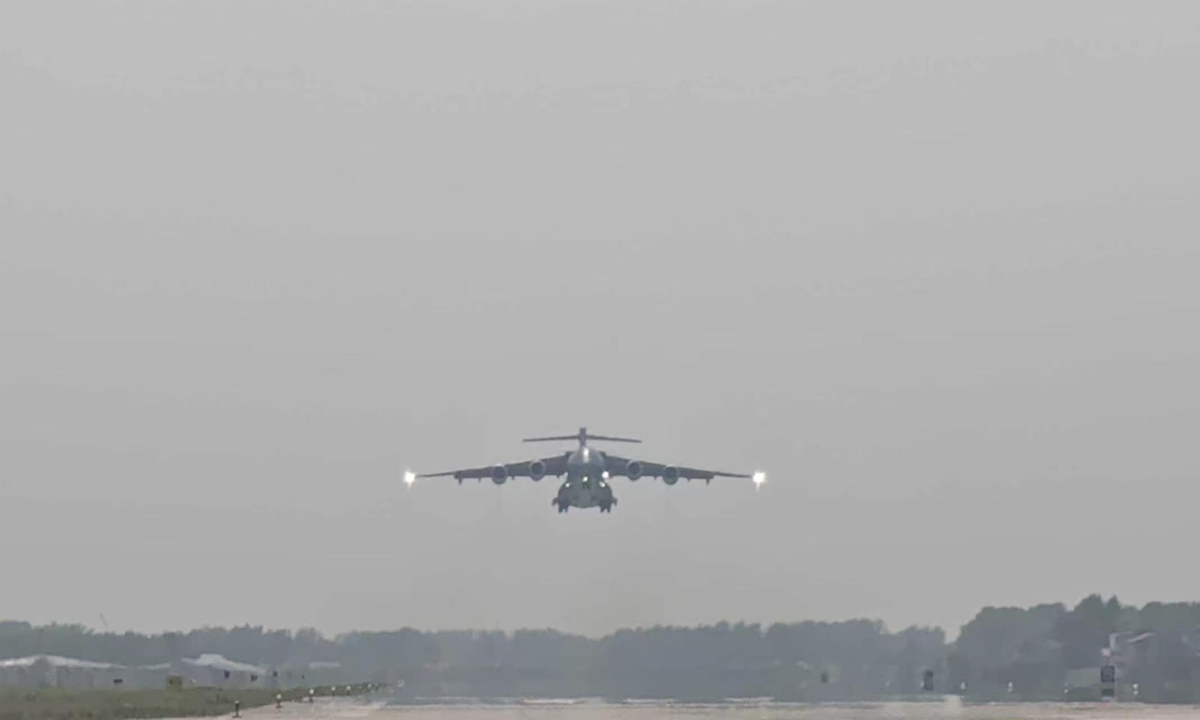
A Y-20B transport aircraft of the People's Liberation Army Air Force (PLAAF) on Monday afternoon took off and headed for South Korea to repatriate the remains of the 13th batch of Chinese People's Volunteers martyrs.
A Y-20B transport aircraft of the People's Liberation Army Air Force (PLAAF) on Monday afternoon took off and headed for South Korea to repatriate the remains of the 13th batch of Chinese People's Volunteers martyrs. After the Y-20B enters China's airspace on its return flight, four J-20 fighter jets of the Chinese Air Force will provide escort.
Since 2015, the PLAAF has dispatched aircraft to the South Korea every year for the mission of repatriating martyrs' remains. Starting from 2020, the PLAAF began using its domestically developed large transport aircraft, the Y-20 series, for this mission. This year marks the Y-20B's first participation in such a repatriation mission.
The PLAAF has simultaneously released the mission emblem on Monday for bringing back the remains of the 13th batch of Chinese People's Volunteers martyrs. The emblem is composed of patterns including a sculpture of volunteer soldiers, a chest badge of the Chinese People's Volunteer Army, a formation of one Y-20B accompanied by four J-20 fighter jets, service members of the new era, and peace doves. It is inscribed with the words "Heroes 1950" and "Homecoming 2026."
Designed as an integrated dual-medal structure, the emblem symbolizes the inheritance of the legacy of the heroes returning home, and embodies the sincere sentiments of PLAAF personnel to remember history and honor the martyrs.
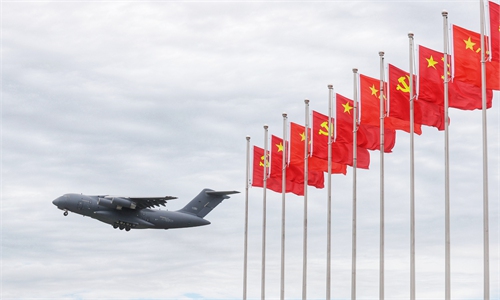
The latest mission not only represents the Y-20B's first martyr repatriation task, but also its first overseas mission in service. At the military parade in solemn commemoration of the 80th anniversary of the victory of the Chinese People's War of Resistance Against Japanese Aggression and the World Anti-Fascist War in 2025, a transport aircraft echelon consisting of three Y-20A and three Y-20B aircraft passed in review. It was the first public inspection appearance of the Y-20B equipped with domestically developed engines known as the "Chinese Heart."
The Y-20 series transport aircraft has been deployed on a major cross-border mission, which sets it apart from routine domestic transport operations. This demonstrates that its new high-bypass-ratio domestically developed engine has undergone a period of testing and validation, and is now mature and reliable, Wang Yunfei, a Chinese military affairs expert, told the Global Times on Monday.
Being able to undertake such a mission indicates that the aircraft has completed its final design certification and operates with proven stability. The successful deployment of the Y-20B fully demonstrates that the aircraft has earned full trust and is capable of performing a wide range of roles and missions. In the future, it will be gradually and widely fielded within the Chinese military, undertaking longer-range and more complex strategic transport missions, Wang said.
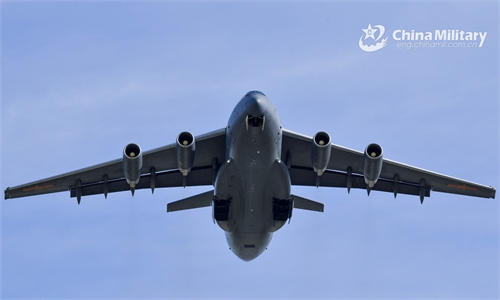
The Y-20B is an upgraded variant derived from the original Y-20 platform. Fitted with new-generation domestically manufactured aero-engines, the aircraft features extended range, increased payload capacity and higher flight speed, boasting robust long-range strategic airlift capabilities, according to Xinhua News Agency.
Powered by domestically produced high-bypass turbofan engines, the Y-20B has also undergone upgraded modifications to its supporting systems, including power supply, hydraulic control and flight control systems. With improved fuel efficiency, longer range and greater load capacity, the Y-20B also enjoys enhanced adaptability to harsh natural environments. It is capable of completing missions under more complex operational conditions and fully meets national strategic airlift requirements.
According to Wang, the main upgrade of the Y-20B lies in its engines, which offer higher fuel efficiency, allowing for greater range on the same amount of fuel, as well as improved stability and reliability. Additionally, adjustments have been made to the navigation, communication, and air traffic management systems. This marks a significant evolution for the Y-20 series. Future transport variants will likely be developed based on this configuration. With enhanced reliability, it may also serve as the foundation for derivative models such as an aerial tanker, paratroop transport, and even an airborne early warning aircraft.
RELATED ARTICLES