IN-DEPTH / IN-DEPTH
Imaging tomorrow: Young Chinese digital artist inspires Elon Musk with sci-fi animations, reflecting booming industry
Editor's Note:
The youth are the vanguards of our time, showcasing boundless energy and vibrant personalities.
Gen-Zers not only represent the makers of the future but also serve as agents of change in the present. With an open mindset and an international outlook, they actively integrate into the currents of globalization, engaging in deep exchanges, and collaborating with youth from around the world to explore pathways and strategies to address global challenges.
The Global Times launched the "Voice from Gen Z" series, which focuses on the proactive actions and innovative achievements of young people in areas such as global governance, cultural exchange, environmental protection, and technological innovation. Through this column, we aim to showcase the unique charm and future leadership of global Gen-Zers.
The youth are the vanguards of our time, showcasing boundless energy and vibrant personalities.
Gen-Zers not only represent the makers of the future but also serve as agents of change in the present. With an open mindset and an international outlook, they actively integrate into the currents of globalization, engaging in deep exchanges, and collaborating with youth from around the world to explore pathways and strategies to address global challenges.
The Global Times launched the "Voice from Gen Z" series, which focuses on the proactive actions and innovative achievements of young people in areas such as global governance, cultural exchange, environmental protection, and technological innovation. Through this column, we aim to showcase the unique charm and future leadership of global Gen-Zers.
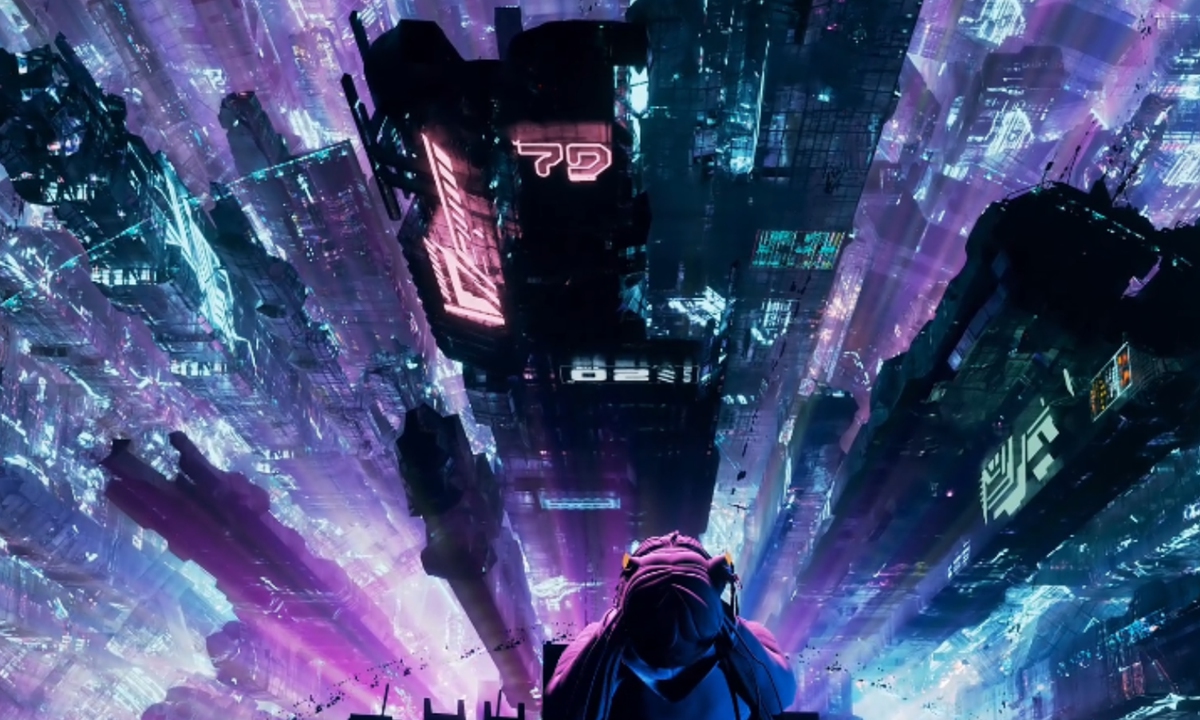
A sci-fi art work of Huang Rui featuring future city Photo: Courtesy of Huang
What does the animation that inspired tech billionaire Elon Musk look like? Recently, Chinese digital artist Huang Rui shared a special experience on one of China's leading video-sharing platforms Bilibili: he discussed the future prospect of a Type II civilization, a stellar civilization capable of harnessing all the energy of its home star, with Musk.
Huang's sci-fi animation on future civilization not only attracted this entrepreneur, who is deeply engaged in aerospace and artificial intelligence (AI) related fields, but also gave him inspiration, making Musk think more about what would be the mass-optimized solution for turning solar output into useful computing power, according to a video Huang released on Bilibili on March 15.
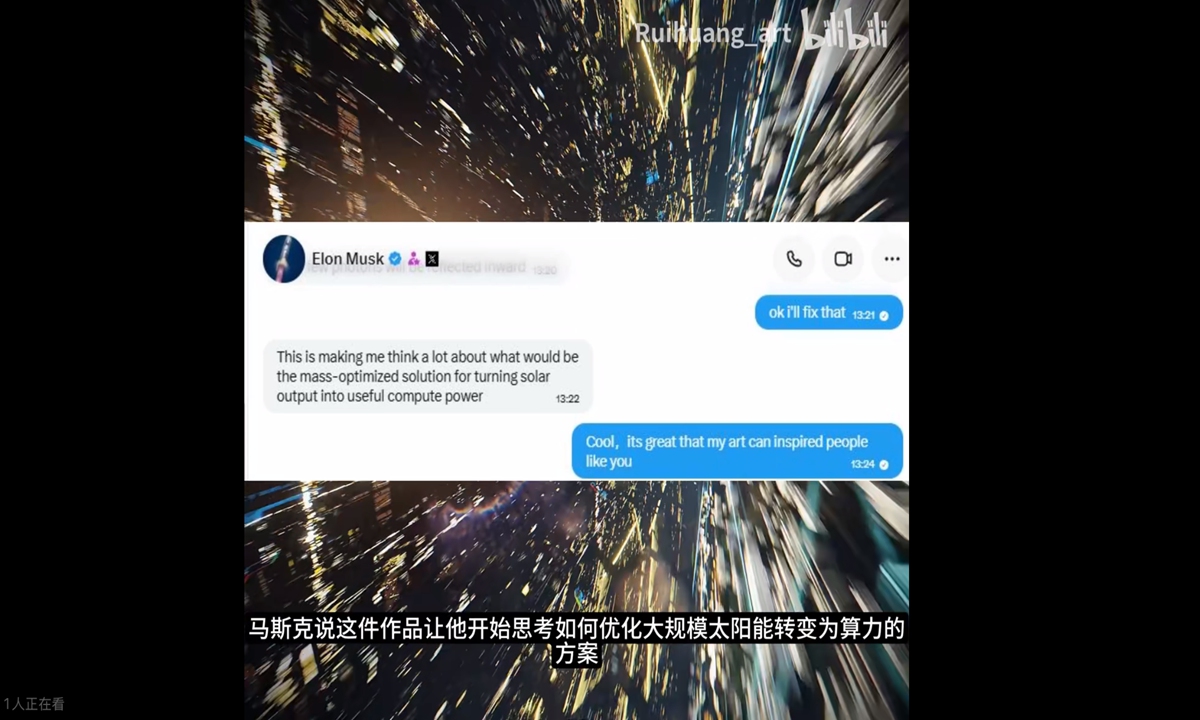
Photo: A screenshot of Huang Rui's Bilibili account
Going through the videos Huang shared on Bilibili, the Global Times reporter found that his animation works mostly feature grand cosmic scenes and exquisite details: large aerospace rockets soar into the sky, huge ring-shaped worlds float in the deep space, and spaceships shuttle between them... It was this vivid imagination and realistic texture that attracted Musk's attention two years ago. In October 2024, Musk reposted Huang's work on social media platform X and commented "We should have built giant space stations!"
Huang told the Global Times that he once provided feedback for Musk's generative AI chatbot Grok, and the two also had in-depth exchanges on topics such as brain-computer interface, AI and science fiction. And when Huang showed Musk some art designs he created for renowned Chinese writer Liu Cixin's Hugo Award-winning sci-fi novel The Three-Body Problem, Musk replied "Pretty cool!"
A lonely road
Although Huang's works are now popular on global social media platforms, his road to sci-fi creation has not been smooth.
Born in 2000, Huang has been a sci-fi fan since childhood. When he was a child, he watched the DVD of sci-fi films Star Wars with his father. An auxiliary disc explaining the CG (computer graphics) production process planted the seed of sci-fi creation in him.
Huang has been learning to paint since childhood and started studying oil painting at university in 2019. However, he gradually found that the carrier of traditional oil painting could no longer carry the spaceships, space ports and interstellar civilizations he conceived in his mind.
In his sophomore year, Huang started to teach himself 3D creation and Blender software. At that time, there were few 3D creation training courses for the sci-fi direction in China, and the relevant learning resources for Blender were also very scarce. In order to master the core skills, he could only gain experience from the behind-the-scenes documentaries of physical special effects movies in the 1980s and 1990s, and explore the construction logic of sci-fi scenes little by little without the guidance of teachers.
"It was quite lonely at that time," Huang told the Global Times. He gave an example: when he went to the cinema to watch the premiere of sci-fi movie Mortal Engines featured in a post-apocalyptic world in 2018, he was the only one in the entire theater.
Today, Huang is no longer the teenager who created alone: his special effects videos have attracted more than 600 million views on social media platforms at home and abroad; he has also participated in the concept design of domestic and foreign film, television and game works; his digital art piece Starbase 2050 was featured in Sotheby's New York Digital Art Day Auction in December 2024; and his personal exhibition titled "The Scale of Civilization" opened at the X Museum in Beijing in March.
Faced with these recognitions across borders and industries, Huang remained quite calm. He said that this proved that his "exploration in digital art over the past few years has finally paid off." He firmly believes that "if you truly love and focus on doing one thing, it will surely shine over time."
"I only know how to do sci-fi art, so I want to do it to the extreme," he said.
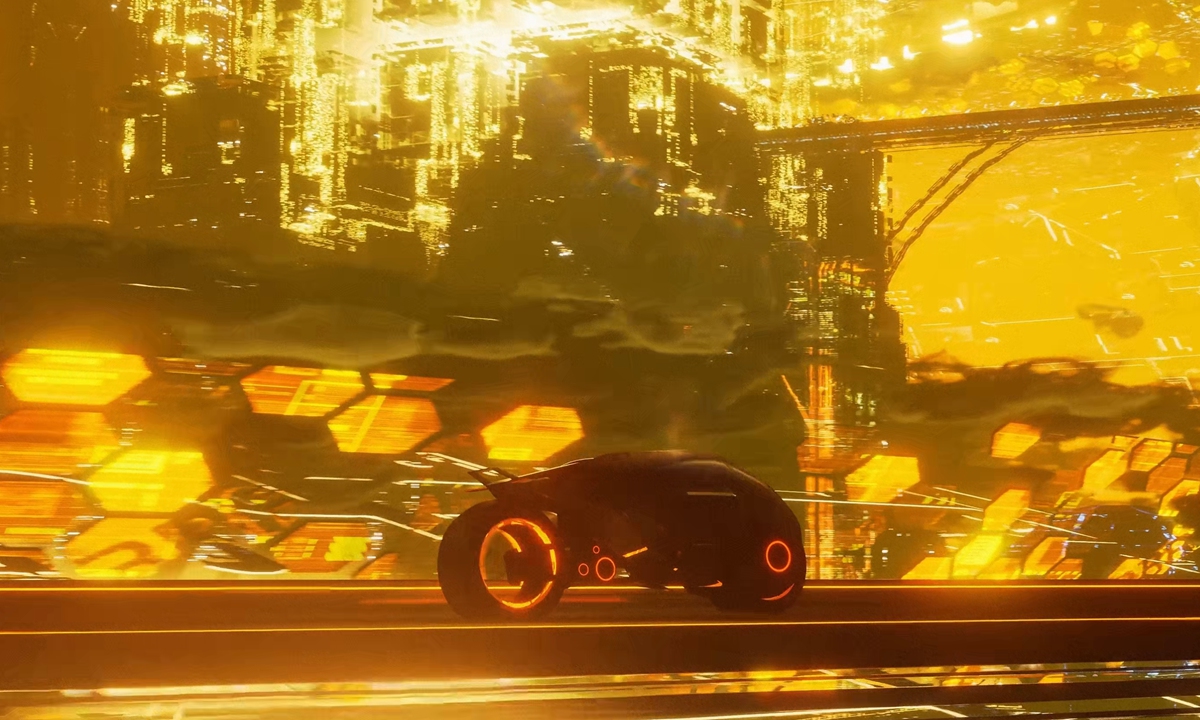
A sic-fi art work of Huang Rui featuring a vehicle running on the road in future city Photo: Courtesy of Huang
A new stage
Huang's experience to some extent revealed the common situation of sci-fi fans in China. A few years ago, science fiction was only a hobby of a small circle, with low social recognition and a very limited audience for sci-fi works. But in recent years, with the popularity of sci-fi books, films and television works, such as The Three-Body Problem and The Wandering Earth series, Chinese science fiction has ushered in a new stage of high-quality development.
According to the 2026 China Sci-Fi Industry Report released in late March, China's sci-fi industry achieved a total revenue of 126.1 billion yuan ($18.5 billion) in 2025, exceeding the 100-billion-yuan mark for three consecutive years.
Huang feels the profound changes in the industry. Science fiction is popular in China and the Chinese sci-fi industry also shows a more open attitude toward embracing AI technologies compared to its overseas counterparts, he said.
Rather than providing inspiration for technological development, Huang hopes that his works can inspire the world's longing for peace and unity. "There are constant conflicts in the world, but I hope that through my works, I can show a future where humans can unite and cooperate."
RELATED ARTICLES