Illustration: Chen Xia/Global Times
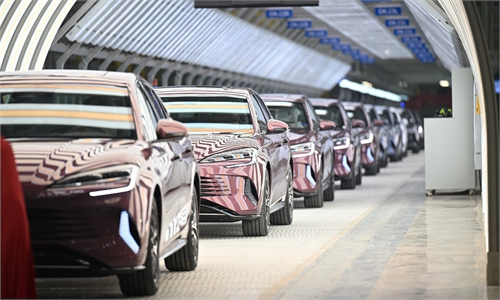
The upcoming 2026 Beijing International Automotive Exhibition, to be held from April 24 to May 3, is set to be a crucial window for observing the shifting landscape of the global auto industry.Western carmakers will bring new electric vehicles (EVs) made with Chinese technology to the major auto show in Beijing this week, striving to stay relevant in the world's largest car market, the Financial Times reported on Monday.
For instance, BMW will showcase its electric iX3 sport-utility vehicle with an extended chassis, which was developed in China using local technologies from Momenta, Huawei and Alibaba, according to the report.
Such technological convergence is not merely a demonstration of how much these automakers value China, but also a reaffirmation that collaboration is the key to unlocking the sector's transformative potential.
From an industry perspective, the embrace of Chinese technology by foreign automakers first and foremost confirms the central position of the Chinese market in the global automotive arena. This importance goes far beyond the sheer scale of consumption or revenue contribution. China maintained its position as the world's largest auto market for the 17th consecutive year in 2025, according to Xinhua.
China's production and sales of new-energy vehicles (NEVs) both exceeded 16 million units last year, with NEVs accounting for more than 50 percent of new car sales in the domestic market. Such demand provides immense room for development. More critically, China has emerged as the primary testing ground for identifying industry trends, refining cutting-edge technologies, and validating business models. This virtuous cycle between technological progress and market expansion represents an invaluable asset for the global automotive transition.
This development may explain why foreign automakers' positioning of the Chinese market has undergone a major change. Once viewed primarily as source of sales and profits, China now sees foreign car producers actively marketing locally sourced technology and supply chains as selling points. If foreign automakers want to keep up in the global competition, they likely need first prove themselves in the Chinese market, which requires integrating into China's technological ecosystem and relying on local supply chains and research and development capabilities to create competitive products.
The extent to which foreign carmakers can capitalize on China's industrial strengths depends on their openness to collaboration. The country's EV sector boasts unique advantages: rapid technological iteration, agile supply chains, and efficient market feedback mechanisms.
When foreign automakers turn to Chinese technology, it's essentially a win-win choice. On the one hand, it can help them consolidate their market share in China; on the other hand, they can rely on China's industrial chain advantages to incorporate products into their global matrix and export them. For example, Volkswagen plans to export cars developed and made in China to more overseas markets, Reuters reported in November 2025. Nissan will collaborate further with its Chinese joint venture partner Dongfeng to bring the battery-powered N7 to Latin America and Southeast Asia, according to the FT report.
The development shows that in an era of deep global industrial integration, open cooperation and mutual technological development remain the mainstream trend in automotive development. China is emerging as a key participant and contributor to this process. From BMW to Volkswagen and Nissan strengthening their electrification footprints in China, these strategic adjustments by foreign automakers are essentially recognitions of China's market value and industrial strengths. They are also driving the evolution of China's automotive partnerships from mere manufacturing to higher levels of co-innovation.
Throughout this process, China's unwavering commitment to high-level opening-up has provided fertile ground for local businesses and also offered vast development space for foreign brands. This open and inclusive environment is precisely why China's automotive industry has risen rapidly and continues to attract global players.
RELATED ARTICLES