Beijing to hold 2nd World Humanoid Robot Games in August, adding robot tug of war, pitch-pot, weightlifting
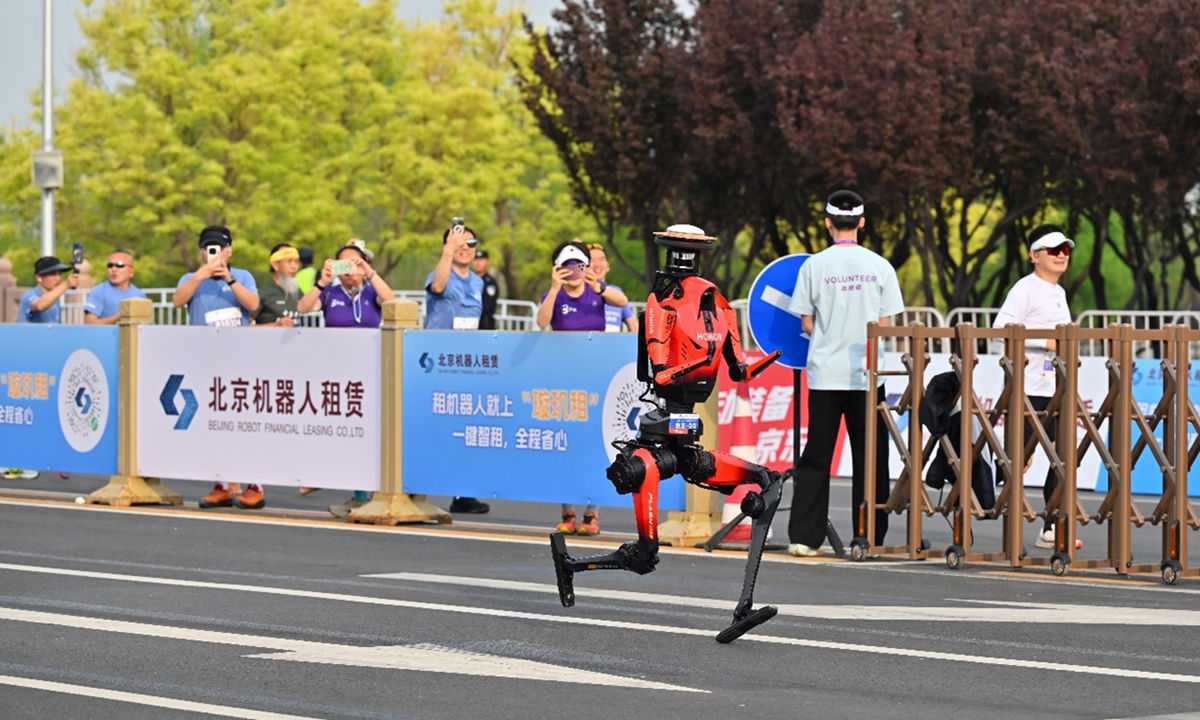
An HONOR Robotics D1 humanoid robot, dubbed "Lightning," runs at the 2nd Humanoid Robot Half Marathon held in Beijing on April 19, 2026. Photo: Tao Mingyang/GT
The second World Humanoid Robot Games will be held in Beijing from August 22 to 26, the organizers announced at a press conference on Tuesday. The event, co-hosted by the Beijing municipal government and China Media Group, will take place at the National Speed Skating Oval stadium.The Games will feature two main categories and 32 events, divided into competitive and scenario-based contests.
The competitive category encompasses nine disciplines and 26 events, such as athletics, football, gymnastics, weightlifting, martial arts, street dance, sport dance, tug-of-war and pitch-pot. The scenario-based category comprises six events, covering home, hotel, industrial, emergency response, hospital and retail settings.
In the competitive events, alongside traditional highlights such as the 100-meter race, football and martial arts, the Games will introduce new contests including robot tug-of-war, which requires coordinated teamwork to generate maximum force; pitch-pot, derived from a traditional Chinese ritual and testing precision control and perception; and weightlifting, which challenges upper-body load capacity, showcasing the rapidly advancing overall capabilities of humanoid robots, Jiang Guangzhi, director of the Beijing Municipal Bureau of Economy and Information Technology, said.
Notably, robot football players this year are capable of dribbling while in motion and making diving saves, with their competitive level expected to advance from that of "preschoolers" to the "youth" stage, Jiang said.
The scenario-based events will also take place in real-world settings, comprehensively testing humanoid robots' coordination of "brain, eyes and hands" in environmental perception, decision-making and precise manipulation.
The aim is to cultivate task-capable humanoid "workers" such as workshop operators, household assistants and firefighters, and to explore a new model that links competition with industry by "winning medals first, and securing orders," according to Jiang.
"The rapid progress of robotics has raised our expectations for this year's Games, and we expect robot athletes to deliver more impressive performances in three areas," Jiang said.
"First, it's about greater autonomy. The level of embodied intelligence has improved significantly, so the 100-meter race has been upgraded to a fully autonomous event, with rules also encouraging teams in scenario-based competitions to adopt fully autonomous approaches for positioning, recognition and operation.
"And it's about greater dexterity. This year's events feature more tasks requiring fine manipulation, such as sorting clothes in home settings, firefighting in emergency scenarios and food preparation in retail environments.
"Third, it's about greater practicality. Scenario-based events will no longer be held in simulated venues but in real-world settings such as factories, hotels and model homes, enabling robots to autonomously and continuously perform long-horizon tasks in complex environments — moving from 'demonstration tools' toward 'practical productivity.'"
In addition to organizing the competitions, Beijing has rolled out supportive policies such as "first-use trials" for robots and a "challenge-based bidding" mechanism for key components.
The city is also advancing the Beijing Humanoid Robot Innovation Center to build four major platforms covering common technology research and development (R&D), embodied intelligence data, pilot testing and validation, and public industrial services. Multiple robotics industrial parks and pilot-scale testing bases are being developed across the Beijing-Tianjin-Hebei region, alongside a government investment fund of 100 billion yuan ($14 billion) to systematically support the growth of the humanoid robotics industry in Beijing.
As a result, Beijing's robotics sector is entering a new wave of innovation, shifting from technological leadership to real-world application. The city's innovation ecosystem continues to improve, with breakthroughs across motion control, embodied artificial intelligence (AI) models and biomimetic interaction, placing it among the national leaders in innovation density, Jiang said.
The World Robot Games test mobility, joint flexibility, heat dissipation, and more. This year's results are significantly better than last year's, reflecting Chinese companies' all-round R&D and manufacturing progress, which has also drawn public attention and strengthened the supply chain, Ma Jihua, a veteran tech industry insider, told the Global Times.
Robots are moving from "show" to "use." Performance gains come from software and hardware advances that apply beyond sports. Open competition reveals strengths and weaknesses, fostering mutual learning. These agile robots will find many real-world uses in life and work, and may even enable innovations once beyond human imagination, Ma said.
Chen Jing, a vice-president of the Technology and Strategy Research Institute, told the Global Times on Tuesday that from the half-marathon to the World Humanoid Robot Games, the competition logic has shifted from "physical fitness" testing to an integrated assessment of "fitness + intelligence." With more than 30 events—far beyond a single long-distance race — the 100-meter event has become fully autonomous, abandoning remote control to test embodied intelligence and real-time decision-making. This marks a transition from asking "can it run?" to "how does it run and decide?"
This year's event integrates traditional Chinese sports into competition, adding pitch-pot after martial arts to test precision and posture control. More crucially, the "win medals first, then orders" model designs events based on real needs from factories and hospitals. Robots must autonomously complete long-horizon tasks, pushing them from demonstration tools to practical productivity, Chen said.
Another highlight is the "dexterous hand" already installed on some robots, Chen said. It is a key bottleneck for commercialization and the next competitive frontier. Whoever demonstrates stable, precise dexterous manipulation in complex events will likely secure industry orders first, truly turning robots into trustworthy "workers" or "assistants," Chen added.
RELATED ARTICLES